Clear Sky Science · en
Development and optimization of a female-specific Biomechanical model for biodynamic response analysis: a comparison with male biomechanical models
Why Everyday Vibrations Matter
Anyone who spends long hours driving a truck, operating heavy machinery, or riding off-road vehicles has felt their body shake and rattle. Those vibrations are more than just annoying—they can contribute to back pain, fatigue, and long-term health problems. Yet most safety standards and seat designs are based on measurements taken from men. This study asks a simple but important question: do women’s bodies really react to vibration in the same way, or do we need models that are designed for female anatomy from the ground up?
A Fresh Look at the Seated Female Body
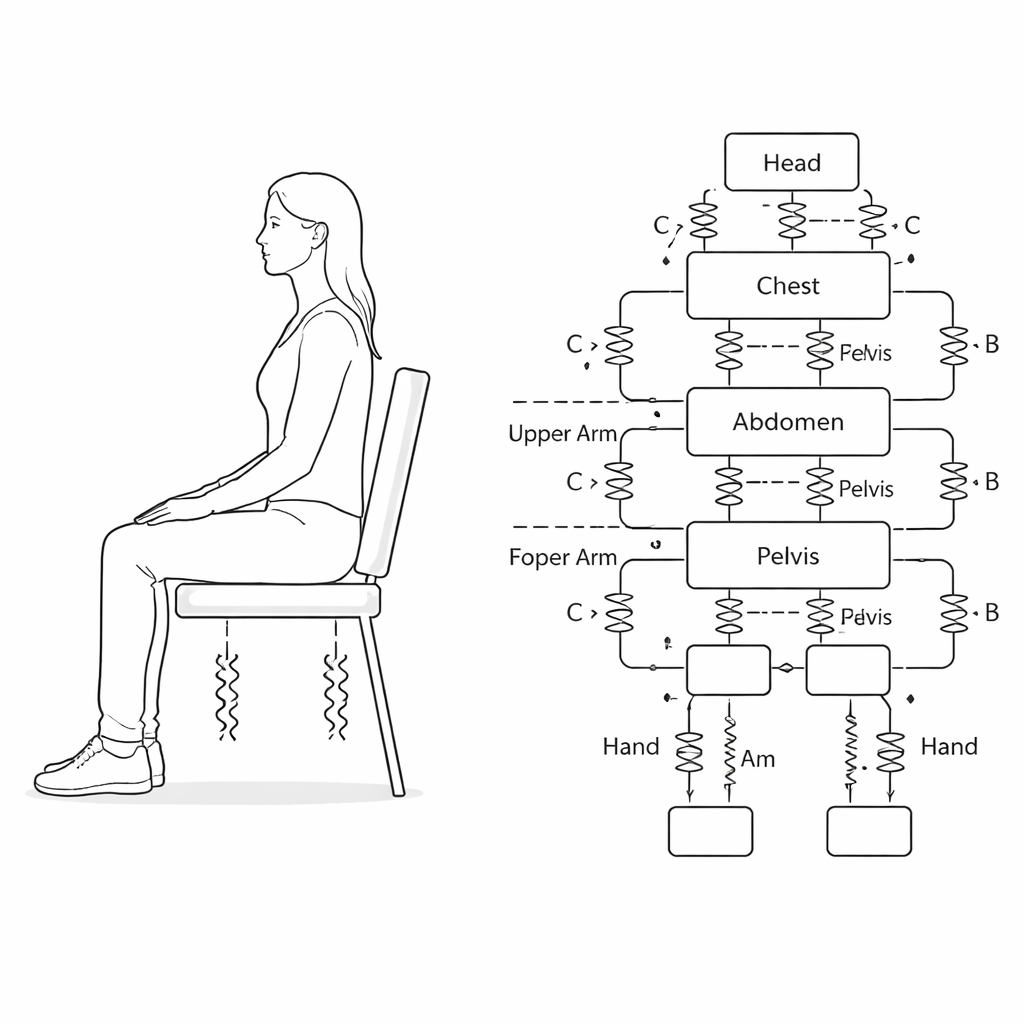
The researchers set out to build a detailed mechanical stand-in for the female body, focusing on a person sitting upright on a seat that shakes up and down. Instead of testing directly on people—which can be costly and uncomfortable—they created a "lumped" model that breaks the body into ten main parts: head, chest, abdomen, pelvis, and the segments of both arms and hands. Each part is treated like a small weight connected by springs and shock absorbers, capturing how flesh, bone, and joints flex and damp vibrations. The model concentrates on vertical motion, the direction most responsible for discomfort and health risk in vehicles, while deliberately ignoring side-to-side or back-and-forth shaking to keep the problem manageable.
Turning Real Body Data into a Working Model
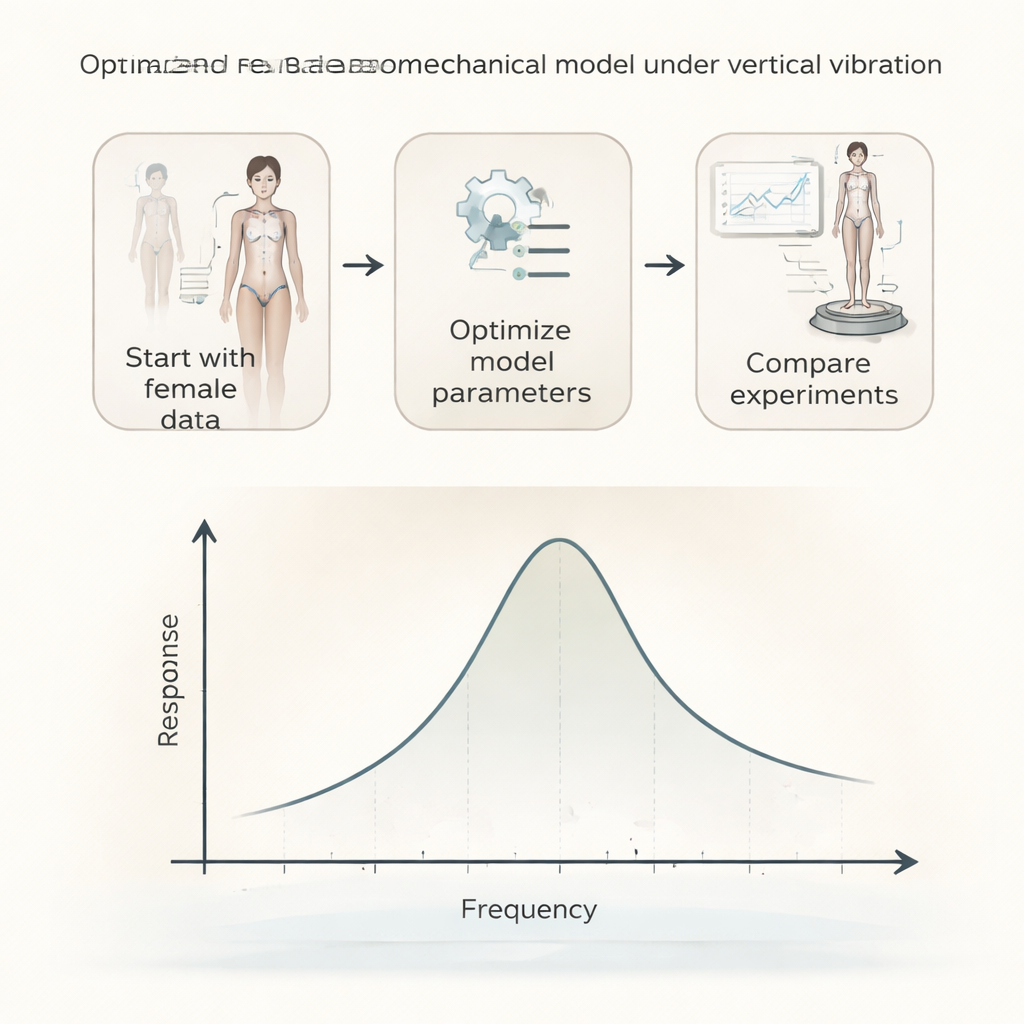
To make this virtual woman realistic, the team based each body segment’s weight and softness on data from average adult females, rather than simply shrinking male figures. Earlier research has shown that women tend to have lower overall body mass, more soft tissue damping, and different fat and muscle distribution compared with men. These traits change how vibrations travel from the seat to the head. The authors used measurements from controlled lab experiments in which women sat on vibrating seats while instruments tracked how much motion reached their heads and how much force passed through the pelvis. They then tuned the model so that three key indicators—how strongly vibrations reach the head, how much the body resists motion at the seat, and the "apparent mass" felt at the base—lined up with the real-world data across a range of low frequencies.
Fireflies, Algorithms, and Better Fits
Fine-tuning such a complex model by hand would be nearly impossible, so the team relied on a computer method inspired by the flashing behavior of fireflies. In this optimization approach, each "firefly" represents a different guess at the body’s mechanical settings. Brighter fireflies correspond to guesses that better match the experimental results, and dimmer ones move toward them over many cycles. With this technique, the model’s internal springs and dampers were gradually adjusted until the simulated responses almost overlapped with the measurements. The best version of the female model matched the experimental curves at about 97% accuracy overall, a level that slightly surpassed several well-known male-based models when tested on the same kind of data.
How Women’s Bodies Respond Differently
The final comparison between the new female model and existing male models revealed consistent differences. For the same seat motion, women’s bodies tended to pass more vibration up toward the head but showed lower peak forces at the seat, reflecting their different body composition and bone structure. The model also predicted slightly lower natural vibration frequencies for female bodies, meaning that their most sensitive "shaking zone" occurs at somewhat lower frequencies than for men. These patterns help explain why women may report greater discomfort or fatigue under certain driving conditions even when the vehicle is the same.
Designing Safer and More Comfortable Seats
In plain terms, the study shows that women are not simply smaller versions of men when it comes to how vibrations travel through the body. A carefully crafted, female-specific model can predict their responses to shaking more accurately than male-based models that are merely scaled down. This matters for designing car and tractor seats, setting vibration limits at workplaces, and even shaping crash-test dummies that stand in for real people. By acknowledging and modeling these gender-based differences, engineers and health researchers can move toward vehicles and workspaces that better protect the comfort and long-term health of both women and men.
Citation: Guruguntla, V., Yuvaraju, B.A.G., Rao, T.S.S.B. et al. Development and optimization of a female-specific Biomechanical model for biodynamic response analysis: a comparison with male biomechanical models. Sci Rep 16, 5987 (2026). https://doi.org/10.1038/s41598-026-36165-2
Keywords: whole-body vibration, female biomechanics, ergonomic seat design, vehicle ride comfort, biodynamic modeling