Clear Sky Science · en
A hybrid machine learning framework for offline signature verification using gray wolf optimization
Why Smarter Signature Checks Matter
Every day, banks, companies, and government offices rely on handwritten signatures to approve payments, sign contracts, and confirm identities. Yet paper signatures are surprisingly easy to forge, and people’s writing naturally changes with age, mood, or even a shaky hand. This paper introduces “SignGuard,” a computer system that can examine scanned signatures and decide, with very high accuracy, whether they are likely genuine or forged—without needing special pens or tablets.
From Paper Scribble to Digital Clue
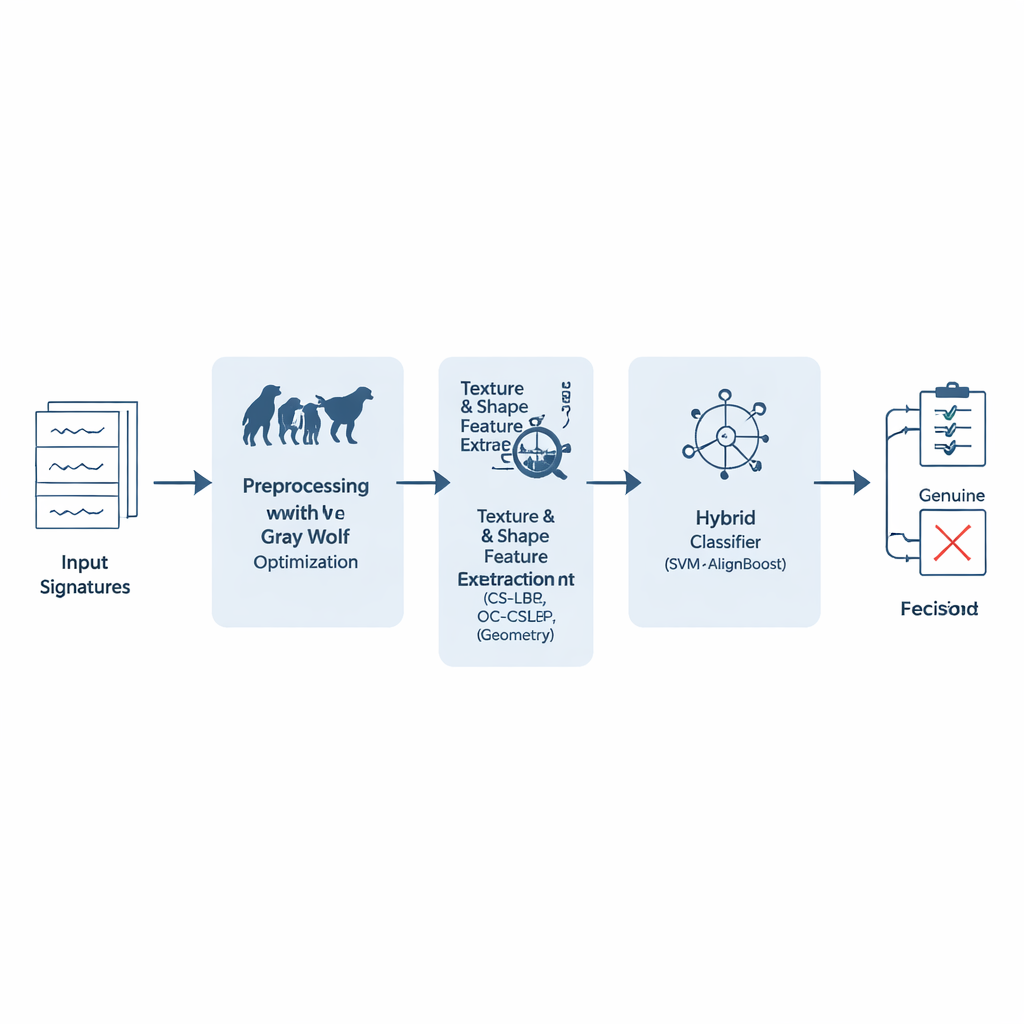
Traditional signature checks depend on a person’s eye or on simple image comparisons, both of which can be fooled by a skilled forger. SignGuard starts by turning each scanned signature into a clean, standardized picture. It resizes the image and then applies a search strategy inspired by the hunting behavior of gray wolves, called Gray Wolf Optimization. In computing terms, this strategy helps the system automatically find the most informative areas of the signature image while ignoring background noise and unhelpful details. This careful “clean-up and focus” step lays the groundwork for more reliable analysis.
Reading the Texture of a Signature
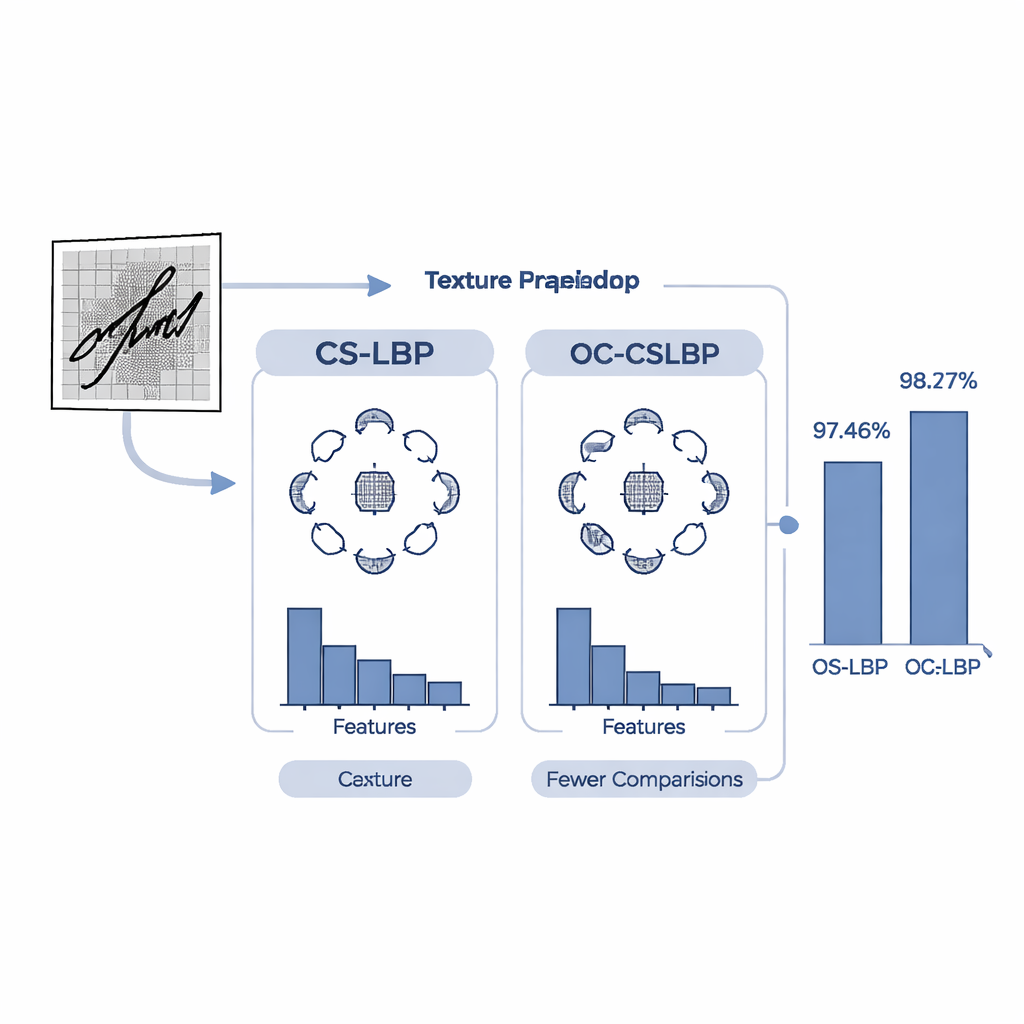
Once the image is prepared, SignGuard does not look at the signature as a whole shape only; it studies its fine-grained texture. It uses mathematical descriptors known as Local Binary Patterns and two specialized variants called CS-LBP and OC-CSLBP. In simple terms, these methods compare the brightness of tiny groups of neighboring pixels, turning the subtle ink patterns and stroke edges into numerical codes. These codes capture how the pen strokes change direction, how thick or thin they are, and how the ink is spread—all patterns that tend to be consistent for a genuine signer but hard for a forger to imitate perfectly.
Making Signatures Comparable and Fairly Judged
Real signatures are rarely perfectly aligned. A document might be scanned at an angle, or a person might sign slightly tilted on the page. To avoid being misled by such rotations, the system uses a step called Principal Orientation Alignment. This aligns each signature to a reference angle so that the computer compares “like with like” rather than mixing up tilt with identity. After alignment, SignGuard combines three kinds of information—overall shape, local texture, and optimized statistical clues—into a single feature set. These features are then passed to a hybrid decision engine that merges two well-known machine learning methods, Support Vector Machines and XGBoost, so that the strengths of one method can compensate for the weaknesses of the other.
Testing on Real Signatures and New Forgery Sets
To see whether SignGuard works beyond the lab, the authors tested it on several public collections of real and forged signatures from different languages, plus a new Indian dataset they built called DeepSignVault. Across tens of thousands of images, the system correctly distinguished genuine from forged signatures in over 98% of cases when using the improved OC-CSLBP texture method. It also made very few dangerous mistakes: only a small fraction of forged signatures were wrongly accepted as genuine, and in the best cases no genuine signatures were wrongly rejected. The authors also analyzed how similar genuine signatures are to each other, and how far apart they are from forgeries, showing that their approach produces a clear gap between honest and fake writing.
What This Means for Everyday Security
For a layperson, the message is straightforward: SignGuard shows that computers can learn to “read” the microscopic texture of a handwritten signature well enough to spot even skilled fakes with high confidence, using ordinary scanned documents. While the system is too computationally heavy today for the smallest devices and can still struggle with extreme distortions or unusual writing styles, it points toward safer handling of checks, contracts, and official forms without replacing the familiar act of signing on paper. As such methods improve and become lighter to run, they could become a quiet but powerful guardian of trust in financial, legal, and administrative paperwork around the world.
Citation: Rathore, N.C., Juneja, A., Kumar, N. et al. A hybrid machine learning framework for offline signature verification using gray wolf optimization. Sci Rep 16, 7124 (2026). https://doi.org/10.1038/s41598-026-36163-4
Keywords: offline signature verification, handwritten biometrics, forgery detection, machine learning security, document authentication