Clear Sky Science · en
Machine learning prediction of food addiction in university students using demographic, anthropometric and personality traits
Why our relationship with food can feel out of control
Many people joke about being “addicted” to chocolate or fast food, but for some, cravings and loss of control around eating are serious and distressing. University students are especially vulnerable, juggling stress, new freedoms, and changing bodies. This study asks a timely question: can computer programs learn to spot which students are at higher risk of food addiction, using simple information about their background, body measurements, and personality? If so, we might one day catch problems earlier and tailor support before eating habits spiral into long‑term health issues.
Looking at students from many angles
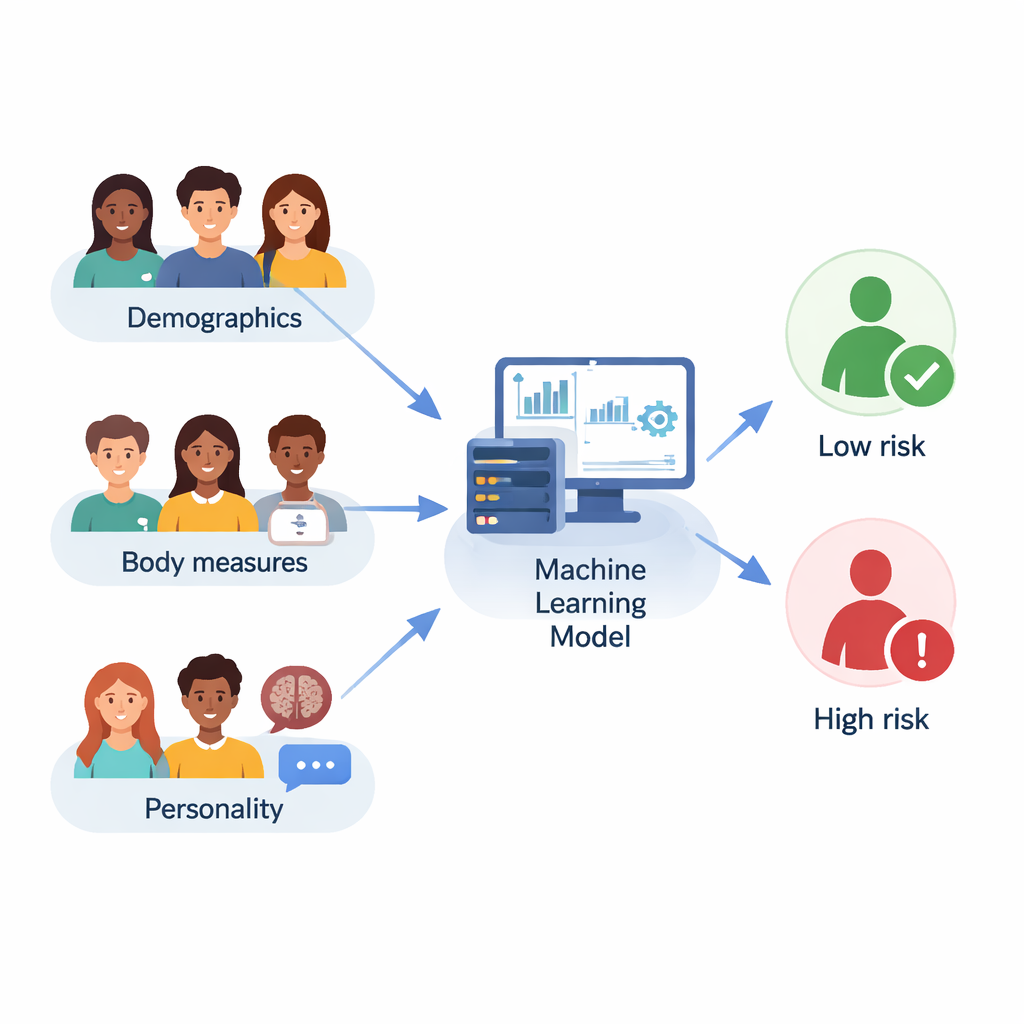
The researchers worked with 210 university students in Ahvaz, Iran, aged 18 to 35. Each student provided basic details such as age and education level, reported their height and weight so that body mass index (BMI) could be calculated, and completed a standard personality questionnaire. They were also screened with a brief Yale Food Addiction Scale, which classifies whether someone shows addiction‑like patterns toward highly palatable foods, such as intense cravings, failed attempts to cut back, or eating despite negative consequences. Only 30 students met the criteria for food addiction, while 180 did not, reflecting how such problems affect a smaller share of the population.
Balancing uneven data and training smart machines
Because far fewer students were classified as food‑addicted, the dataset was lopsided. This imbalance can trick computer models into mostly predicting the majority group and ignoring the high‑risk minority. To counter this, the team used two data‑handling tricks. First, they applied a method called Tomek Links to carefully remove confusing majority‑group cases that sat too close to minority cases. Then they used SMOTE, which creates realistic synthetic examples of the minority group, to even out the numbers. Only the training data were altered in this way; a separate untouched test group was held back to check how well the models performed on new, unseen students.
Putting many algorithms to the test
The researchers did not rely on a single mathematical recipe. Instead, they compared ten different machine learning models, from simple methods like logistic regression and k‑nearest neighbors to more advanced “ensemble” methods such as Random Forest, Gradient Boosting, LightGBM, and CatBoost. They also tried twelve feature‑selection strategies to decide which questions and measurements were most informative, and used cross‑validation and automated searches to tune each model’s settings. Overall performance was judged using several measures, including accuracy (how often the model was right), F1‑score (a balance of catching true cases without too many false alarms), and the area under the ROC curve, which captures how well a model separates higher‑risk from lower‑risk individuals.
What drives the predictions under the hood
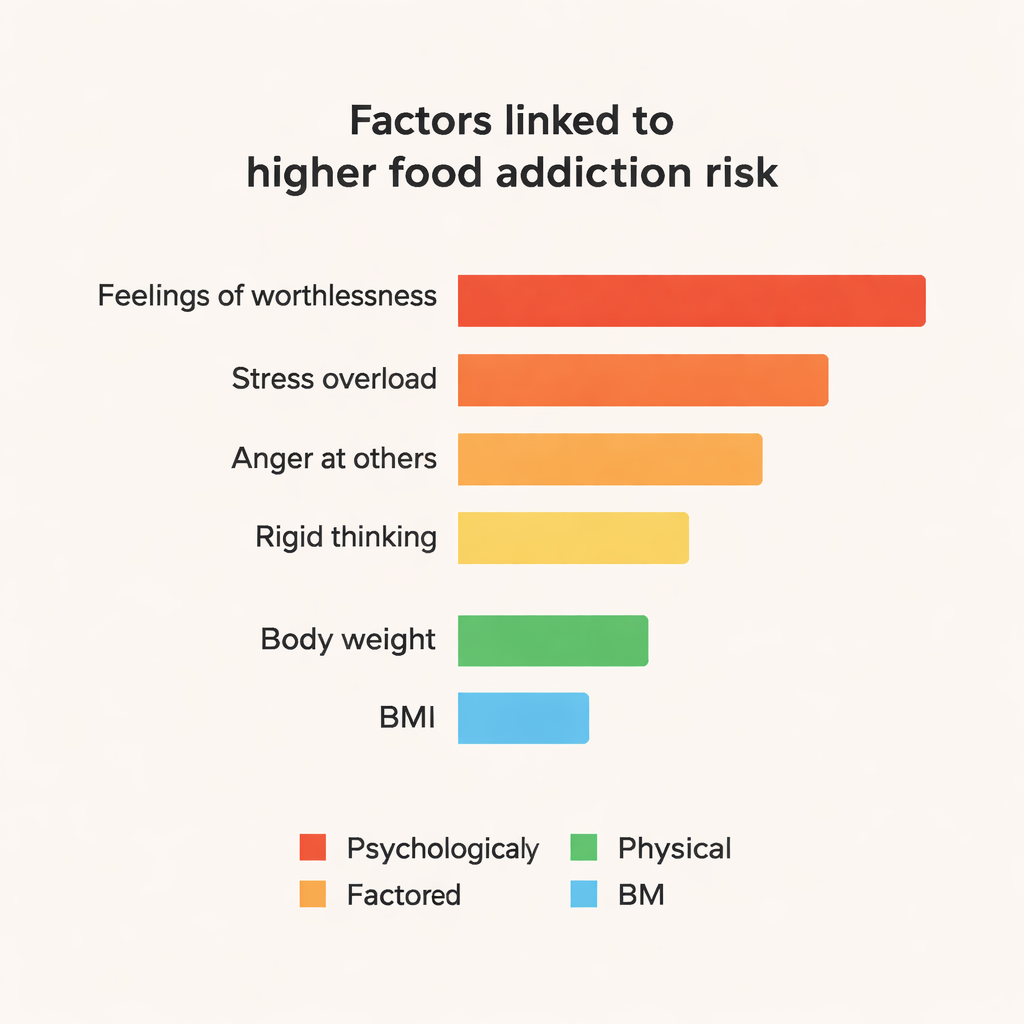
Ensemble models, especially CatBoost and Random Forest, consistently outperformed simpler approaches, reaching around 84% accuracy and F1‑scores of about 0.84 in this small dataset. To move beyond “black box” predictions, the team used a tool called SHAP to explore which features pushed the model toward labeling someone as food‑addicted. The standout influences were psychological: strong statements such as “Sometimes I feel completely worthless,” feeling like “falling apart” under stress, frequent anger at how others treat them, emotional tension, and rigid, inflexible thinking. Body weight and BMI also mattered, but they were less central than these emotional and personality‑related signals. Traits linked to positive mood and good organization showed a mild protective effect.
What this means for everyday life
For the average reader, the key message is that food addiction is not simply about willpower or liking tasty snacks. In this pilot group of students, deeper emotional struggles—low self‑esteem, difficulty handling stress, and strained relationships—were tightly intertwined with problematic eating. Early versions of machine learning tools, fed with basic questionnaires and body measurements, were able to pick up on these patterns with encouraging accuracy. However, the authors stress that their sample was small, based on self‑reports, and drawn from a single university, so the results are preliminary. With larger and more diverse studies, similar models might eventually be used alongside standard clinical assessments to flag young people who could benefit from support in managing both their emotions and their eating habits.
Citation: Rahimnezhad, A., Mortazavi, S.T., Behdarvand, Y. et al. Machine learning prediction of food addiction in university students using demographic, anthropometric and personality traits. Sci Rep 16, 6745 (2026). https://doi.org/10.1038/s41598-026-36162-5
Keywords: food addiction, university students, personality traits, machine learning, emotional eating