Clear Sky Science · en
Structural determinants of intimate partner violence in Afghanistan: unequal risks for women in polygamous and monogamous unions
Why this matters for everyday life
Behind the headlines about war and politics in Afghanistan lies a quieter crisis inside people’s homes. This study looks at how often Afghan women are hurt, threatened, or controlled by their husbands or partners, and how this risk changes in families where a man has more than one wife. Understanding these hidden patterns of harm is essential for anyone concerned with human rights, peacebuilding, and the health of families.
Violence at home on a massive scale
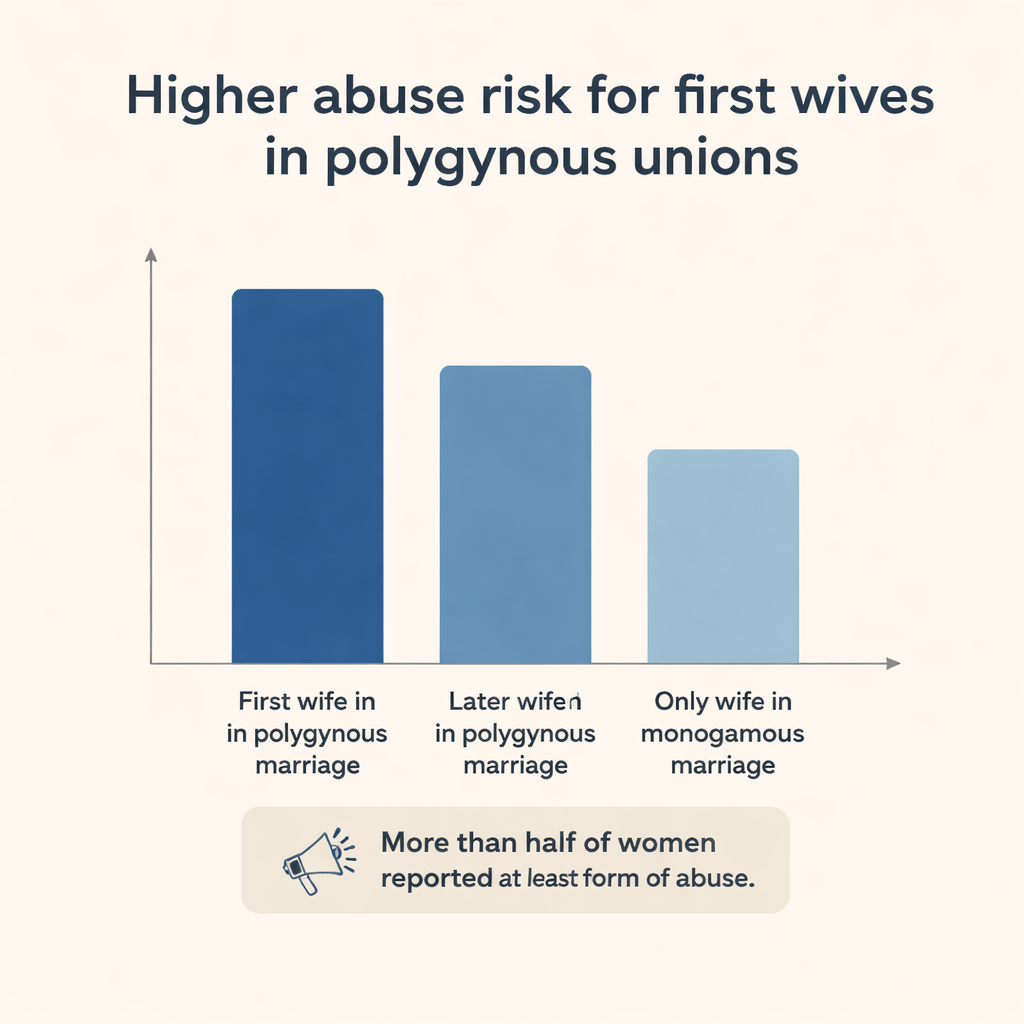
The researchers analyzed data from a large national survey of more than 21,000 married or partnered women aged 15 to 49 across all 34 provinces of Afghanistan. They focused on three types of harm: emotional abuse (such as insults and threats), physical violence (such as hitting, kicking, or using weapons), and sexual coercion (forcing or pressuring a woman into sex she does not want). More than half of the women said they had experienced at least one of these forms of abuse in the previous year. Nearly one in two had faced physical violence, about one in three emotional abuse, and almost one in ten sexual abuse. These figures suggest that violence from a partner is not an exception but a common part of life for many Afghan women.
Polygamous households and unequal wives
In Afghanistan, as in parts of Africa and South Asia, some men marry more than one wife, a practice known as polygyny. About one in twenty women in the study lived in such unions. The authors did not just compare polygamous marriages with one‑wife marriages; they also looked inside polygamous households, asking whether the first wife faced different risks than the later wives. They found that first wives were in a particularly dangerous position. After taking into account where women lived, how wealthy their households were, and other circumstances, first wives were about twice as likely as one‑wife women to report physical and emotional violence, and much more likely to experience sexual abuse and any form of abuse overall.
How conflict and community shape danger
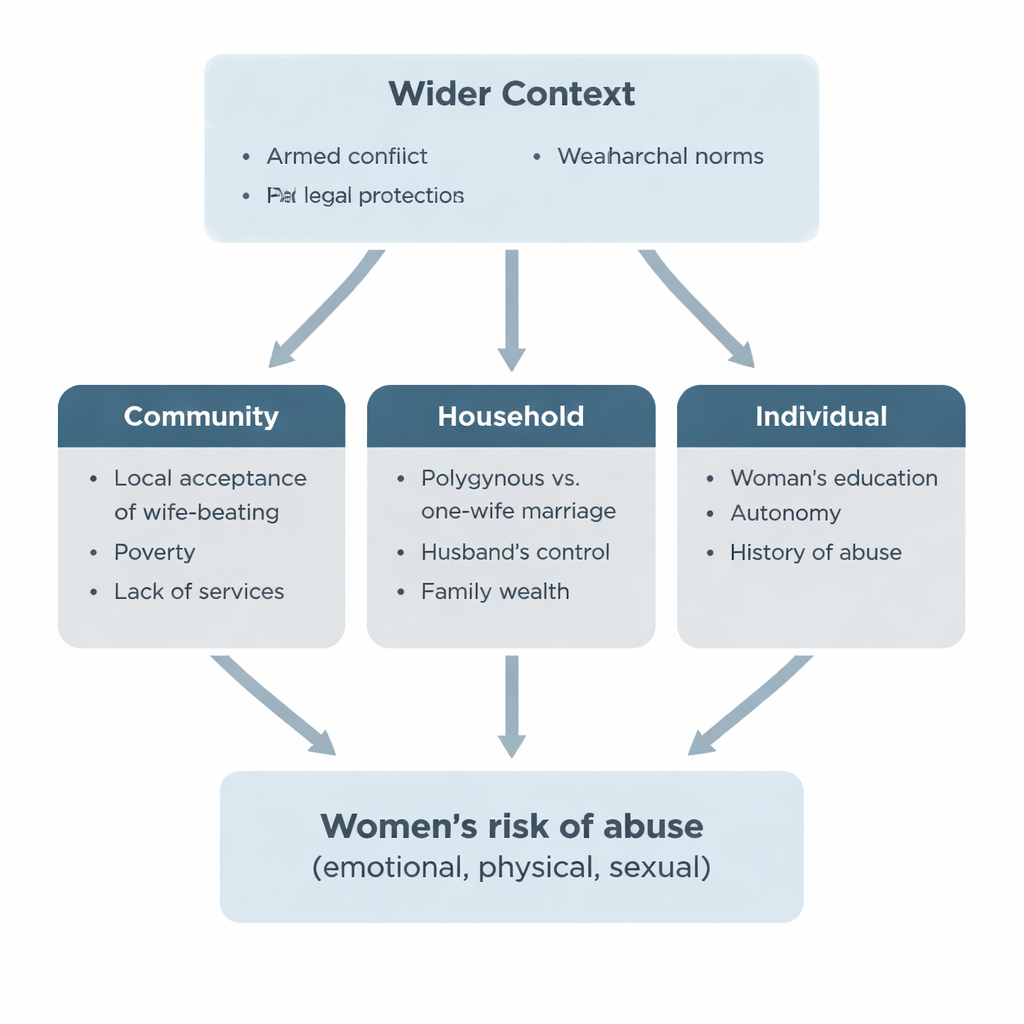
To make sense of these patterns, the researchers used a "layered" way of thinking that looks beyond individual couples. At the community level, they examined how often women in each province reported partner violence, how intense the armed conflict was, and how widely people accepted the idea that a husband is justified in hitting his wife under certain conditions. Living in a province with severe conflict or high acceptance of wife‑beating increased a woman’s odds of suffering abuse, no matter what kind of marriage she was in. Urban residence and higher average education in the community tended to reduce risk. Overall, these broad social and conflict conditions did more to explain differences in women’s experiences of violence than personal traits alone.
Power, money, and control inside the home
Within households, several features stood out. Women whose husbands tightly controlled their movements and decisions, or who drank alcohol, were far more likely to experience any kind of abuse. Poverty and low education on the husband’s side also raised risk, while owning property and living in a richer household offered some protection. On the individual side, women with more schooling, more say in household decisions, and less acceptance of wife‑beating were less likely to report violence. Yet even after accounting for these protections, first wives in polygynous unions remained at higher risk than both later wives and women in one‑wife marriages, suggesting that the very hierarchy among co‑wives creates extra vulnerability.
What the findings mean for change
For a general reader, the message is stark but clear: in Afghanistan, partner violence is widespread, and it is especially severe for women who are first wives in multi‑wife marriages. This is not simply about "bad" individuals; it is rooted in armed conflict, harsh gender norms, economic stress, and power imbalances in families and communities. The authors argue that reducing this violence will require more than passing laws. It calls for coordinated efforts to challenge beliefs that excuse wife‑beating, to strengthen legal protection and accountability, to expand women’s access to education, work, and property, and to weave support for women’s safety into peace and reconstruction programs. In short, changing the structure around women is as important as helping any one woman escape an abusive home.
Citation: Akbary, M.F., Marefat, M.B., Rasa, D. et al. Structural determinants of intimate partner violence in Afghanistan: unequal risks for women in polygamous and monogamous unions. Sci Rep 16, 5205 (2026). https://doi.org/10.1038/s41598-026-36161-6
Keywords: intimate partner violence, Afghanistan, polygamous marriage, women’s rights, gender inequality