Clear Sky Science · en
Morphological evaluation and ınheritance of powdery mildew resistance in garden pea (Pisum sativum L.)
Why pea diseases matter to your dinner plate
Garden peas are more than a side dish: they’re a compact package of protein, vitamins and minerals that millions of people rely on. But a widespread fungal disease called powdery mildew can cover pea plants in a white fuzz, shrinking harvests and reducing pod quality. This study asks two practical questions with big implications for farmers and consumers alike: which pea types naturally resist this disease, and how is that resistance passed from one generation of plants to the next?
Finding standout pea plants in the field
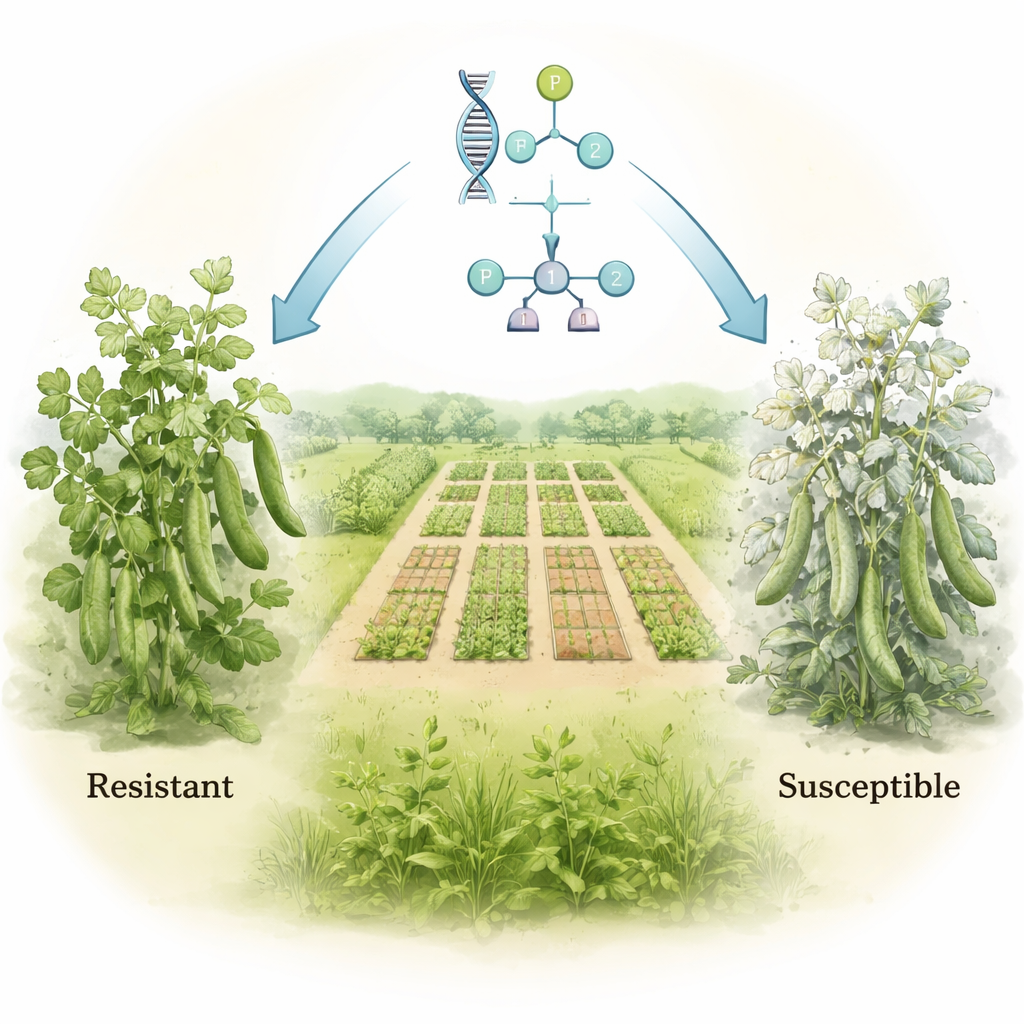
The researchers began with eleven diverse garden pea varieties grown at a research farm in New Delhi over several seasons. They carefully measured ten traits that matter to growers and buyers, including how tall plants grew, how early they flowered, how many pods and seeds they produced, pod size, and overall yield per plant. The team also made 55 different cross-pollinations among these parents to see which hybrid combinations performed best, essentially running a large, controlled tasting trial for plant performance.
Peas that combine good yields and good health
Not all peas are created equal. Some parent varieties stood out for specific strengths: one type (GP-17) flowered especially early, another (VP-233) had the longest and widest pods, and GP-473 produced heavy pods, many seeds, and a high shelling percentage, meaning more edible peas per pod. IP-3 gave the most pods per plant, while VRP-7 delivered the highest yield per plant. Among the hybrids, several cross-combinations outperformed their parents, delivering more pods, larger pods, or higher yields. This shows that breeders can boost multiple desirable traits at once by choosing parents wisely.
Putting plants under disease pressure
To test disease resistance, the team did not wait for chance infections in the field. They mass-produced spores of the powdery mildew fungus and sprayed them onto 30-day-old plants, ensuring that every variety and cross was challenged under the same conditions. After 12–14 days, they scored how much of each leaf was covered using a standard 0–9 scale and then converted these ratings into a percent disease index. Five varieties—GP-6, GP-473, Arka Ajit, Pusa Pragati and VP-233—showed only tiny amounts of infection, placing them in the resistant group, while others ranged from moderately susceptible to highly susceptible.
Tracing resistance like a family trait
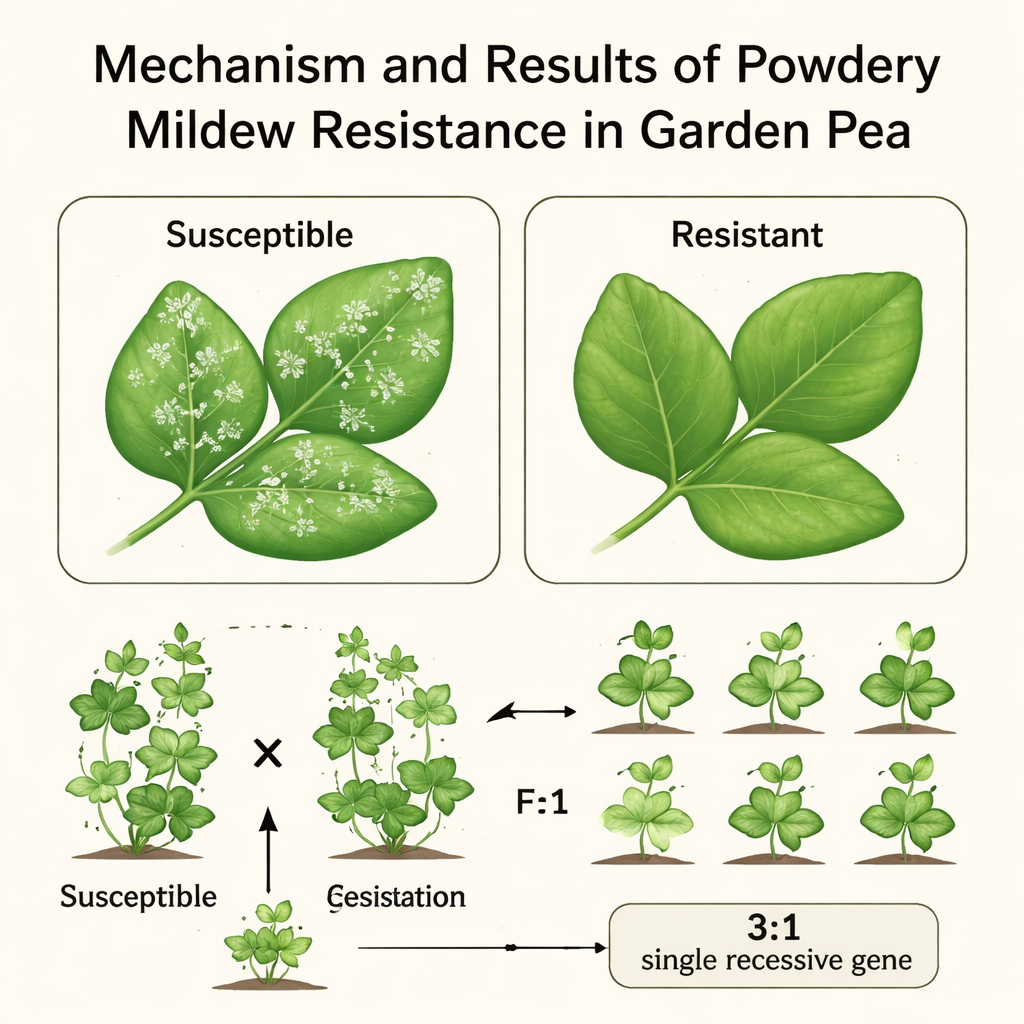
The key scientific question was how this resistance behaves when resistant and susceptible peas are crossed. For five different resistant–susceptible pairings, the researchers followed six generations: each parent, the first hybrid generation (F1), a self-pollinated second generation (F2), and two backcrosses where the F1 was crossed back to either the resistant or susceptible parent. By counting how many plants in each generation were resistant versus susceptible and comparing these counts to classic Mendelian ratios, they found a consistent pattern. F1 plants were all susceptible, F2 plants fell into roughly three susceptible for every one resistant, and backcrosses matched the expected 1:1 or 1:0 splits. Statistical tests confirmed that these patterns were not due to chance.
What it means for future pea varieties
For a non-specialist, the take‑home message is straightforward: in the resistant lines GP-6, GP-473 and VP-233, powdery mildew resistance behaves like a simple hidden (recessive) trait controlled by a single gene. When two carriers of this hidden trait are crossed, about one quarter of their offspring show clear resistance. This is very good news for breeders, because it means they can systematically cross high‑yielding but disease‑susceptible peas with these resistant sources and, over a few generations, recover new varieties that are both productive and naturally protected. The study also notes that confirming the exact gene with DNA markers and testing across more locations will be important next steps, but it already charts a clear path toward pea varieties that fight off powdery mildew without heavy reliance on fungicides.
Citation: Ram, H., Dhar, S., Choudhary, H. et al. Morphological evaluation and ınheritance of powdery mildew resistance in garden pea (Pisum sativum L.). Sci Rep 16, 5983 (2026). https://doi.org/10.1038/s41598-026-36160-7
Keywords: garden pea, powdery mildew, disease resistance, plant breeding, recessive gene