Clear Sky Science · en
Impact of air pollution on mental health in bangladesh: a comparison between Dhaka and Rajshahi
Why Dirty Air Can Cloud the Mind
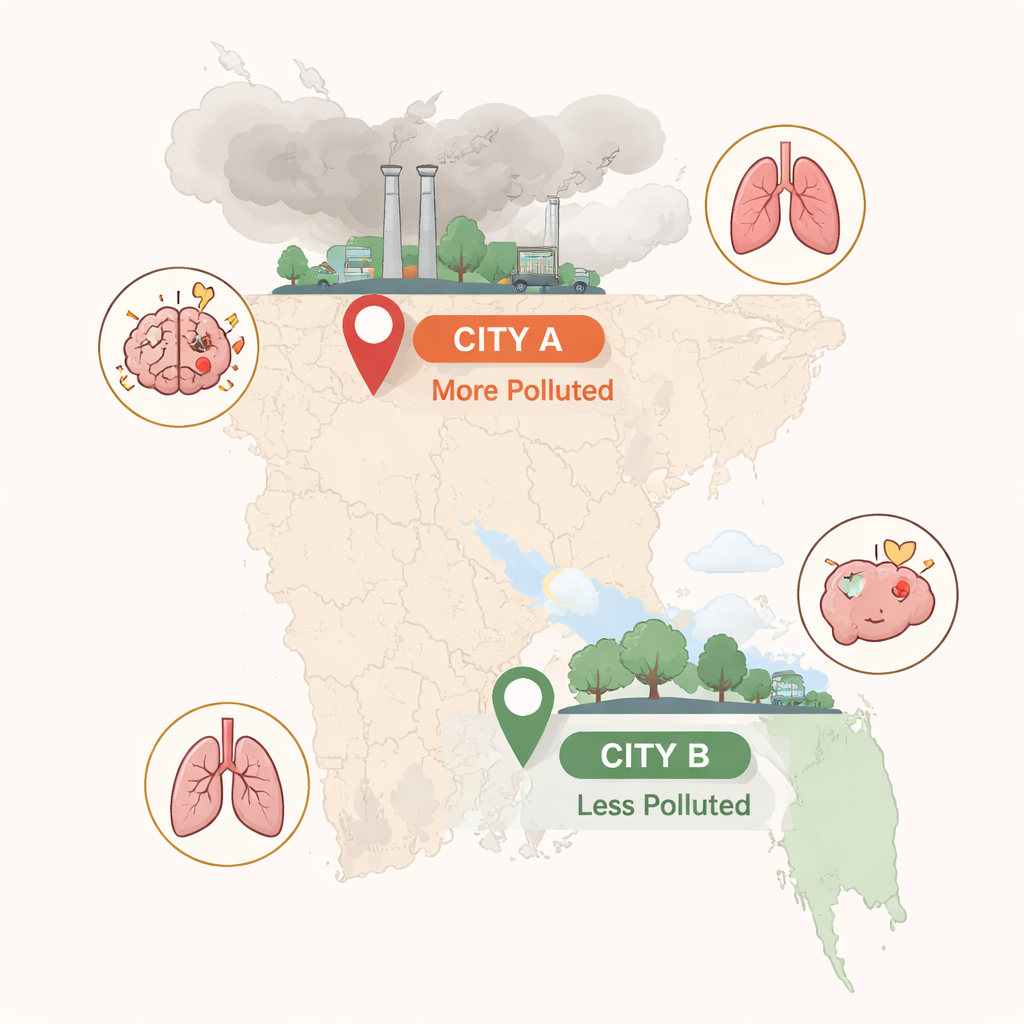
Many of us think of air pollution as a threat to our lungs and heart, but this study asks a more unsettling question: can bad air also disturb our thoughts and emotions? Focusing on two Bangladeshi cities—heavily polluted Dhaka and the relatively cleaner Rajshahi—the researchers explored whether breathing dirty air is linked to higher levels of depression, anxiety, and stress in everyday life.
Two Cities, Two Very Different Skies
The study compares Dhaka, one of the world’s most polluted megacities, with Rajshahi, a growing but less polluted urban center. Over three months, the team gathered official readings of common air pollutants, including fine and coarse particles from dust and smoke, gases from traffic and industry, and ground-level ozone. At the same time, they surveyed more than 2,700 adults—about half from each city—who had lived there at least six months, asking where they lived, how much smoke and fumes they noticed, and how they felt mentally.
Measuring Feelings in a Measurable Way
To avoid relying on vague impressions, the researchers used a standard questionnaire called DASS‑21 that turns feelings of depression, anxiety, and stress into numerical scores. Participants rated simple statements—such as whether they felt tense, hopeless, or unable to relax—on a four-point scale. The team then combined these scores with both the measured pollution levels and people’s own reports of how often they encounter smoke, dust, and vehicle emissions, and how they judge the air quality in their neighborhoods.
Heavier Smog, Heavier Mental Burden
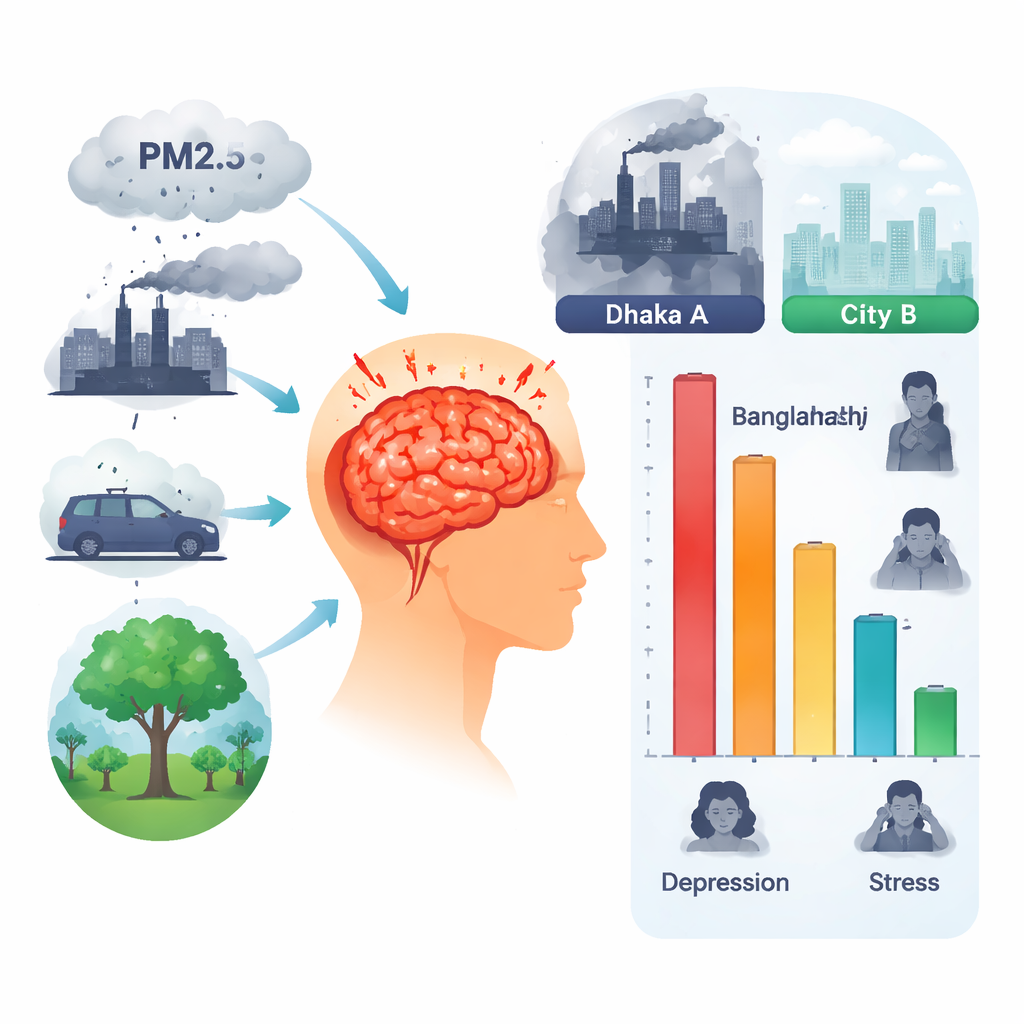
The differences between the two cities were stark. In Dhaka, about 57 percent of residents reported moderate to very severe symptoms of both depression and anxiety, and nearly half reported high stress. In Rajshahi, the figures were notably lower—around 37 to 38 percent for depression and anxiety, and 32 percent for stress. When the team dug deeper with statistical models, they found that higher levels of all major pollutants—especially tiny particles known as PM2.5—were strongly linked to worse mental health scores, even after accounting for age, income, and other background factors.
What People Perceive Also Matters
Interestingly, how people perceived their air mattered almost as much as what monitors recorded. Those who said they frequently encountered smoke and exhaust, or who rated their neighborhood air as poor, tended to have higher levels of depression, anxiety, and stress. Living or working near busy roads, factories, or garbage-burning sites, and being exposed to indoor smoke from solid-fuel cooking or tobacco, also added to mental distress. In contrast, higher income and older age were linked with slightly better mental health, possibly because they offer more resources and coping skills to buffer environmental stress.
What This Means for Everyday Life
For a non-specialist reader, the takeaway is clear: air pollution is not only a physical hazard but also a hidden driver of emotional suffering. Residents of Dhaka, where the air is much dirtier, face a noticeably heavier burden of depression, anxiety, and stress than those in cleaner Rajshahi. The study suggests that cleaning up urban air—through stricter emission controls, better public transport, and more green spaces—could ease not just coughing and breathlessness, but also quiet the mental strain that comes with living under a constant haze.
Citation: Siddik, M., Mahmud, A., Ali, A. et al. Impact of air pollution on mental health in bangladesh: a comparison between Dhaka and Rajshahi. Sci Rep 16, 6723 (2026). https://doi.org/10.1038/s41598-026-36158-1
Keywords: air pollution, mental health, Bangladesh, urban environment, depression and anxiety