Clear Sky Science · en
Towards standardisation of zinc slag as a sustainable fine aggregate substitute in concrete
Why Waste Could Help Save Our Rivers
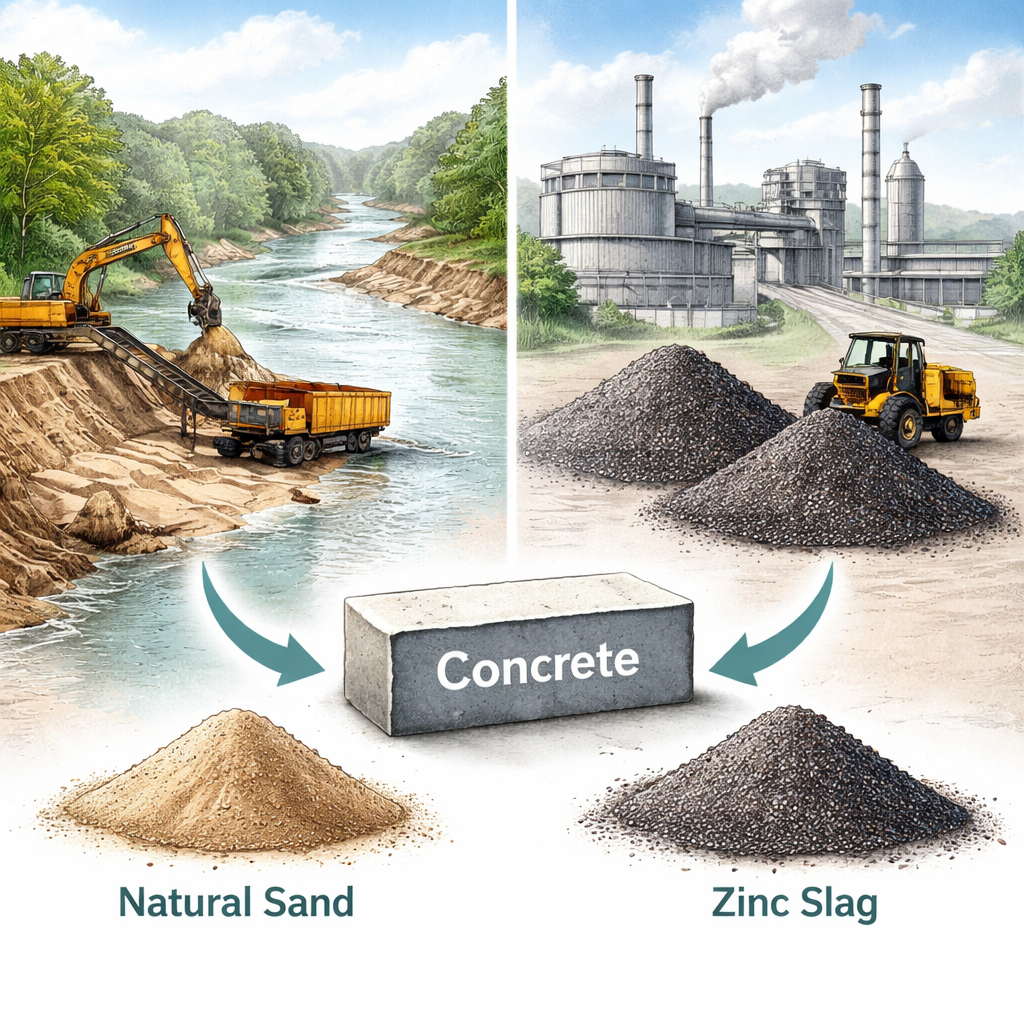
Sand might seem endless, but the construction boom is stripping riverbeds and coastlines at a staggering pace. At the same time, metal smelters around the world generate mountains of industrial leftovers that are hard to reuse. This study asks a deceptively simple question with big environmental stakes: can zinc slag—an abundant by-product of zinc refining—safely and reliably stand in for natural sand in concrete, without sacrificing strength, durability, or safety?
From River Sand to Factory Leftovers
Concrete is built from cement, water, coarse stones and, crucially, fine grains such as sand. As cities expand, demand for sand has soared, damaging rivers, deltas and coastal ecosystems and pushing up costs. In parallel, modern zinc smelting plants, especially in countries like South Korea, churn out large quantities of zinc slag. This gritty material is made of cooled, crushed droplets from the smelting process. Its size, density and mineral makeup suggest it could behave a lot like sand in concrete. Yet standards in major regions, including Korea, have so far ignored zinc slag, largely because of fears about heavy metals and inconsistent quality.
Taking a Close Look at the Slag Itself
The researchers began by treating zinc slag as if it were a new ingredient in a recipe that must be thoroughly checked before going into the mix. They measured how heavy the particles are, how much water they soak up, how their sizes are distributed, and what they look like under an electron microscope. They also analysed its elemental makeup and crystal structure, and tested it for unwanted impurities such as clay, loose dust, salts and bits of coal. Finally, they checked both the total content and leaching behaviour of hazardous elements like lead, cadmium and arsenic to see whether any could escape into the environment.
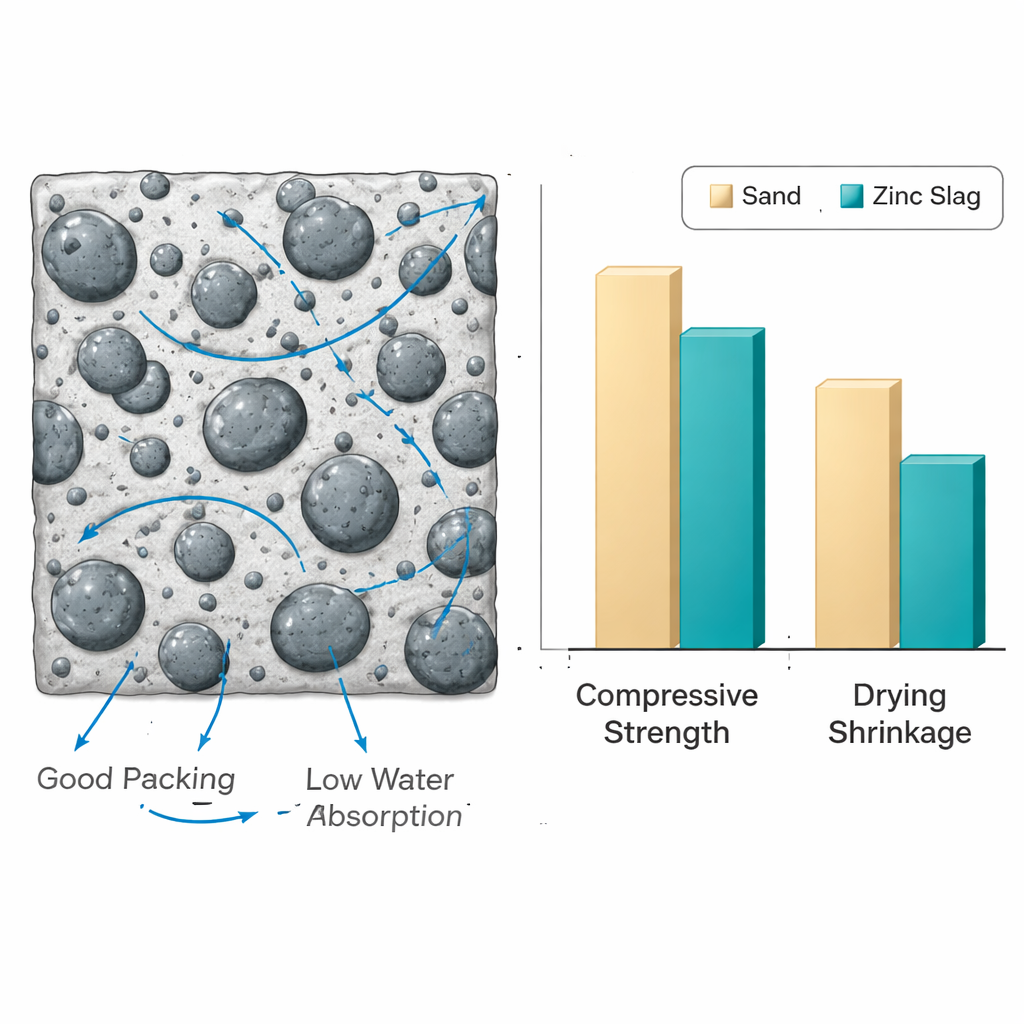
The slag turned out to be dense and well graded, with particles spanning a range of sizes that pack together efficiently. Its water absorption was very low—much lower than natural sand—which means it does not rob wet concrete of mixing water. Microscope images showed mostly angular grains, plus some smoother, rounded beads that can help the mix flow. Chemically, the slag resembled other industrial slags that are already accepted in standards, and the tests for harmful elements and leaching all fell comfortably within regulatory limits. In practical terms, the material behaved like a clean, stable manufactured sand.
How Concrete Made with Slag Performed
Armed with this information, the team produced two families of concrete: a normal-strength mix and a high-strength mix, both common in real projects. For each, they replaced natural sand with zinc slag at levels from 10 percent up to 100 percent by volume. They then checked how the fresh concrete behaved—how easily it flowed, how much water was needed to reach a standard workability, and how much air became trapped in the mix—followed by tests on hardened specimens for compressive strength, drying shrinkage and resistance to carbon dioxide penetration (a key cause of reinforcement corrosion over time).
As more slag was added, the concrete actually needed less water to reach the same consistency, thanks to the slag’s low absorption and the “ball bearing” effect of its rounded grains. The mixes remained stable, with no visible segregation of heavy particles. Compressive strength not only met design targets but often improved: at 28 days, normal-strength concrete with slag was up to about 8 percent stronger than the sand-only control, and high-strength concrete up to about 6 percent stronger. Shrinkage over 60 days stayed in the same tight range as ordinary concrete, and carbonation depth after accelerated exposure to carbon dioxide showed virtually no change across all slag replacement levels.
Safety, Durability and What It Means for Standards
For standards bodies and regulators, environmental safety can be a decisive hurdle. Here, zinc slag performed well. Heavy metals were present only in trace amounts, and leaching tests under standardised conditions detected almost nothing in the surrounding liquid, apart from small amounts of boron well below prescribed limits. The slag also showed negligible reactivity with the cement’s alkalis, meaning it should not trigger the slow, damaging expansions sometimes seen when reactive aggregates are used. Together, these results suggest that, from both a structural and environmental viewpoint, zinc slag behaves much like other metallurgical slags that are already written into building codes.
Turning Industrial Waste into a Building Resource
To a layperson, the key message is straightforward: this study finds that zinc slag, a material usually treated as waste, can safely replace river sand in both everyday and high-performance concrete without weakening buildings or shortening their lives. In many cases, the slag-based mixes are slightly stronger and require less water, while keeping shrinkage, trapped air and carbon dioxide resistance within accepted bounds. Because the slag passes strict tests for heavy metal content and leaching, it does not pose a notable pollution risk. These findings provide the kind of hard data needed for future updates to construction standards, potentially turning a troublesome industrial by-product into a mainstream, more sustainable ingredient in the world’s most widely used building material.
Citation: Yoon, J.C., Shivaprasad, K.N., Min, T.B. et al. Towards standardisation of zinc slag as a sustainable fine aggregate substitute in concrete. Sci Rep 16, 5961 (2026). https://doi.org/10.1038/s41598-026-36155-4
Keywords: zinc slag, sustainable concrete, sand replacement, industrial by-products, construction materials