Clear Sky Science · en
Sex estimation from lateral cephalograms via a hybrid multimodel convolutional neural network
Why skull X-rays matter in real-world investigations
When investigators are faced with unidentified remains after a crime, accident, or disaster, one of the first questions they must answer is whether the person was male or female. Knowing this quickly narrows the search for a match and can also guide medical and archaeological research. This study explores how routinely taken orthodontic side-view skull X-rays, called lateral cephalograms, can be combined with artificial intelligence to estimate sex with very high accuracy, offering a fast and objective aid to traditional forensic methods.
From dentist’s X-ray to forensic clue
Lateral cephalograms are standard images used by dentists and orthodontists to plan treatment. They show the side view of the head, including the forehead, nose bridge, jaw, and base of the skull. These regions contain subtle shape differences between males and females, such as the prominence of the forehead, the length of the cranial base, and the vertical height of the face. Until now, experts have measured these differences by hand, using angles and distances between well-defined anatomical points. This manual work is slow, requires specialized training, and can be influenced by the examiner’s judgment, especially when the bones are damaged or images are unclear. 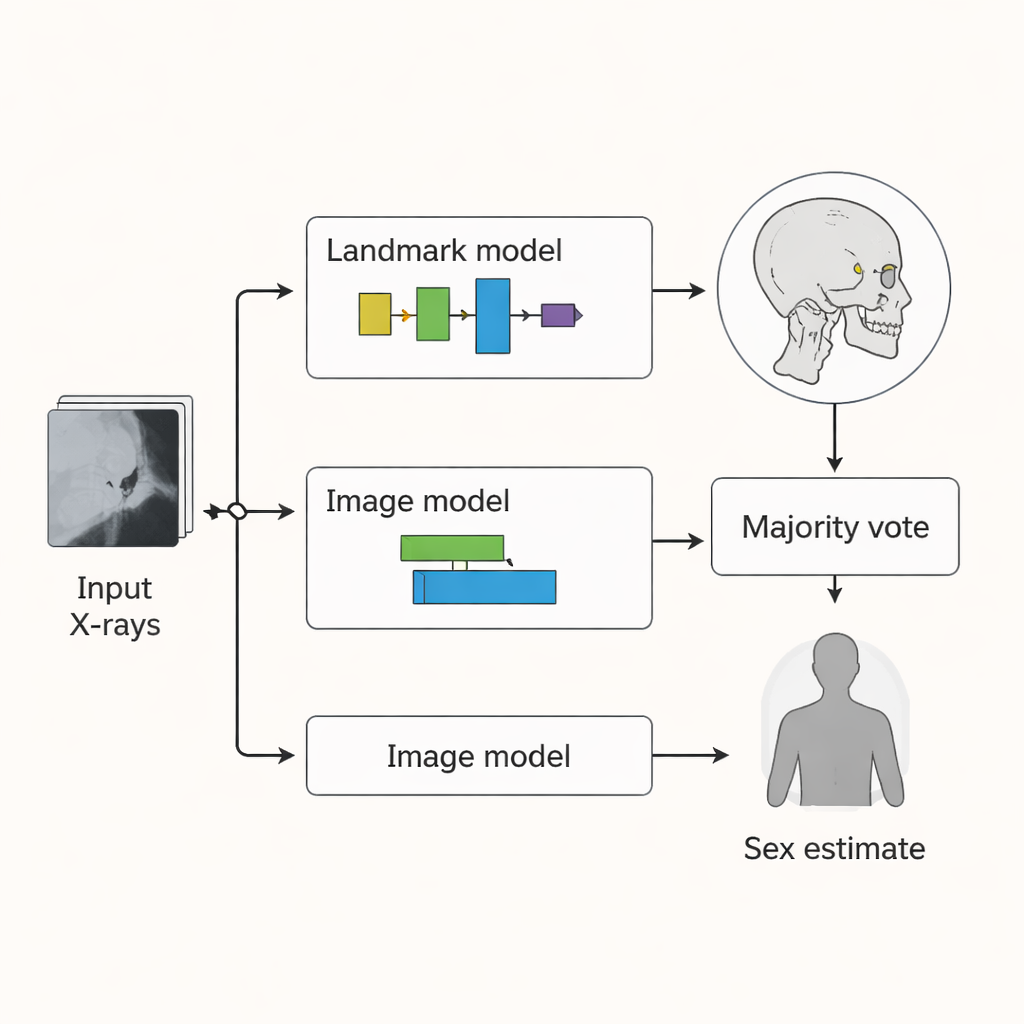
Blending two kinds of artificial intelligence
The researchers designed a “hybrid” computer system that mimics how a human expert studies a cephalogram, while also learning directly from image patterns that may be invisible to the naked eye. One part of the system, based on a neural network called DenseNet169, was trained on X-rays where five key landmarks were carefully marked: the glabella (forehead), nasion (bridge of the nose), sella (a small hollow in the skull base), basion (lower back of the skull opening), and menton (lowest point of the chin). Using these points, the model automatically calculated two important distances—the cranial base length and total facial height—and three angles formed by connecting the points into triangles. These measurements then fed into formulas, developed in earlier work, that output whether the skull is most likely male or female.
Letting the computer “look” without instructions
The second part of the hybrid system used a network called EfficientNetB3, which was not given any landmarks or measurements. Instead, it learned to recognize sex-related patterns by looking directly at the raw X-ray images. Its role resembles that of an experienced radiologist who, over many cases, learns to notice combinations of shadows and shapes that tend to appear more often in men or in women. A separate machine-learning method, known as a random forest classifier, interpreted the features extracted by EfficientNetB3 and produced its own sex prediction. Importantly, this unsupervised pathway was trained on images that did not require labor-intensive manual marking, making it easier to expand the system to larger datasets in the future. 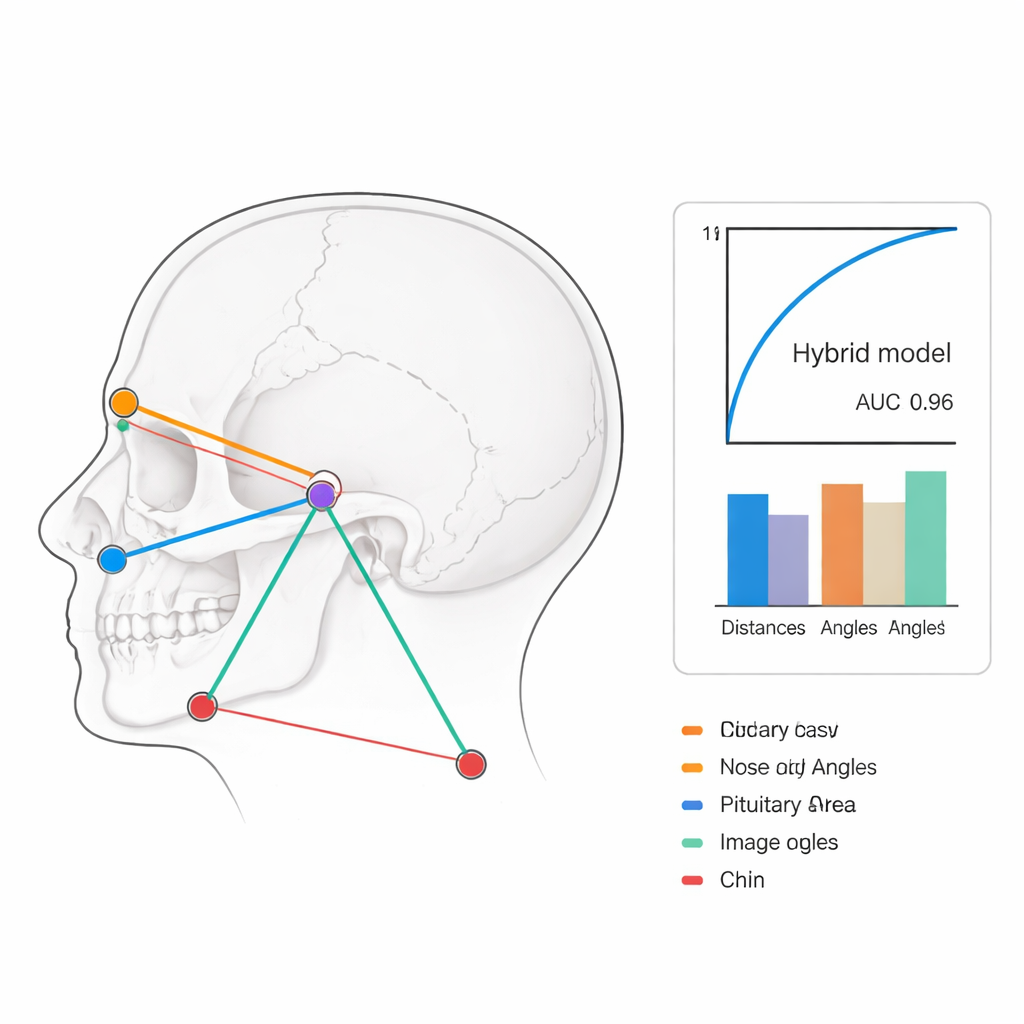
Voting for the best answer
To arrive at a final decision, the researchers combined three “opinions”: one based on linear distances, one based on angular measurements, and one based on the image-only analysis. The system used majority voting—whichever sex was suggested by at least two of the three methods became the final output. On a main dataset of 150 adults, expanded with image augmentation techniques, the distance-based approach alone reached 100% accuracy, and the angle-based one came close, at just under 100%. The image-only model was less accurate, around 81%, but when all three were combined, the overall accuracy was about 99.7%. To test how well this would work in the real world, the team also evaluated the hybrid model on an extra set of 46 X-rays that did not strictly meet the original image-quality rules. Even then, the system correctly estimated sex in about 98% of cases and showed “excellent” diagnostic strength according to standard medical statistics.
What this means for science and society
For forensic scientists, archaeologists, and medical examiners, the study suggests that a carefully designed blend of human-guided measurements and free-form image learning can deliver near-perfect sex estimates from everyday dental X-rays. The method is not meant to replace experts or the traditional gold standard of manual measurement, but to provide a fast, consistent second opinion—especially useful when many cases must be processed at once, as in mass disasters. The authors stress that further testing on larger and more varied collections of remains is needed, as well as careful attention to ethics, transparency, and legal standards. Still, this hybrid neural network marks an important step toward practical, explainable AI tools that can assist in identifying the dead and restoring their legal identity.
Citation: Widyaningrum, R., Rosyida, N.F., Ningtyas, A.H. et al. Sex estimation from lateral cephalograms via a hybrid multimodel convolutional neural network. Sci Rep 16, 6490 (2026). https://doi.org/10.1038/s41598-026-36147-4
Keywords: forensic identification, lateral cephalogram, sex estimation, deep learning, craniofacial radiology