Clear Sky Science · en
Atmospheric aerosol effects on spectral mismatch and the resulting uncertainty in photovoltaic performance
Why the color of sunlight matters for solar panels
Homeowners, investors, and grid planners often treat solar power as predictable: given a certain amount of sunshine, a solar panel should deliver a certain amount of electricity. Yet in practice, identical panels under the same measured sunlight can produce noticeably different power. This paper explains a hidden culprit behind those discrepancies: tiny particles in the air, called aerosols, subtly change the “color mix” of sunlight in ways that standard tests do not capture, leading to quiet gains or losses in real‑world solar performance of up to about ten percent.
Sunlight in the lab versus sunlight in the real world
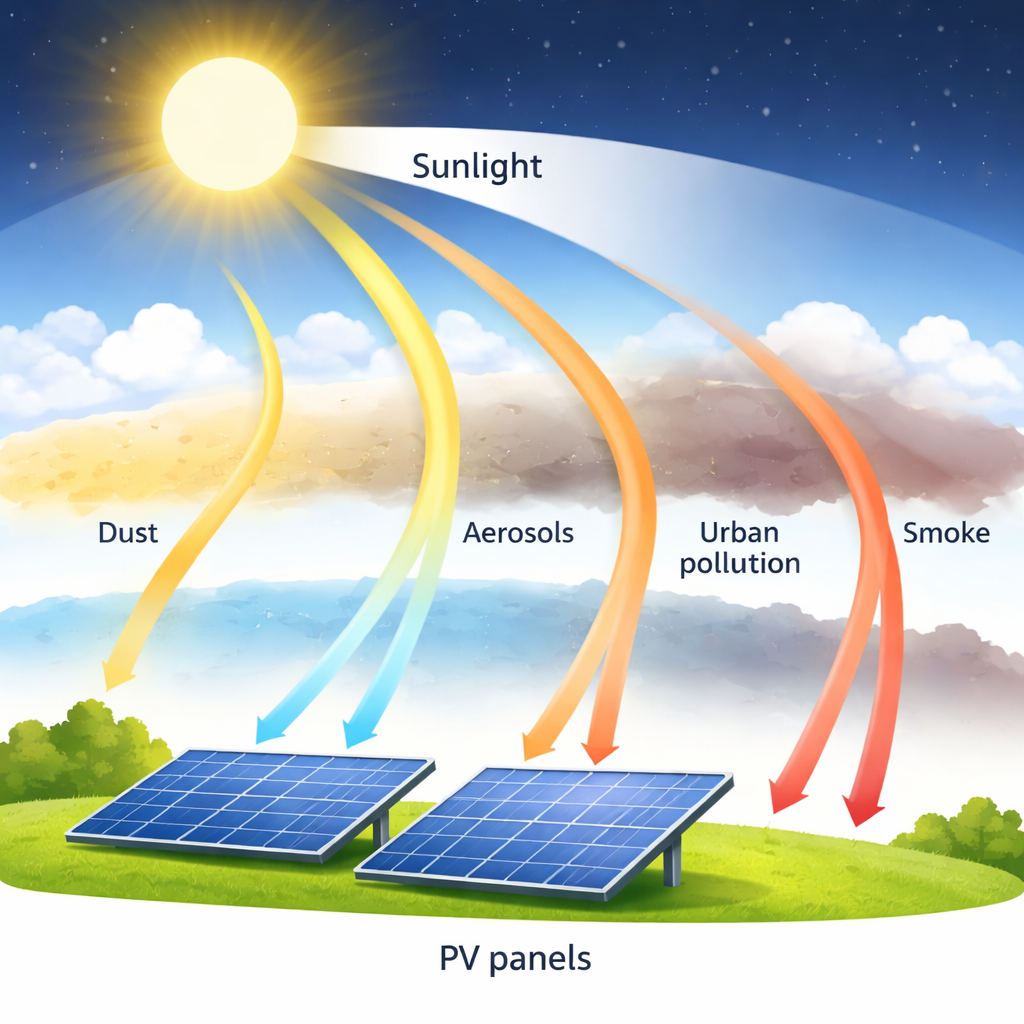
The efficiency of commercial solar modules is certified under carefully defined Standard Test Conditions. In the lab, panels are illuminated with a reference spectrum known as AM1.5G, which represents an idealized mid‑day Sun in a clear atmosphere, and the cells are kept at 25 °C. Outside the lab, however, the spectrum of sunlight is almost never identical to this standard. As sunlight passes through the atmosphere it is absorbed and scattered by gases, water vapor, and especially aerosols—fine particles from sea spray, dust, pollution, and biomass burning. Standard irradiance sensors measure only the total power of this light, not its detailed spectrum, so changes in spectral shape can cause the power output of a panel to drift from its rated value even when the measured irradiance appears unchanged.
A simple number for a complex spectrum
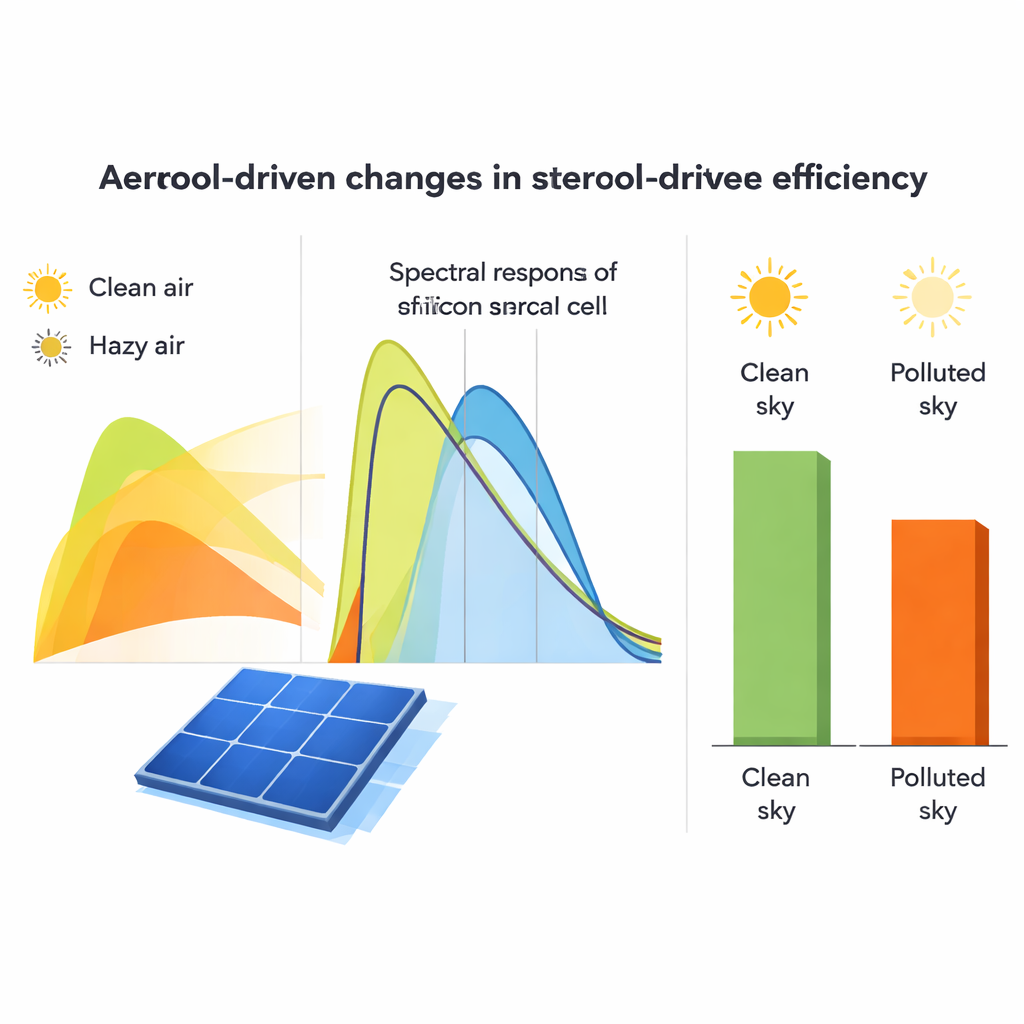
To track this effect, the authors focus on a quantity called the spectral factor. It compares how strongly a solar cell responds to the actual sunlight spectrum versus the standard AM1.5G spectrum. If the spectral factor is greater than one, the real atmosphere gives the panel a spectral “bonus”; if it is less than one, there is a loss. Using a well‑validated radiative transfer model (SMARTS2), the study simulates hundreds of thousands of realistic spectra, varying the Sun’s height in the sky, the tilt of the panel, atmospheric water vapor, and detailed aerosol properties. A key step is to combine each simulated spectrum with the known wavelength‑by‑wavelength sensitivity of crystalline silicon cells, the dominant technology on today’s market, to see how much useful electrical current each spectrum would generate.
What different aerosols and panel angles really do
The team explores five broad aerosol types: marine spray, desert dust, mixed particles, urban‑industrial pollution, and smoke from biomass burning. Even when their spectra look similar to the naked eye, these aerosols shift sunlight subtly toward redder or bluer wavelengths and change the balance between direct sunlight and diffuse sky glow. The simulations show that panels lying flat tend to suffer spectral losses, especially when fine, absorbing aerosols such as urban haze or smoke are present and when the Sun is low on the horizon. As the tilt angle increases, these losses shrink and can turn into gains. Vertically mounted panels—similar to building facades—often experience notable spectral gains, particularly in hazy conditions with fine particles, even though their total captured sunlight may be lower.
From color shifts to real power gains and losses
In a large “virtual experiment,” the authors compute the effective efficiency of a 20% silicon module under almost 900,000 different combinations of latitude, panel tilt, Sun position, and atmospheric properties. They find that aerosol‑driven spectral mismatch alone can push efficiency up or down by roughly 10%, and in some specific conditions even more. Coarse particles such as marine aerosols and desert dust tend to favor higher efficiencies at mid‑latitudes, while fine pollution and smoke create stronger variability and generally lower efficiencies at higher latitudes. Statistical tests confirm that these differences between aerosol classes are not just noise but systematic effects. For regions like China, where both large solar fleets and frequent pollution episodes occur, the results imply that dirty air can quietly erode solar output beyond the obvious dimming of the Sun.
What this means for solar planning and everyday systems
To a non‑specialist, the central message is that the “quality” of sunlight matters as much as its quantity. Two days with the same measured sunshine can yield different power from the same solar array because aerosols have reshaped the spectrum in ways that favor or hinder silicon cells. The authors show that under typical outdoor conditions this hidden effect can change efficiency by about one tenth, and modest losses can appear even on seemingly mild days when panels are nearly flat, the Sun is low, and the air contains moderate amounts of fine absorbing particles. As solar power continues to expand, especially in polluted or dusty regions and on building facades, accounting for these spectral effects will help make performance estimates more reliable and financial planning more secure.
Citation: Hategan, SM., Paulescu, E. & Paulescu, M. Atmospheric aerosol effects on spectral mismatch and the resulting uncertainty in photovoltaic performance. Sci Rep 16, 5339 (2026). https://doi.org/10.1038/s41598-026-36144-7
Keywords: solar spectrum, aerosols, photovoltaic efficiency, spectral mismatch, solar resource assessment