Clear Sky Science · en
Genome-wide analysis of the MYB gene family and its stress-responsive expression under salinity and drought in sesame
Why tougher sesame plants matter
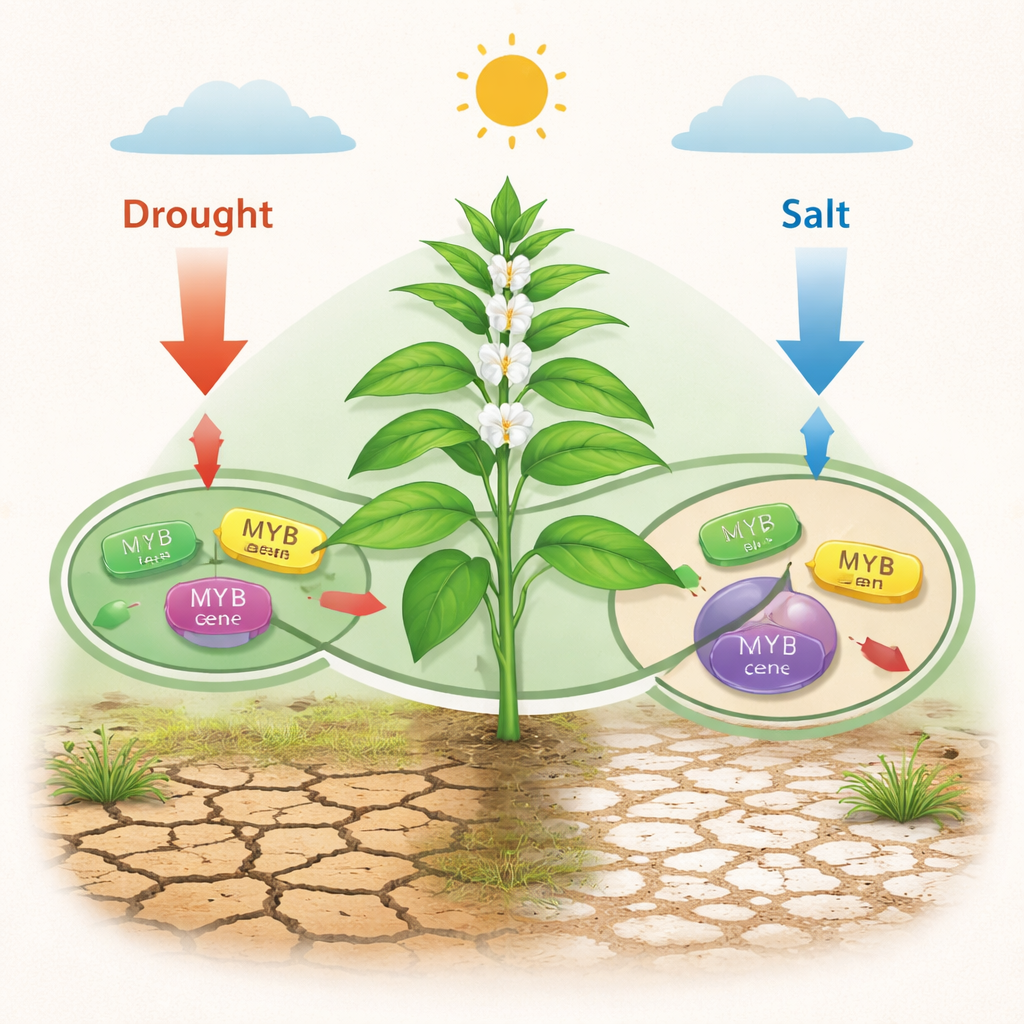
Sesame is more than a burger bun garnish. This ancient “queen of oilseeds” is prized for its flavorful, antioxidant-rich oil and its ability to grow where many crops fail. As climate change brings harsher droughts and saltier soils, understanding why sesame copes better than most plants could help secure food and oil supplies in dry regions. This study digs into sesame’s DNA to uncover a large family of control genes that help the plant sense stress and adjust its growth, offering clues for breeding future-proof crops.
The plant’s genetic control switches
Inside every sesame cell, hundreds of genes act like switches that turn other genes on or off. Among the most important are MYB genes, a big family of “master switches” already known in other plants to influence growth, color, and responses to heat, cold, and lack of water. The researchers scanned the sesame genome and cataloged 148 MYB genes, each carrying the hallmark DNA-binding segment that lets it latch onto target genes. These MYB switches differ widely in size, electrical charge, and predicted stability, suggesting a toolkit of parts tuned for different roles in the plant.
Where the switches sit and what surrounds them
The team then asked two simple questions: where are these genes in the genome, and what “control knobs” sit just upstream of them? They found MYB genes scattered across all 16 sesame chromosomes, but clustered more densely on a few, hinting at past duplication events and hot spots of evolution. Most of the corresponding MYB proteins are predicted to work in the cell nucleus, where gene regulation happens, though some may also operate in chloroplasts, the cytoplasm, or even the cell membrane. In the DNA regions that control when MYB genes turn on, the scientists discovered many short sequence motifs linked to light, plant hormones, and—crucially—stress responses such as drought, cold, wounding, and salt. This pattern suggests that MYB switches themselves are wired to respond quickly when conditions turn hostile.
Tracing family ties and hidden patterns
To make sense of so many related genes, the researchers grouped sesame MYBs into 11 major branches based on sequence similarity and repeated amino acid patterns, called motifs. Some motifs are shared widely, implying basic, housekeeping roles; others appear only in small subgroups, hinting at more specialized tasks such as fine-tuning reactions to a particular stress. By comparing sesame MYBs with those from the model plant Arabidopsis, and by examining stretches of DNA that remain similar between species, the team showed that many MYBs arose through copying and reshuffling of chromosome segments over evolutionary time. Some of these duplicated genes were kept and diverged in function, while others likely faded, leaving a MYB collection that reflects sesame’s long adaptation to challenging environments.
Watching stress genes in action
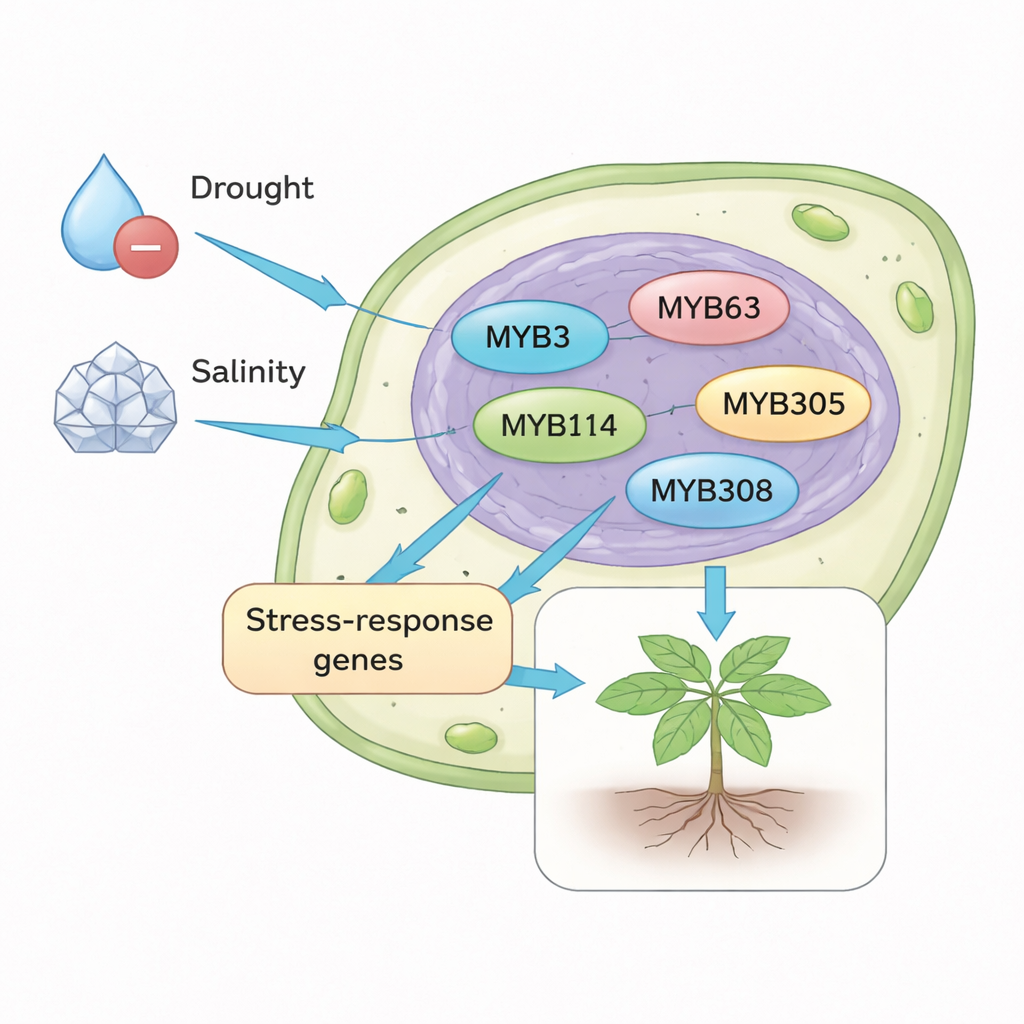
Catalogs and evolutionary trees are useful, but the key question is: which MYB switches actually move when the plant is thirsty or salted? To test this, the authors focused on five genes—SiMYB3, SiMYB63, SiMYB114, SiMYB305, and SiMYB308—and measured their activity in three sesame varieties that differ in drought and salt tolerance. Seedlings were exposed to either simulated drought or salty water, and leaf samples were taken over 48 hours. All five genes became more active under stress, but in different patterns depending on the variety and how long the stress lasted. Some, like SiMYB114 and SiMYB305, jumped sharply in response to salt, especially in more tolerant varieties, while SiMYB308 showed a dramatic early surge under drought in one genotype. These time- and genotype-specific patterns suggest that each gene plays a distinct role in helping sesame sense and manage hardship.
What this means for future crops
For non-specialists, the take-home message is straightforward: sesame’s resilience is not magic but the work of many finely tuned genetic switches. By mapping the full MYB gene family and showing that several members respond strongly to drought and salinity, this study highlights concrete targets for breeders and genetic engineers. Tweaking the activity of key MYB genes such as SiMYB114, SiMYB305, and SiMYB308 could one day yield sesame varieties—and perhaps other crops—that stay productive on poor, dry, or salty soils, helping agriculture keep pace with a warming, more water-stressed world.
Citation: Padyab, S., Asghari Zakaria, R., Zare, N. et al. Genome-wide analysis of the MYB gene family and its stress-responsive expression under salinity and drought in sesame. Sci Rep 16, 6203 (2026). https://doi.org/10.1038/s41598-026-36141-w
Keywords: sesame, drought tolerance, salt stress, MYB genes, crop resilience