Clear Sky Science · en
Transforming iron ore tailings into high reactivity binders for multifunctional and eco- efficient foamed concrete
Turning Mining and Farm Waste into Better Building Blocks
Every year, mountains of industrial waste—from iron mines, coal plants, and rice mills—are piled into tailings dams and landfills, threatening soil, water, and air. This study shows how some of that waste can be turned into a valuable ingredient for lightweight foamed concrete, a material used for walls, floors, and fill in buildings. By carefully blending these by‑products into the cement, the researchers managed not only to cut the environmental burden but also to make the concrete stronger and more durable.
Why Foamed Concrete Needs an Upgrade
Foamed concrete is a special kind of concrete packed with tiny air bubbles. Those bubbles make it much lighter than normal concrete and give it good thermal and sound insulation, which is useful for modern, energy‑efficient buildings. But there is a trade‑off: to reach even moderate strength, foamed concrete usually needs a lot of cement, which is expensive and carbon‑intensive to produce. Even then, its strength often falls short of what is needed for serious structural work, and its sponge‑like structure can let in water and salts that damage steel reinforcement over time. Finding a way to boost strength and durability while cutting cement use is therefore both an engineering and environmental priority. 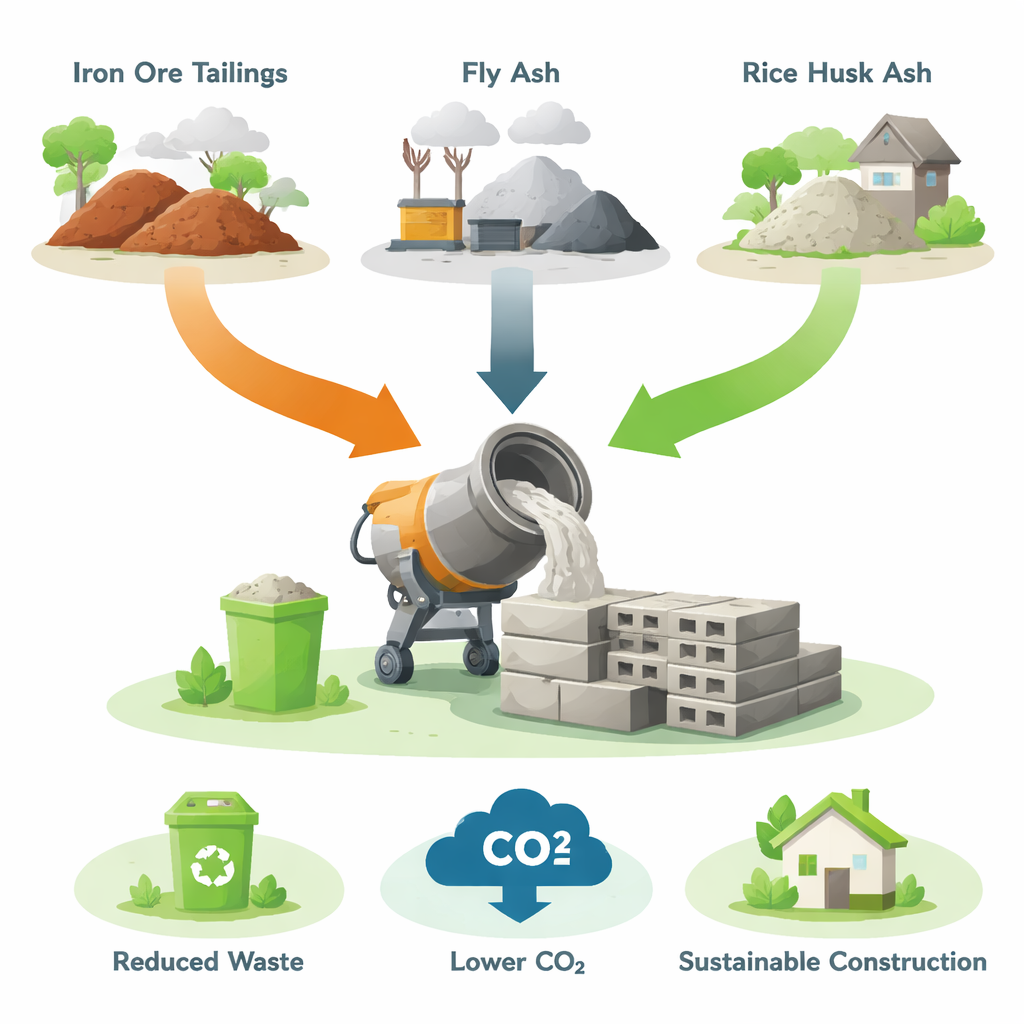
From Waste Piles to High‑Performance Mix
The team focused on three common wastes: iron ore tailings from mineral processing, fly ash from coal‑fired power plants, and rice husk ash left over from burning rice husks. All three contain reactive forms of silica and other minerals that can behave like cement if finely ground and properly blended. The researchers produced a series of foamed concrete mixes where these three materials replaced 0%, 12%, 24%, 36%, 48%, or 60% of the cement, always in equal proportions (one‑third each). They kept other ingredients—water, sand, foam, and base cement—constant, then cast and cured hundreds of samples for testing. This allowed them to see how different replacement levels affected workability, hardening time, internal pore structure, water resistance, and mechanical strength.
How the New Mix Changes the Inside of Concrete
Detailed laboratory tests, including measurements of pore size and images taken with a scanning electron microscope, revealed what was happening inside the material. At modest replacement levels, especially when 24% of the cement was swapped for the waste blend, the concrete developed a denser, more refined pore network: fewer large voids, more tightly packed particles, and a thicker layer where paste and sand interlock. Chemically, the silica and alumina in the wastes reacted with calcium compounds from the cement to form extra binding gel, which filled gaps and tied the mix together. This improved microstructure reduced the ease with which water and air could pass through, and it blocked pathways that allow damaging chloride salts to penetrate. At very high replacement levels, however, the mix became over‑diluted in cement, leaving more large pores and weakening these beneficial effects. 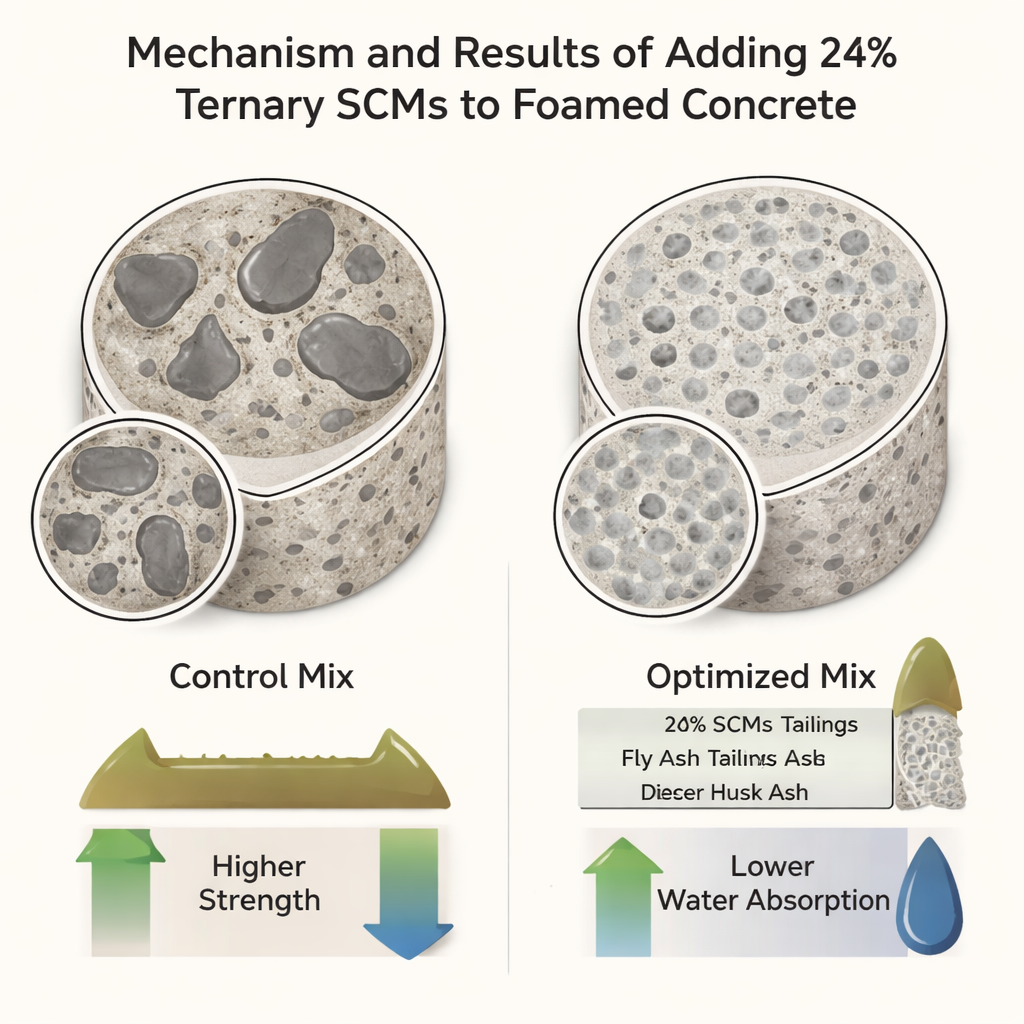
Stronger, Tougher, and More Resistant to Moisture
The practical payoff of this optimized 24% blend was clear in the mechanical and durability tests. Compared with plain foamed concrete, the improved mix showed roughly 15% higher compressive strength (resistance to crushing), over 24% higher bending strength, and nearly 29% higher splitting tensile strength, which reflects resistance to cracking. Its stiffness, measured by the elastic modulus, also increased, making it better able to carry loads without deforming. At the same time, it absorbed less water, drew in moisture more slowly, and allowed less air and chloride ions to pass through. In other words, by adding a carefully chosen amount of iron ore tailings, fly ash, and rice husk ash, the researchers produced a lighter‑weight concrete that is not only stronger but also better protected against long‑term environmental damage.
A Practical Path to Greener Construction
For non‑specialists, the headline is straightforward: mixing about one‑quarter waste minerals into foamed concrete can make it both greener and better. This approach reduces the demand for high‑carbon cement and gives new life to waste from mines, power plants, and agriculture that would otherwise pose environmental risks. The study suggests that, with proper quality control, such blends could help builders create lighter walls and floors that use less raw material, last longer, and lower the overall climate footprint of construction—an important step toward more sustainable cities.
Citation: Sattar, A.A., Mydin, M.A.O., Omar, R. et al. Transforming iron ore tailings into high reactivity binders for multifunctional and eco- efficient foamed concrete. Sci Rep 16, 5693 (2026). https://doi.org/10.1038/s41598-026-36139-4
Keywords: foamed concrete, iron ore tailings, supplementary cementitious materials, waste valorization, sustainable construction