Clear Sky Science · en
Interocular agreement and differences of ocular growth in cataract patients
Why both eyes rarely match perfectly
Cataract surgery is one of the most common operations in the world, and its success depends on knowing the exact size and shape of each eye to choose the right replacement lens. Doctors often assume that a person’s two eyes are nearly identical and use one eye’s measurements to guide treatment of the other. This study asked a simple but important question: how similar are our two eyes really, and does that symmetry change in people with very short or very long eyes, or between men and women?
Measuring eye size in hundreds of patients
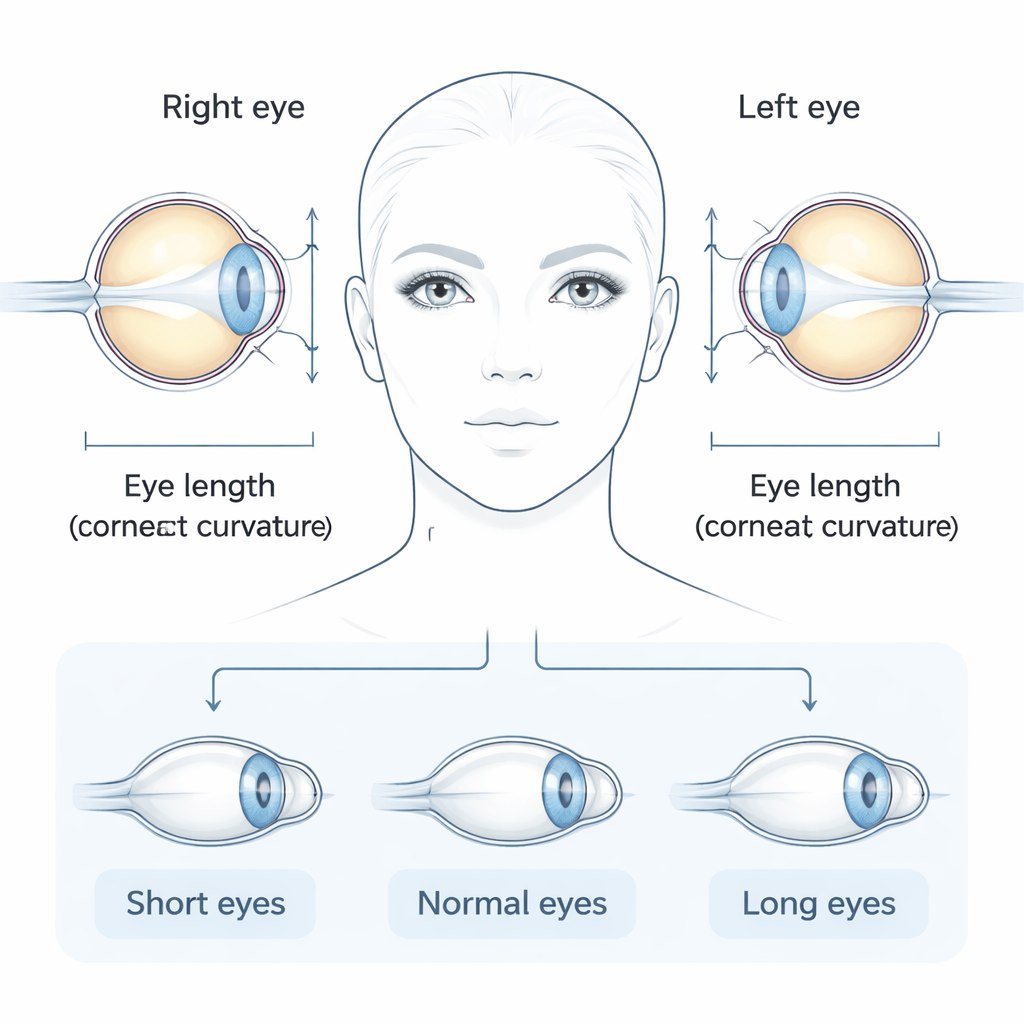
The researchers reviewed measurements from 715 adults with cataracts, all taken with a highly precise optical device before surgery. They focused on the eye’s front-to-back length (axial length) and a combined measure that relates this length to the curvature of the clear front window of the eye, the cornea. These two numbers together give a snapshot of how the eye has grown over a lifetime and strongly influence whether a person is nearsighted or farsighted. Patients were grouped into short eyes, normal-length eyes, and long eyes, and results were also compared between men and women.
How similar are the right and left eyes?
Overall, the two eyes of most patients matched each other quite well. The ratio between eye length and corneal curvature was especially stable from one eye to the other, supporting the everyday medical habit of treating the eyes as a pair. However, small but real differences in raw eye length showed up when all patients were considered together and in women specifically. Men tended to have slightly longer eyes and, more importantly, their two eyes matched each other more closely than women’s did. This suggests that biological sex influences how evenly the two eyes grow over time.
Short and long eyes break the symmetry
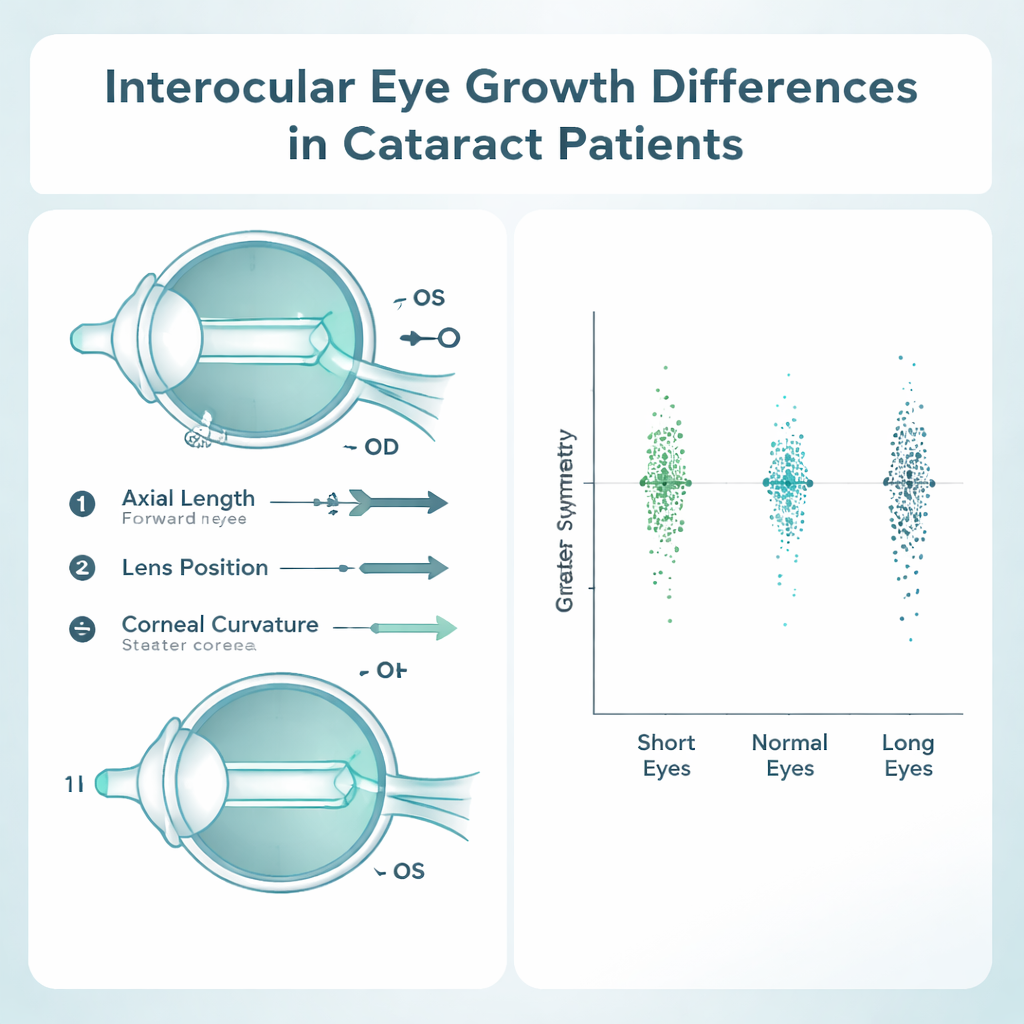
When the team looked at eye-length groups, people with normal-length eyes showed the best match between their two eyes. In this group, the right and left eye lengths and ratios stayed tightly aligned. In contrast, patients with very short or very long eyes showed much more mismatch. Long eyes, which are often linked to high degrees of nearsightedness, had the widest spread in differences between the two sides, hinting at more unstable or uneven growth. Short eyes also showed weak agreement in length, although the ratio that accounts for corneal curvature was somewhat steadier, implying that the cornea may partly compensate for length differences.
Linked changes in front-of-the-eye structures
The study went beyond simple length comparisons and examined how differences between the two eyes in length lined up with differences in other features, such as the depth of the front fluid-filled chamber, the thickness and position of the lens, and the steepness of the cornea. Eyes that were longer on one side tended to have a deeper front chamber and a lens that sat in a slightly different position in that eye. Differences in the steepness of the cornea between the two eyes were also strongly tied to differences in the length-to-curvature ratio. Together, these patterns show that when one eye grows differently, several front structures shift along with it rather than changing in isolation.
What this means for cataract surgery patients
For most cataract patients, especially those with normal-length eyes, it is reasonably safe for surgeons to assume that both eyes are similar. But the study highlights important exceptions: women and people with very short or very long eyes are more likely to have a noticeable mismatch in eye size and shape from one side to the other. Because even a tiny length difference can change the strength of the implanted lens, the authors argue that each eye in these higher-risk groups should be evaluated carefully and individually, rather than relying too heavily on the fellow eye. Doing so can improve the chances of clear vision after surgery and supports a more personalized approach to planning cataract operations.
Citation: Jin, L., Wu, Y., Zhang, F. et al. Interocular agreement and differences of ocular growth in cataract patients. Sci Rep 16, 6095 (2026). https://doi.org/10.1038/s41598-026-36134-9
Keywords: cataract surgery, eye length, corneal curvature, interocular symmetry, intraocular lens power