Clear Sky Science · en
Effect of partial replacement of volcanic ash with slag on the performance of sustainable alkali-activated materials for lead-contaminated soil remediation
Cleaning Up Toxic Soil with Rock and Industry Waste
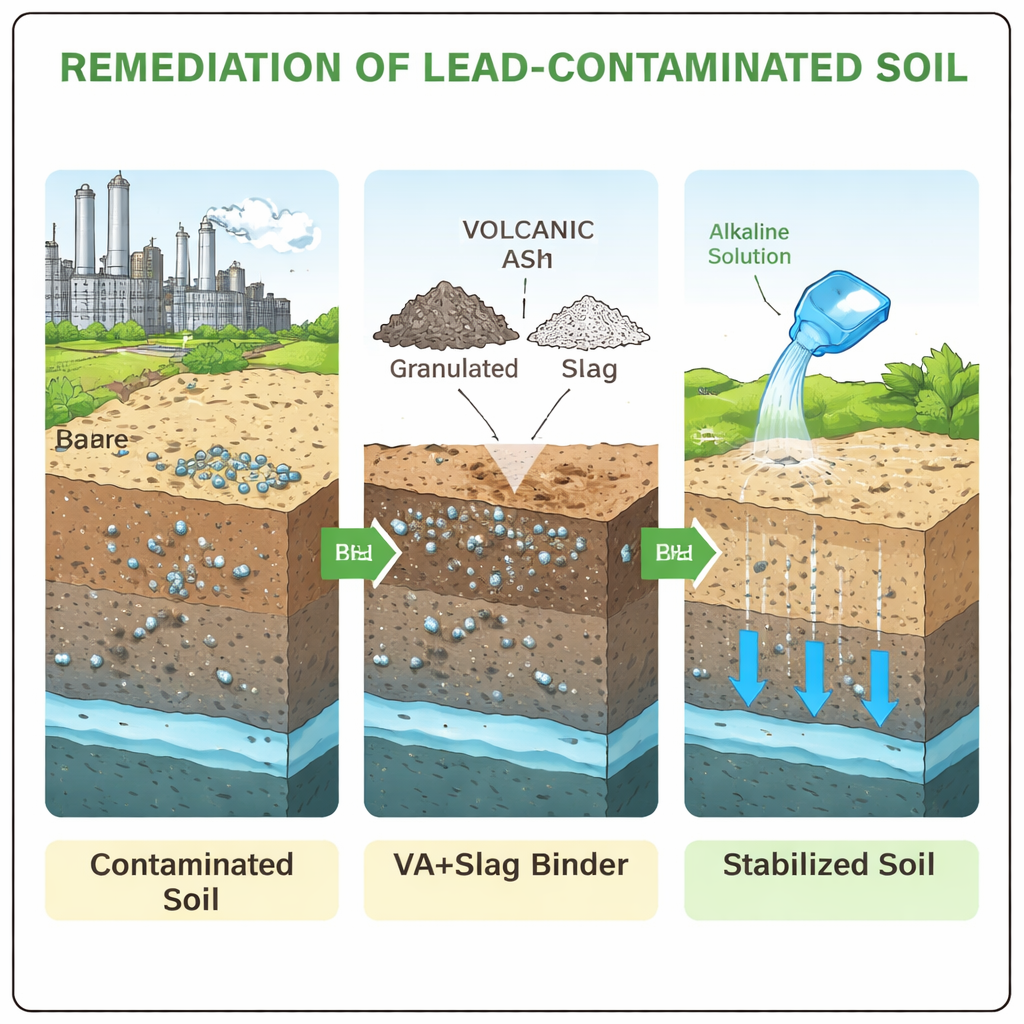
Lead in soil is a silent hazard that can linger for decades around factories, mines, roads, and waste sites, slowly entering food, water, and our bodies. This study explores a promising way to lock that lead safely in place using two inexpensive materials: volcanic ash, a natural powder from ancient eruptions, and slag, a glassy by-product of steelmaking. Together, they form a kind of low‑carbon “artificial rock” that can turn dangerous ground into a much safer, solid mass.
A New Recipe for Safer Ground
The researchers set out to answer a practical question: can we make contaminated soil both safer and stronger using a binder that is cleaner than ordinary cement? Instead of Portland cement, they used an “alkali‑activated” mixture made mostly from volcanic ash, with part of that ash replaced by finely ground blast‑furnace slag. When these powders are mixed with a concentrated sodium hydroxide solution and soil, they react to form a hard, stone‑like network. The team deliberately spiked a real clayey sand with very high levels of lead—five to eight times above typical intervention limits—to test the method under severe conditions. They varied the slag content from 0 to 40 percent of the binder and cured the samples either at room‑like conditions or in a warm oven, then tracked how strong the soil became and how much lead could still wash out.
Stronger Soil That Resists Crumbling
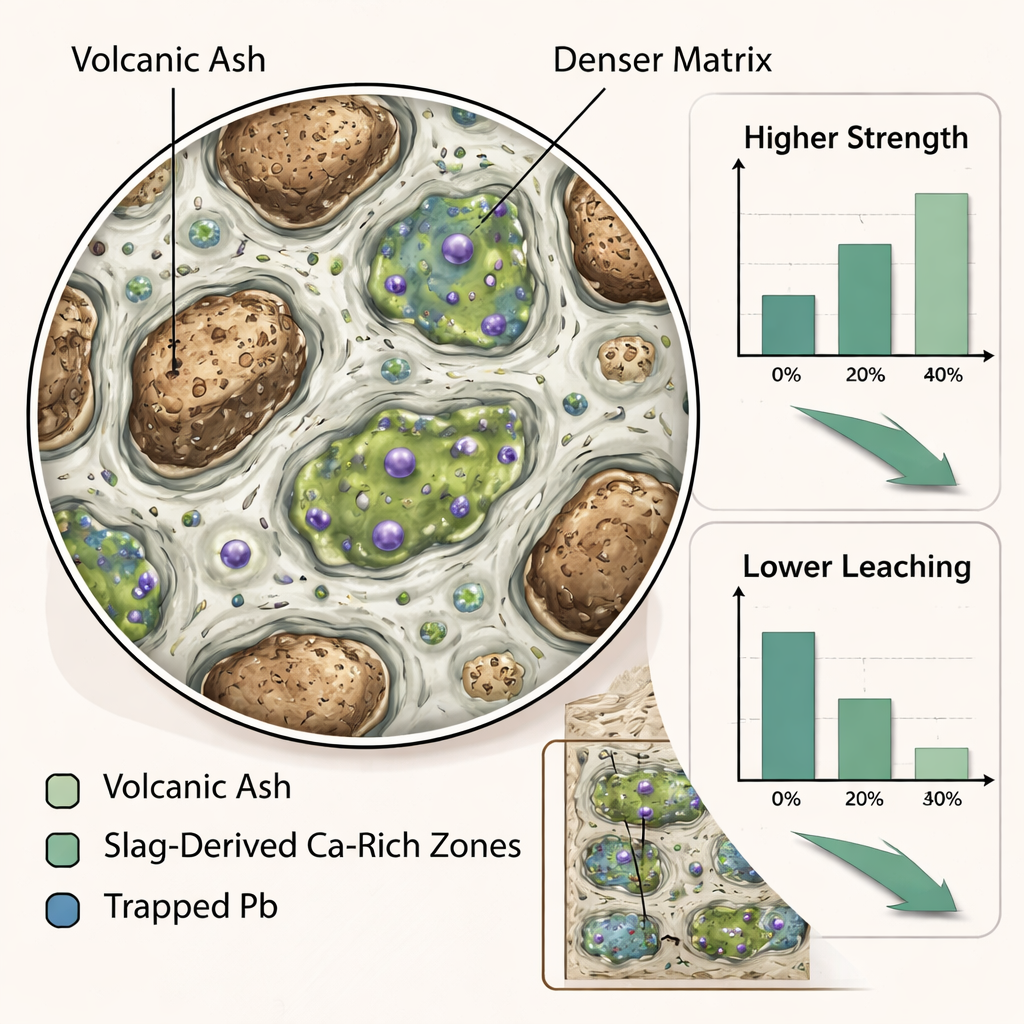
From an engineering standpoint, the hybrid binder turned loose, polluted soil into something closer to a building material. As more slag was added, the hardened soil’s compressive strength rose steadily, especially over longer curing times. With 40 percent slag, oven‑cured samples reached about eight times the strength of untreated soil after 90 days, and even room‑cured samples saw gains of more than 50 percent compared with ash‑only mixes. Lead contamination normally weakens these systems, but slag helped the material “power through” the interference, so that in time, contaminated samples with slag approached the strength of clean ones. Microscopy showed why: the slag encouraged the growth of extra binding gels that filled in pores and microcracks, creating a much denser and more continuous skeleton around the soil grains.
Locking Lead in a Dense Mineral Net
Safety depends on more than strength; the lead must also stay put when rainwater percolates through the ground. In standardized leaching tests, untreated soil released lead at levels far above regulatory limits. Adding a binder made only from volcanic ash already cut that release below the U.S. Environmental Protection Agency threshold. But when 40 percent of the ash was replaced by slag, the improvement was dramatic: more than 99 percent of the lead that could leach from raw soil was held back, with final water concentrations falling below one‑hundredth of the safety limit in the best cases. X‑ray and infrared measurements, along with electron microscope images, revealed that lead was not just trapped in pores but also tied into newly formed mineral‑like gels rich in sodium, aluminum, silicon, and calcium. These gels grew as a continuous film around particles, shrinking pore sizes and physically encapsulating remaining lead.
Balancing Environmental Costs and Benefits
Because the goal is greener clean‑up, the team also ran a life cycle assessment comparing a volcanic‑ash‑only binder with the ash‑and‑slag blend. Swapping in slag trimmed climate‑warming emissions by about five percent for each cubic meter of treated soil and slightly lowered some human‑toxicity indicators. However, the slag‑based option scored somewhat worse in categories tied to ecotoxicity and metal depletion, reflecting both the resource use and impurities associated with steel by‑products. Overall, neither recipe was a clear environmental winner across all measures; instead, each involved trade‑offs between climate benefits and other types of impact.
What This Means for Real‑World Cleanups
For non‑specialists, the take‑home message is that waste volcanic ash and steel slag can be combined to form a tough, rock‑like binder that both strengthens lead‑polluted soils and locks up the metal so it barely moves with water. Under tough laboratory conditions, this hybrid material cut lead leakage by more than 99 percent while greatly boosting soil strength, and it did so with only modest extra environmental cost compared with an ash‑only binder. Before such systems are widely adopted, they must be tested on naturally contaminated sites, under changing weather, and for other metals. Still, the results suggest a practical path toward turning two abundant wastes into tools for safer land and more sustainable remediation.
Citation: Komaei, A., Molaei, M.A. Effect of partial replacement of volcanic ash with slag on the performance of sustainable alkali-activated materials for lead-contaminated soil remediation. Sci Rep 16, 6380 (2026). https://doi.org/10.1038/s41598-026-36132-x
Keywords: lead-contaminated soil, alkali-activated materials, volcanic ash slag binder, soil stabilization, sustainable remediation