Clear Sky Science · en
Recycling treatment of waste oil-based drilling mud in gas fields
Turning Problem Mud into Useful Materials
Modern gas wells rely on thick, oily drilling muds to keep wells stable and equipment running smoothly. But once this mud is used, it becomes a hazardous waste packed with oil, chemicals and sometimes heavy metals. This study shows how that troublesome waste can be transformed into clean water, usable oil and solid building material, turning an environmental liability into a valuable resource.
Why Drilling Mud Waste Matters
Oil and gas development creates huge volumes of waste oil-based drilling mud, a sticky mix of mineral oil, diesel, clays and additives. If this material is dumped without careful treatment, it can contaminate soil and water for many years. At the same time, simply burning or burying it wastes the remaining oil and water locked inside. The authors focused on waste from a gas field in China and asked a simple question: can we design a practical, field-ready process that both protects the environment and recovers useful resources from this mud?
A Three-Step Cleanup and Recycling Chain
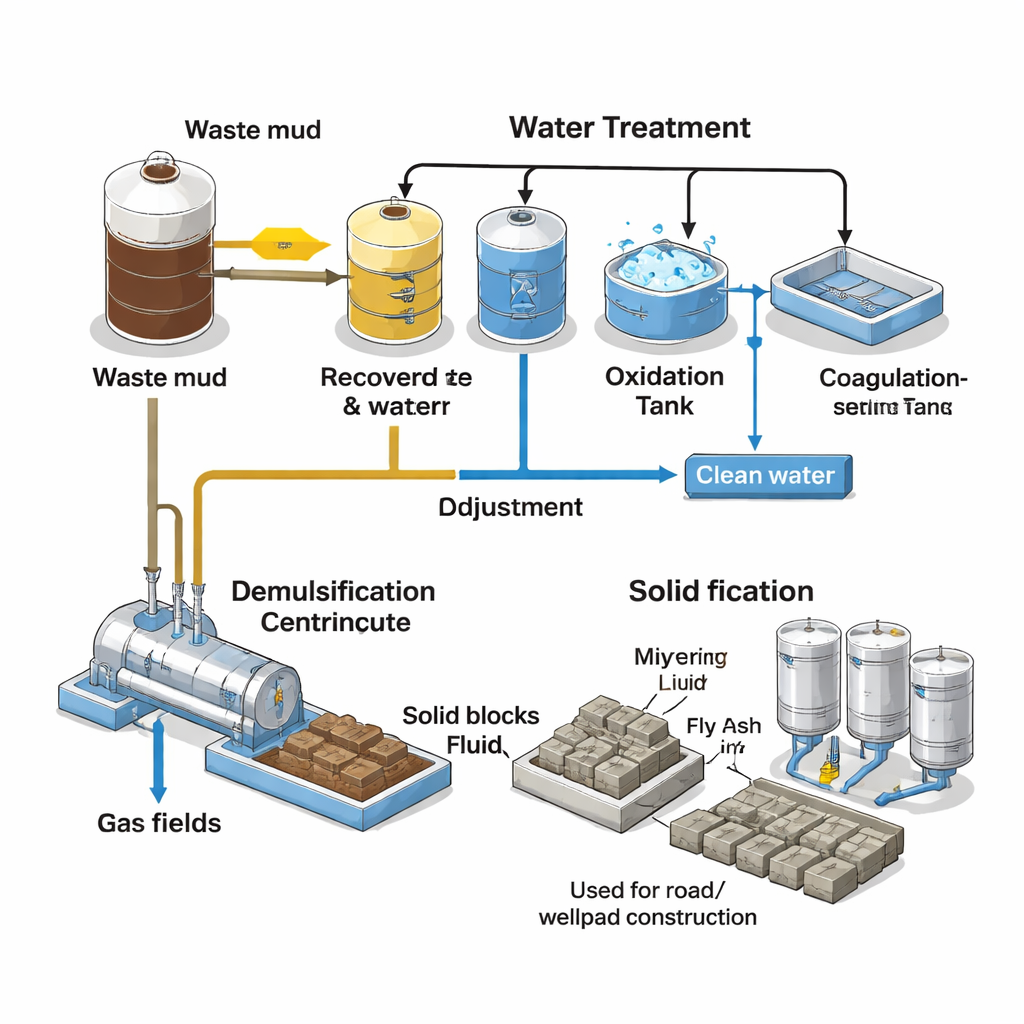
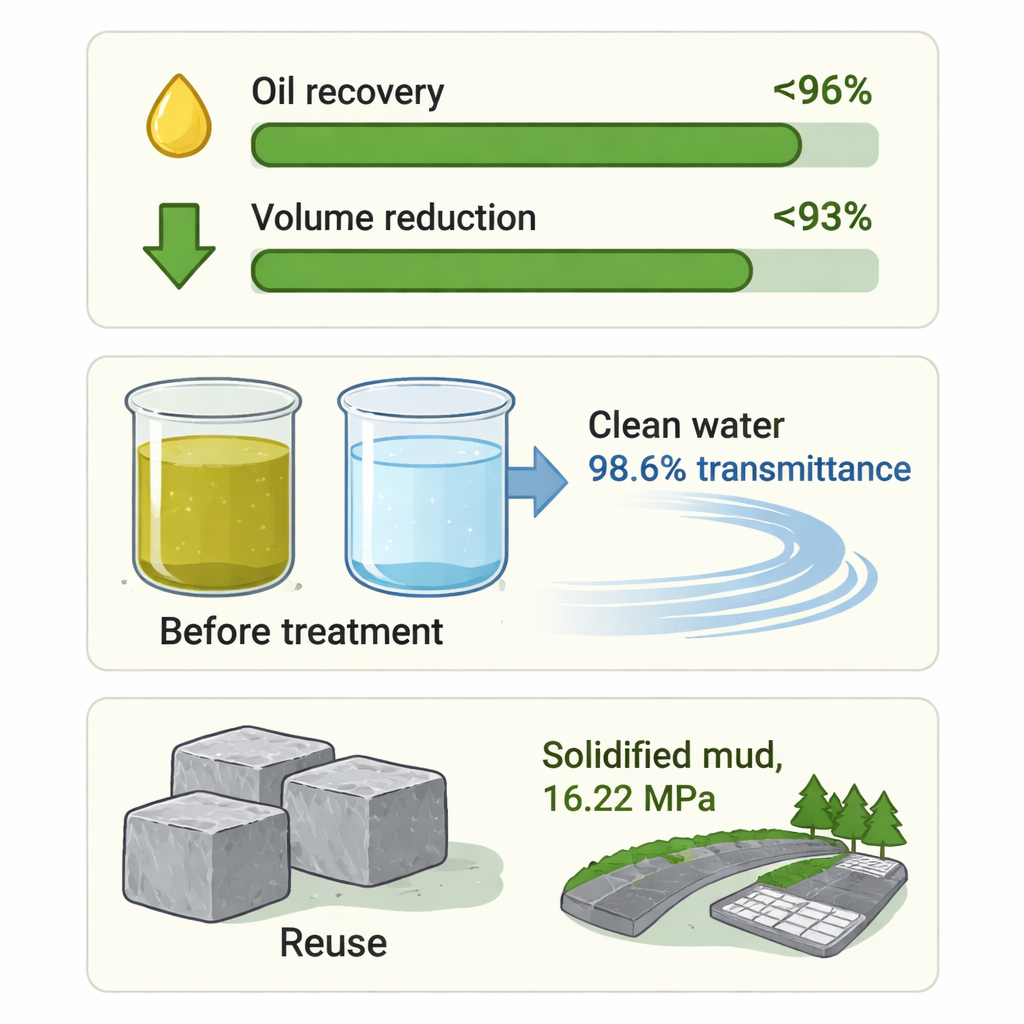
The team built an integrated treatment chain with three main steps: separating the mud, cleaning the water and safely locking up the remaining solids. First, they used a chemical called a demulsifier, gentle heating and a centrifuge to break apart the thick mud. This step allowed the mixture to split into three parts: recovered oil on top, a middle layer of dirty water and a bottom layer of thick, dehydrated mud. The method recovered about 96% of the oil and shrank the volume of waste by more than 93%, leaving only a small amount of solid material to handle. The recovered oil contained very little water and could be reused as fuel.
Cleaning Dirty Water for Reuse
The separated water started out yellow-green, salty and full of organic pollutants and fine particles, making it unusable for new drilling work. To clean it, the researchers first adjusted its acidity, then added an oxidizing chemical (sodium hypochlorite, a relative of household bleach) to break down stubborn contaminants. Next, they raised the pH and added two common water-treatment aids that clump tiny particles together so they can settle out. Through careful testing, they found a recipe that produced very clear water with about 99% light transmittance, low suspended solids and much lower chemical pollution. This “clean water” still had high salt content, but by adding a scale inhibitor they could successfully reuse it to mix fresh fracturing fluid, reducing the need to pump in new freshwater.
Locking Solids into Strong Building Blocks
The remaining dehydrated mud still contained small amounts of oil and trace metals, so simply piling it up would risk slow leakage into the environment. Instead, the team blended it with fly ash, cement and quicklime in different ratios to see which mixtures formed the strongest and safest blocks. The best blend—10% fly ash, 30% cement and 20% quicklime by mass—produced solid blocks with a compressive strength of about 16 megapascals, similar to low-grade concrete. When these blocks were soaked and the leachate was tested, heavy metals were below detection limits and key pollution indicators met China’s wastewater discharge standards. That means the blocks are strong enough for building well pads or access roads and safe enough not to release dangerous substances under normal use.
What This Means for Energy and the Environment
Taken together, this system comes close to a “near-zero discharge” approach for waste drilling mud in gas fields. Most of the oil is recovered as usable fuel, the treated water replaces scarce freshwater in field operations, and the solid residues become construction material rather than landfill waste. The study also shows that this can be done at a competitive cost compared with high-temperature methods like pyrolysis or thermal distillation, and without producing extra air pollution. While the authors note that larger-scale trials and long-term tests are still needed, their work outlines a realistic pathway for gas fields to manage one of their dirtiest waste streams in a cleaner, more circular way.
Citation: Cao, H., Hu, B. Recycling treatment of waste oil-based drilling mud in gas fields. Sci Rep 16, 5778 (2026). https://doi.org/10.1038/s41598-026-36131-y
Keywords: drilling mud, waste recycling, oil and gas, water treatment, solidification