Clear Sky Science · en
Temporal order of activations and interactions during arithmetic calculations measured by intracranial electrophysiological recordings in the human brain
Why your brain’s math timing matters
Even simple sums like 8−3+2 happen astonishingly fast in the brain. But in what order do different brain areas join in, and how do they talk to each other while you calculate? This study used rare, ultra-precise recordings directly from the brains of adults doing step-by-step equations to map, millisecond by millisecond, how the “math network” switches on, coordinates, and then quiets down. Understanding this timing helps reveal how the healthy brain supports everyday skills from paying a bill to reading a graph, and may one day guide better help for people with math difficulties.
Looking inside the brain during live calculations
To capture this hidden activity, the researchers worked with 20 adults with epilepsy who already had thin electrodes placed deep in the brain for clinical reasons. While their brain signals were being recorded, participants solved short arithmetic equations such as 8−3+2, shown one symbol at a time on a screen. The first number mainly required recognizing the symbol, while the second and third numbers required active calculation. The team focused on very fast electrical ripples called high-gamma activity, a reliable sign that local groups of neurons are working hard, and on slow brain rhythms that reveal how distant regions temporarily synchronize while solving a task.
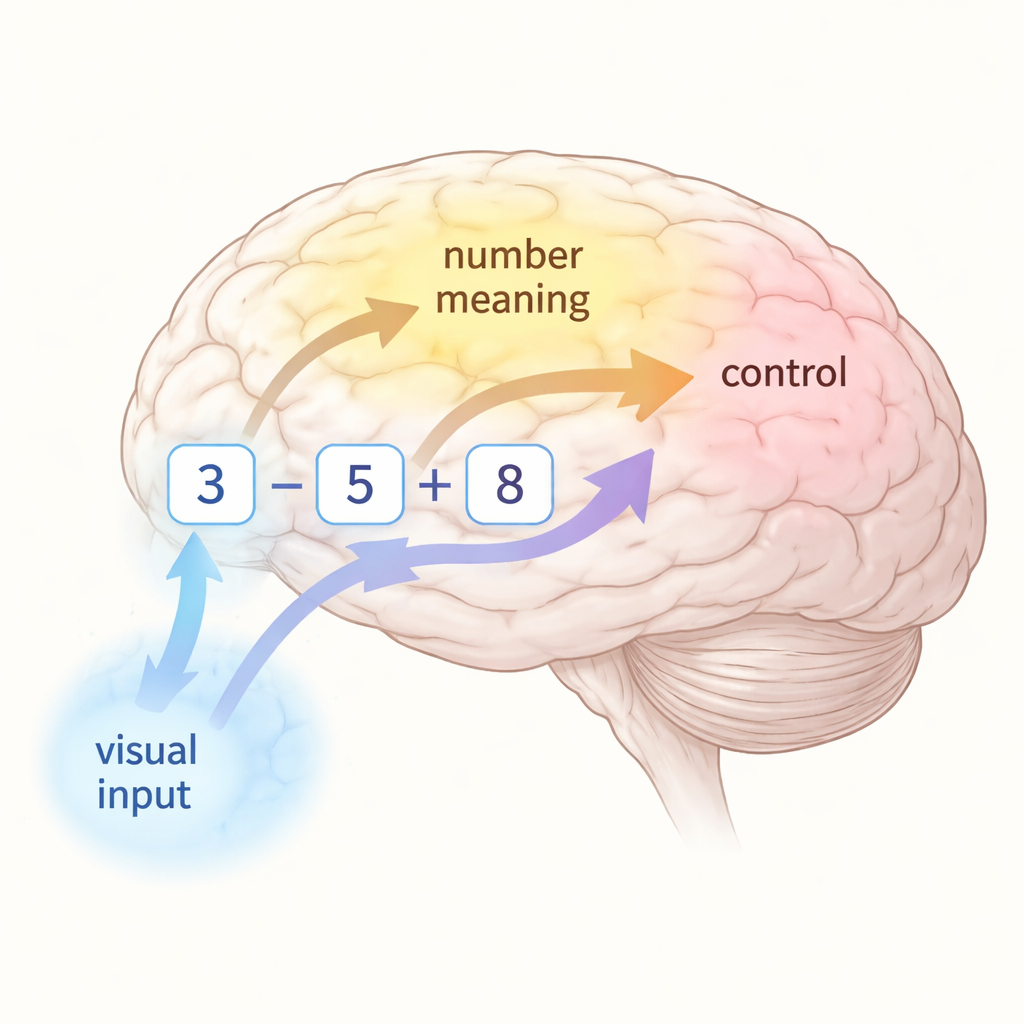
From seeing numbers to working with them
The recordings showed a clear cascade of activity. First, areas at the back and underside of the brain that specialize in visual forms lit up briefly when a number appeared, reflecting quick recognition of the symbol itself. Next, regions along the top and side of the brain, known to support number meaning and quantities, showed a slower, stronger rise in activity as the calculation unfolded. Finally, frontal regions closer to the forehead became more engaged, especially for later steps in the equation, consistent with their role in attention, holding partial results in mind, and deciding whether an answer is correct. At the same time, areas belonging to the so‑called “default mode” network, which are more active during daydreaming or inward focus, became less active, suggesting that resources were being shifted toward the demanding math task.
Abstract numbers, formats, and difficulty
The study also tested whether the brain treats different ways of showing numbers—Arabic digits, written words like “six,” dice patterns, or fingers—as fundamentally different. Surprisingly, most key regions responded in very similar ways regardless of format, hinting that once symbols are recognized, the brain rapidly converts them into a shared, abstract sense of quantity. One parietal region in particular was sensitive to problem difficulty: it worked harder when intermediate results crossed from one decade to another (for example, moving from 45 to 51), a step that typically makes mental arithmetic more effortful. These findings support the idea that this area serves as a core hub for understanding and manipulating numerical magnitude.
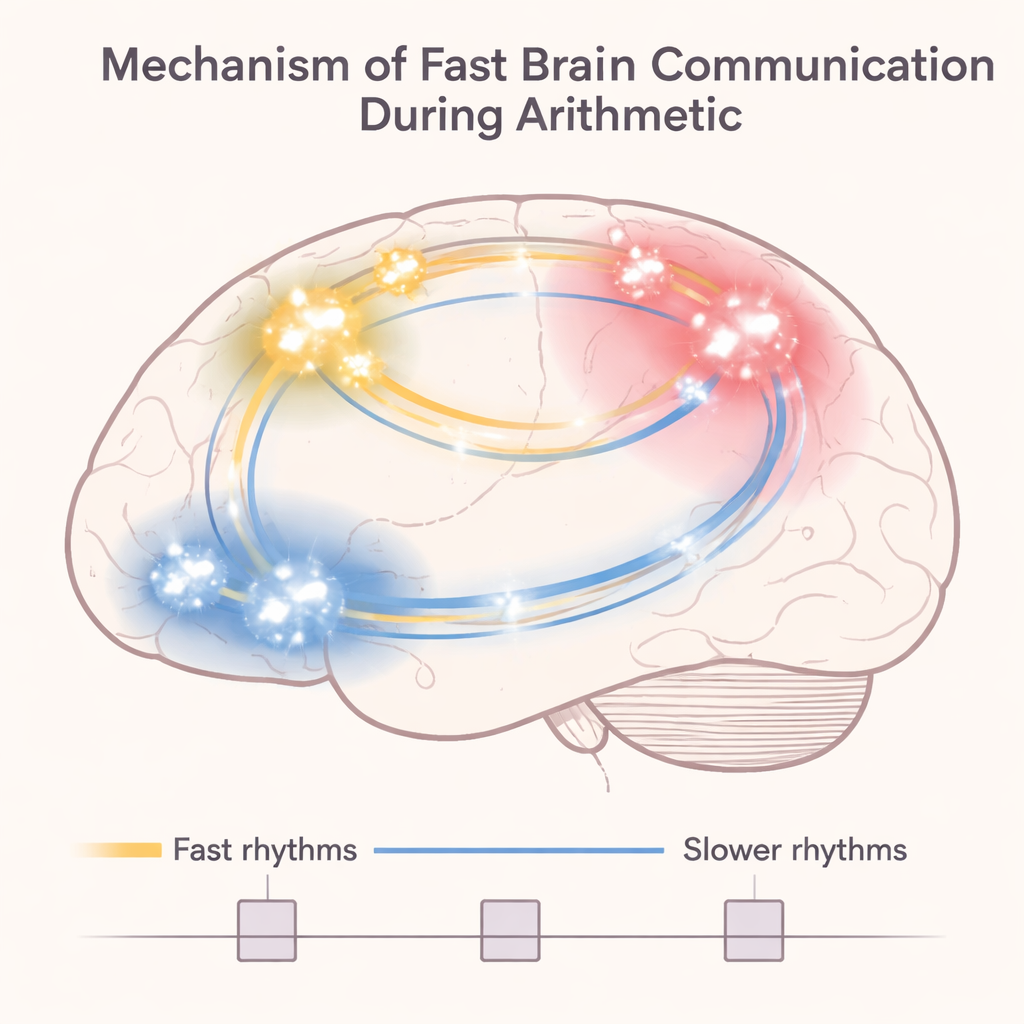
Brainwide conversations during each step
Beyond local activity, the researchers examined functional connectivity—how strongly different regions’ signals rose and fell in sync. During the appearance of each number, connections across the math network briefly strengthened, especially in very slow rhythms called delta and slightly faster theta rhythms. Notably, synchronized theta activity tended to peak earlier than delta, hinting at distinct roles for these rhythms in coordinating brainwide communication. Surprisingly, one of the earliest bursts of connectivity linked visual number areas at the back of the brain directly with frontal control regions, even before those frontal areas reached their peak activity. As the calculation progressed, the pattern expanded to include parietal and sensorimotor regions, forming a stable communication backbone roughly 200–400 milliseconds after each number appeared.
What this means for everyday math
Put simply, the study shows that your brain does math by rapidly passing information from visual regions that recognize numbers, to parietal regions that represent “how much,” and on to frontal regions that manage attention and working memory, all while these areas briefly lock into shared rhythms. Although the work was done in epilepsy patients and compared math to a resting baseline rather than to other thinking tasks, it provides a rare, high‑speed look at the brain’s calculation machinery in action. These insights can help refine theories of how we learn and perform arithmetic, and could eventually inform educational strategies or brain‑based treatments aimed at supporting people who struggle with numbers.
Citation: Kalinova, M., Kerkova, B., Kalina, A. et al. Temporal order of activations and interactions during arithmetic calculations measured by intracranial electrophysiological recordings in the human brain. Sci Rep 16, 5587 (2026). https://doi.org/10.1038/s41598-026-36122-z
Keywords: mental arithmetic, brain networks, intracranial EEG, numerical cognition, functional connectivity