Clear Sky Science · en
Hybrid quantum classical framework for electroencephalogram driven neurological processing in epileptic seizure taxonomy
Why brain waves and quantum tech matter to you
Epileptic seizures can arrive without warning, disrupting daily life, work, and independence. Doctors rely on electroencephalogram (EEG) recordings—tiny electrical signals from the scalp—to spot early signs of trouble. But these signals are noisy and complex, and even advanced computer programs can miss key patterns. This study introduces a new way to read brain waves that mixes today’s best deep‑learning tools with ideas borrowed from quantum computing, aiming for faster, more reliable seizure detection that could one day support real‑time monitoring at the bedside or at home.
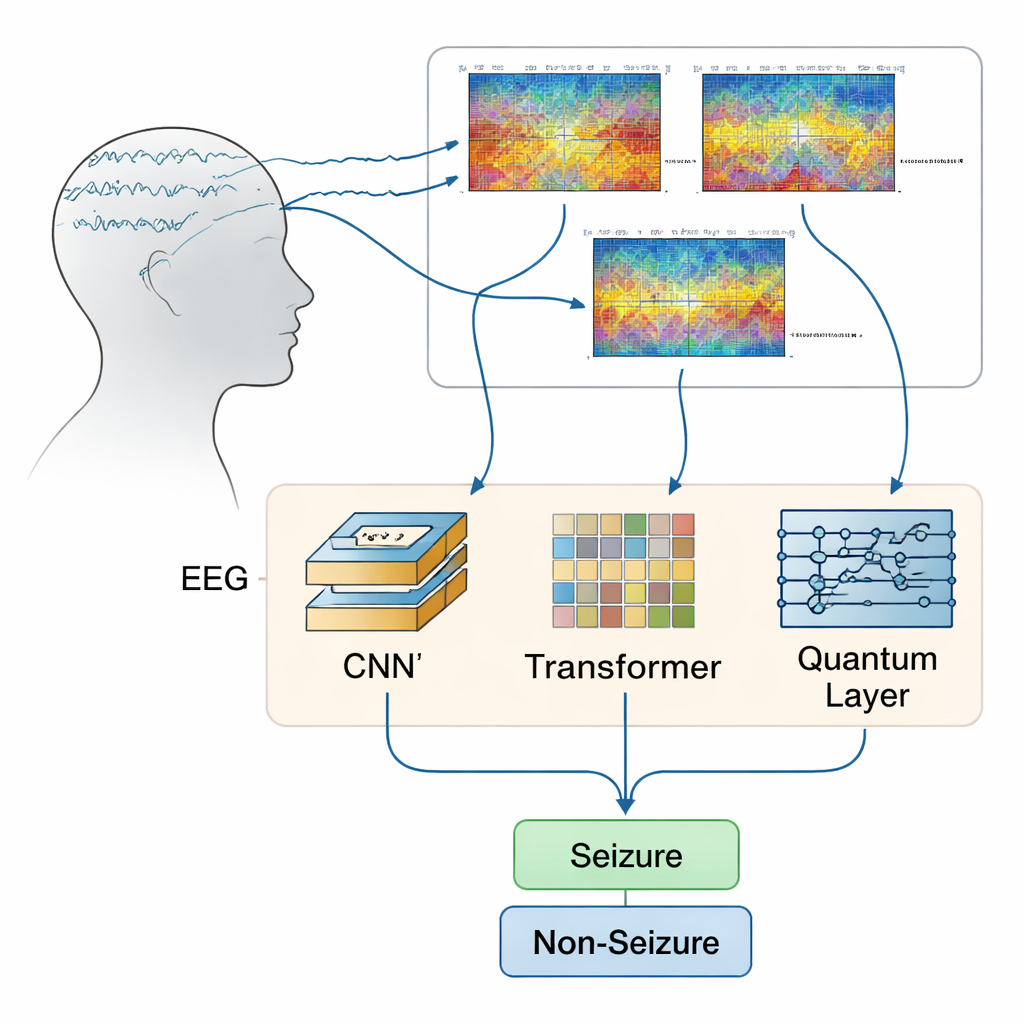
Turning brain waves into pictures
The first step in the authors’ approach is to change how EEG is viewed. Instead of feeding raw squiggly lines directly into a computer model, they transform each segment of EEG into a colorful time‑frequency “scalogram.” This process, called a Continuous Wavelet Transform, shows which rhythms appear at which moments, revealing brief bursts and fast ripples that often signal seizure activity. By converting the data into images, the method taps into powerful tools originally designed for computer vision, allowing patterns in space and time to be captured more clearly and making the brain’s activity easier to interpret.
Blending three smart engines in one model
On top of these EEG images, the team builds a hybrid network they call a Quantum Vision Transformer (QViT). It combines three different pattern‑finding engines. A convolutional neural network (CNN) looks for local shapes and textures in the images, such as sharp spikes or changes in energy. A vision transformer scans the entire image at once, learning longer‑range relationships and context that unfold over time. The third engine is a small quantum‑inspired layer, based on simulated quantum circuits, which is designed to capture subtle, higher‑order relationships that may be hard for classical networks to model. Together, these branches produce a rich, shared representation that feeds a final classifier tasked with deciding whether a given EEG segment reflects a seizure or not.
How quantum ideas enter the picture
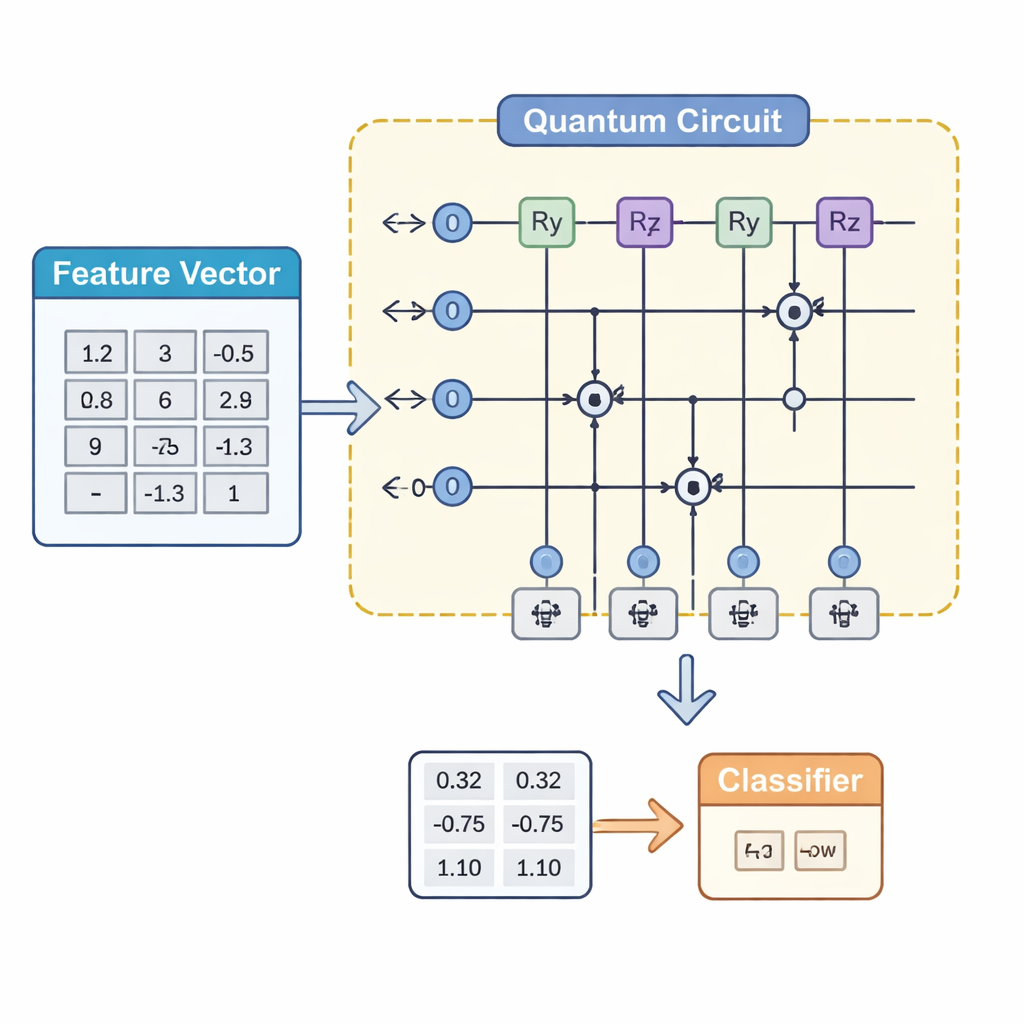
The quantum‑inspired part of the model takes a compact set of numbers from the earlier layers and encodes them into simulated quantum bits, or qubits. Within this space, the data are transformed by a sequence of rotation and entangling operations, then measured to produce new features. Although the study runs entirely on a quantum simulator rather than on real quantum hardware, it uses the same principles: multiple states can be explored at once, and correlations across the data can be represented in ways that are difficult to mimic with conventional layers. These quantum‑derived features are then joined with the CNN and transformer outputs, helping the combined system draw sharper boundaries between seizure and non‑seizure activity.
Testing on real seizure data
To see whether this hybrid design makes a practical difference, the researchers evaluated QViT on two widely used EEG collections for epilepsy research: the CHB‑MIT and Bonn datasets. They split the data into training and testing sets, carefully balanced seizure and non‑seizure examples, and applied extensive but controlled data augmentation to mimic real‑world variability without distorting the underlying brain activity. During training, they used modern optimization tricks—such as adaptive learning rates, label smoothing, and early stopping—to keep the model from over‑fitting. The final system achieved about 99% accuracy and similarly high F1‑scores on the test data, with very few false alarms or missed seizures. Additional checks, including reliability curves and visual maps of the learned feature space, suggested that the model’s confidence scores are well calibrated and that seizure and non‑seizure signals form clearly separated clusters in its internal representation.
What this could mean for future care
For patients and clinicians, these results point to a possible next generation of seizure‑detection tools that are both more accurate and more trustworthy. By fusing detailed time‑frequency pictures of brain activity with complementary deep‑learning blocks and a quantum‑inspired layer, the framework offers strong performance without giving up interpretability: clinicians can still relate decisions back to familiar EEG patterns. While the current work runs on simulated quantum hardware and focuses on a simple yes‑or‑no seizure decision, the same ideas could be extended to distinguish between different seizure types or to run continuously on wearable devices. In the long term, hybrid quantum‑classical approaches like this one may help turn raw brain waves into timely, actionable alerts that improve safety and quality of life for people living with epilepsy.
Citation: Padmaja, B., Maram, B., Raheem, A.K.A. et al. Hybrid quantum classical framework for electroencephalogram driven neurological processing in epileptic seizure taxonomy. Sci Rep 16, 5305 (2026). https://doi.org/10.1038/s41598-026-36121-0
Keywords: epileptic seizures, EEG analysis, quantum-inspired learning, deep neural networks, seizure detection