Clear Sky Science · en
Fabrication of anisotropic magnetic helical microswimmers utilizing Spirulina platensis templates and their integration with Janus PCL/Chitosan nanoparticles
Microscopic Swimmers with a Big Mission
Imagine fleets of tiny, corkscrew-shaped robots swimming through the bloodstream, steered from outside the body by magnets and carrying cancer drugs directly to tumors. This study brings that vision a step closer to reality by building biohybrid “microswimmers” from a common spiral-shaped microalga, Spirulina, and specially designed magnetic nanoparticles. The work shows how to make these swimmers efficiently, how to load them with a chemotherapy drug, and how their shape affects how fast and how far they can travel in realistic biological fluids.
Turning Spirals from Nature into Tiny Machines
At the heart of this research is a clever shortcut: instead of painstakingly sculpting microscopic screws in the lab, the team borrows a ready-made spiral from nature. Spirulina, best known as a health supplement, is actually a helical (spring-like) microalga. The researchers coat these natural spirals first with iron oxide to make them magnetic and then with a thin layer of silica glass to protect them and add a porous, stable surface. This turns each Spirulina filament into a robust magnetic tail that keeps its spiral shape even in demanding environments, and whose length and number of turns can be tuned by brief ultrasound treatment that snips the filaments into shorter segments. 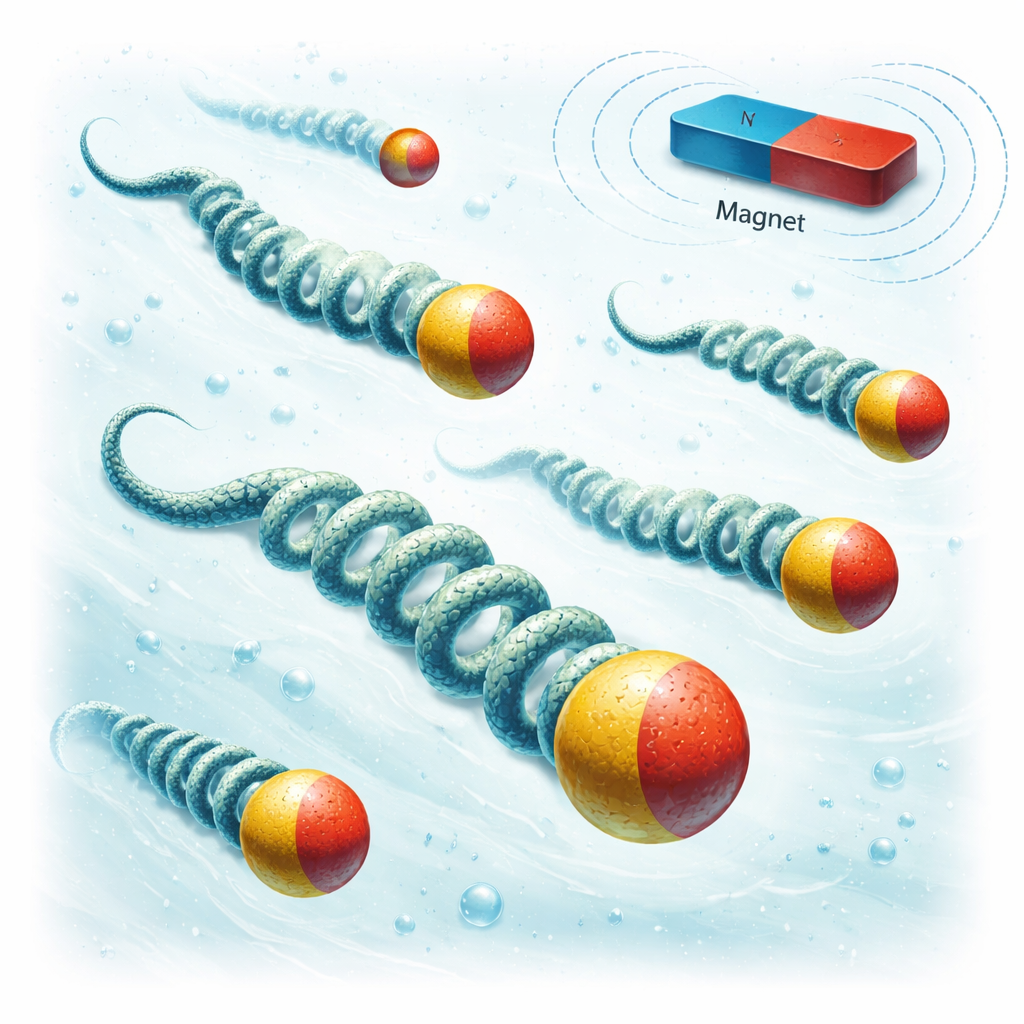
A Two-Faced Head for Smart Cargo
To turn a simple magnetic spiral into a true microswimmer, the scientists add a distinct head made from so‑called Janus nanoparticles—tiny spheres with two very different faces. One half is made of polycaprolactone, a biodegradable plastic that prefers oily environments, and the other half is chitosan, a sugar-based material that mixes well with water and is friendly to cells. Inside these polymer shells sits a magnetic iron oxide core. By carefully controlling the chemistry, the team decorates one side of each nanoparticle with silane groups that can latch onto the silica-coated Spirulina tail. Using a polymer film as a soft mask, they ensure that only one end of each helix sticks out of the film and can bond to the Janus particles. The result is an asymmetric “head–tail” architecture much like a tiny sperm cell or screw with a bulb at one end.
Swimming Under Magnetic Control
When these biohybrid swimmers are placed in a rotating magnetic field, their iron-rich tails and heads try to align with the field and start spinning. Because the tail is helical, this rotation is converted into forward corkscrew motion—similar to how a boat’s propeller pushes water. The researchers systematically compared swimmers of three sizes, corresponding to different numbers of spiral turns, in water and in protein-rich liquids that mimic blood and serum. They tracked individual paths under a microscope and calculated both average speed and how widely the swimmers spread out over time. Longer helices with more turns consistently moved faster and diffused more efficiently, reaching speeds of about 65 micrometers per second in water under a rotating field. In thicker, more realistic fluids the swimmers slowed down, but those with multiple turns still outperformed shorter or poorly formed spirals, revealing that helix length and turn count are key design knobs for future medical microrobots. 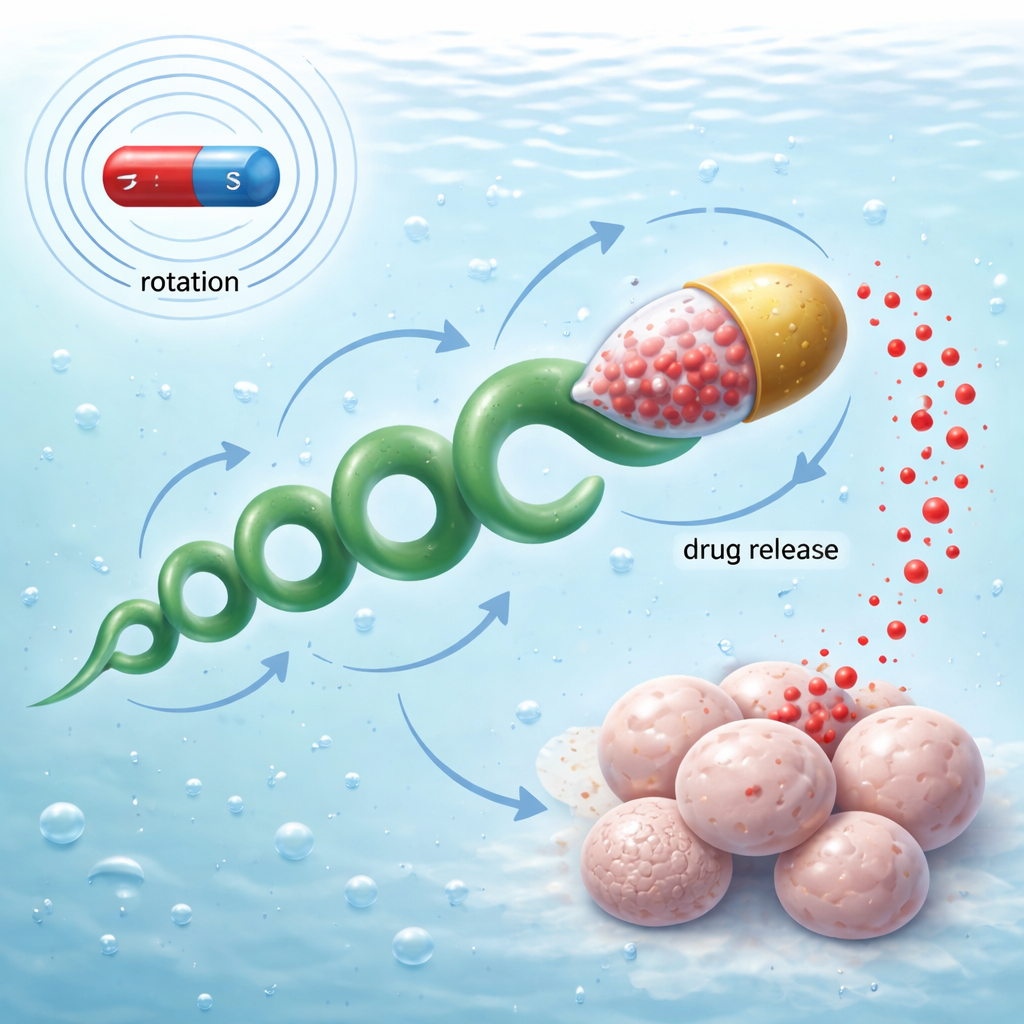
Carrying and Releasing a Cancer Drug
Beyond motion, the team tested whether the Janus heads could act as miniature drug carriers. They loaded them with the chemotherapy agent doxorubicin and measured how much drug could be packed in, how tightly it was held, and how quickly it leaked out. The particles held a respectable fraction of drug and released it more rapidly in slightly acidic conditions, similar to those around many tumors, than at normal blood pH. In cell culture tests with melanoma cells, drug-free swimmers showed little toxicity, indicating good biocompatibility of the materials themselves. When loaded with doxorubicin, however, they reduced cancer cell viability in a dose-dependent manner, though more gently than free drug, consistent with a slower, sustained-release behavior from the nanoparticle matrix.
From Lab Concept to Future Therapies
To a layperson, the main outcome of this work is that researchers have built a tiny, magnetically steerable “delivery truck” whose body comes from algae and whose head is a smart, two-faced nanoparticle. They show that these swimmers can move efficiently in realistic fluids, that making them longer and more coiled improves their propulsion, and that they can safely carry and release a common cancer drug in a controlled way. While these experiments were done in the lab and not yet in animals or people, the platform offers a practical recipe and clear design rules for future medical microrobots that might one day navigate the body, sense disease, and deliver therapies exactly where they are needed.
Citation: Jahani, M., Khoee, S. & Mirmasoumi, M. Fabrication of anisotropic magnetic helical microswimmers utilizing Spirulina platensis templates and their integration with Janus PCL/Chitosan nanoparticles. Sci Rep 16, 6426 (2026). https://doi.org/10.1038/s41598-026-36118-9
Keywords: microswimmers, magnetic microrobots, Spirulina, drug delivery, nanoparticles