Clear Sky Science · en
Energy optimization of PV systems under partial shading conditions using various technique-based MPPT methods
Why smarter solar panels matter
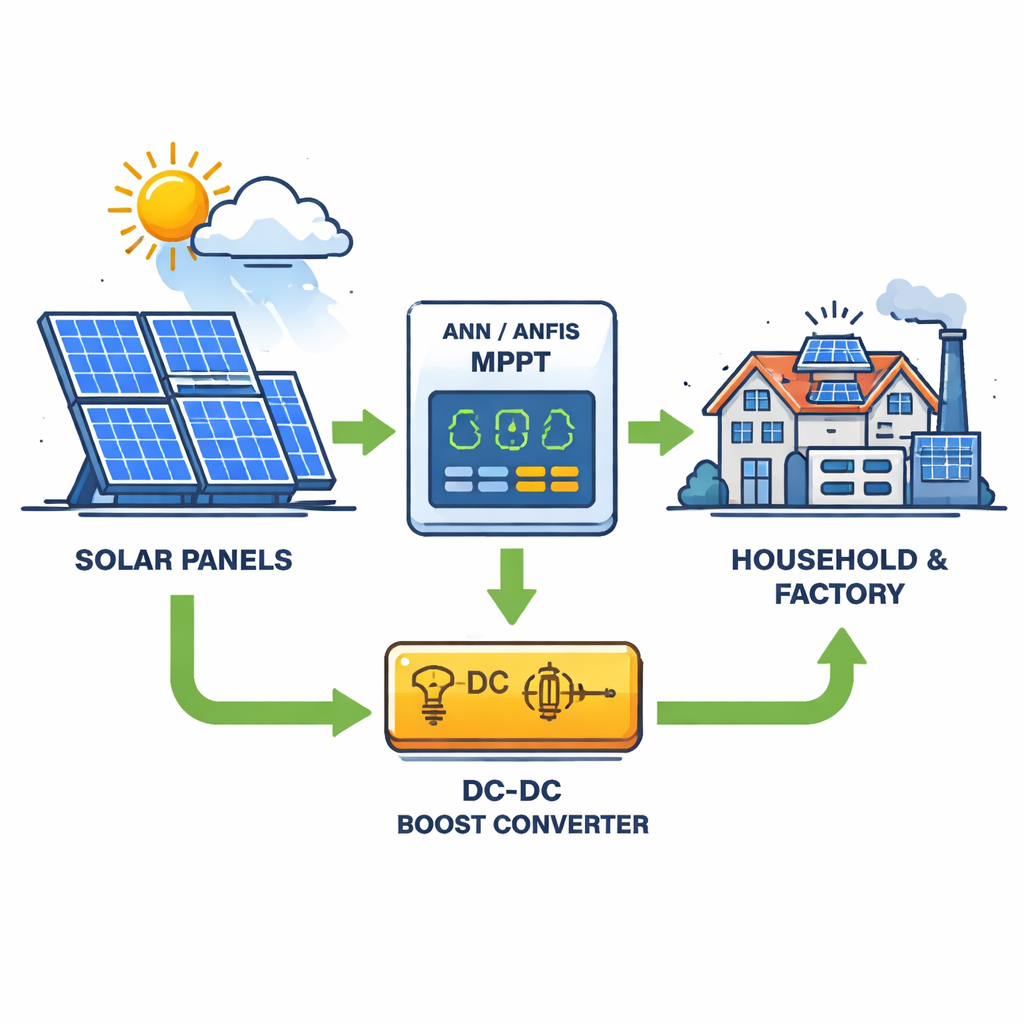
Rooftop and utility‑scale solar panels are becoming one of the main ways we power homes, cities, and even hospitals. But in the real world, panels are often partly shaded by clouds, nearby buildings, or dirt, which quietly eats away at how much energy they produce. This paper explores how “intelligent” control methods—drawing on artificial intelligence—can help solar installations squeeze out nearly every possible watt, even under tricky, ever‑changing conditions.
The hidden problem of uneven sunlight
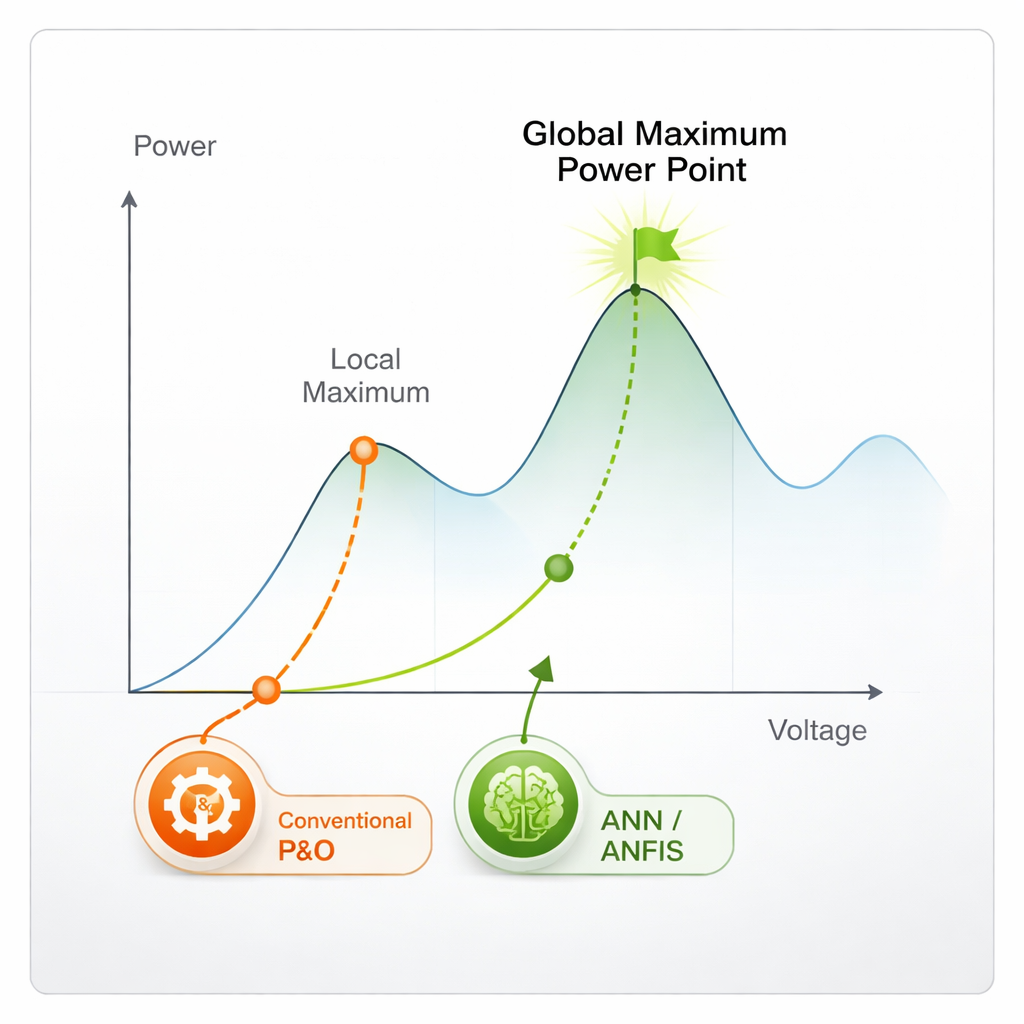
Solar panels don’t behave in a simple, linear way: as their voltage changes, the power they produce follows a curved, often bumpy pattern. Under ideal, full‑sun conditions this curve has a single clear peak, the point where the system delivers maximum power. Under partial shading, however, several smaller peaks can appear. Standard controllers may lock onto one of these “false” peaks instead of the true global maximum, wasting 5–15% of potential energy or more. Temperature swings add another layer of complexity, constantly shifting where the maximum power point sits. With global solar capacity already above 630 gigawatts and expected to more than double by 2030, these hidden losses translate into major missed savings and unnecessary infrastructure costs.
How solar systems hunt for the sweet spot
To keep panels operating at their best point, solar systems use maximum power point tracking (MPPT) controllers. Traditional methods, such as perturb‑and‑observe (P&O) or incremental conductance, nudge the operating voltage up or down and watch whether power rises or falls. These methods are simple and cheap, but they have drawbacks: they can be slow to react to sudden weather changes, they tend to jitter around the optimum instead of settling cleanly, and under partial shading they may confuse a local bump in the curve with the true optimum. In large, grid‑connected or off‑grid systems, this inefficiency affects not only energy yield but also the size of batteries and backup generators that planners must install.
Teaching controllers to “recognize” the best point
The authors propose two smarter MPPT controllers based on artificial neural networks (ANN) and an adaptive neuro‑fuzzy inference system (ANFIS). Instead of blindly stepping through trial‑and‑error, these controllers are trained to recognize patterns in how panel power and voltage change. They use two simple signals: how power changes as voltage changes, and how fast the voltage itself is changing over time. From these, the AI predicts in a single step what control action the DC–DC converter should take to land near the true maximum power point. Training data come from detailed computer simulations where a refined version of the conventional P&O method first finds the exact best point. The AI then learns a direct mapping from the observed behavior of the panels to the correct control signal, without copying the limitations of the older algorithm.
Putting intelligent control to the test
Using a simulated solar array exposed to realistic swings in sunlight and temperature, the researchers compared their ANN and ANFIS controllers to the standard P&O approach. Under uniform sunlight, both AI‑based controllers quickly drove the system close to the theoretical maximum, with the neural‑network controller reaching about 99.5% of the best possible power and the ANFIS controller reaching about 99.75%. They did so around four to six times faster than P&O and with far less “wiggle” in voltage, current, and the converter’s control signal, meaning smoother, more stable power. Under partial shading—where several competing peaks appear on the power curve—the advantage became more striking. The conventional controller often settled on a smaller peak, while both AI controllers homed in on the global maximum, delivering roughly 35% more power than P&O in the tested shading case. Importantly, these gains came with very low computational effort: each control step could be calculated in less than 0.2 milliseconds, making the methods suitable for low‑cost hardware.
What this means for future solar power
For non‑specialists, the key takeaway is simple: smarter control electronics can turn the same solar panels into a noticeably more productive power plant, especially when conditions are less than perfect. By using compact AI models that respond quickly and avoid getting stuck at false peaks, the proposed ANN and ANFIS controllers help panels harvest nearly all available energy, reduce wear on power electronics, and cut the cost of solar power over a system’s lifetime. Among the two, the ANFIS approach edges ahead in accuracy and smoothness, while the ANN is nearly as effective and slightly simpler. Together, they show how a modest dose of artificial intelligence inside the inverter can make solar energy more reliable, affordable, and attractive for both homes and large‑scale projects.
Citation: Benabdallah, N., Belabbas, B., Tahri, A. et al. Energy optimization of PV systems under partial shading conditions using various technique-based MPPT methods. Sci Rep 16, 5128 (2026). https://doi.org/10.1038/s41598-026-36117-w
Keywords: solar energy, photovoltaic systems, maximum power point tracking, artificial intelligence control, partial shading