Clear Sky Science · en
Performance, combustion, emission and optimization characteristics of biodiesel–n-butanol blends enriched with Ni2O3 nanoparticles in a diesel engine
Cleaner truck engines without a full redesign
Heavy-duty diesel engines move food, goods, and people, but they also spew soot and greenhouse gases. Replacing every diesel engine with electric drives or hydrogen overnight is unrealistic, so engineers are searching for ways to make existing engines cleaner and more efficient. This study explores a promising route: blending renewable biodiesel and plant-derived alcohol with tiny metal oxide particles to squeeze more useful work out of each drop of fuel while cutting harmful emissions—all without changing the engine hardware. 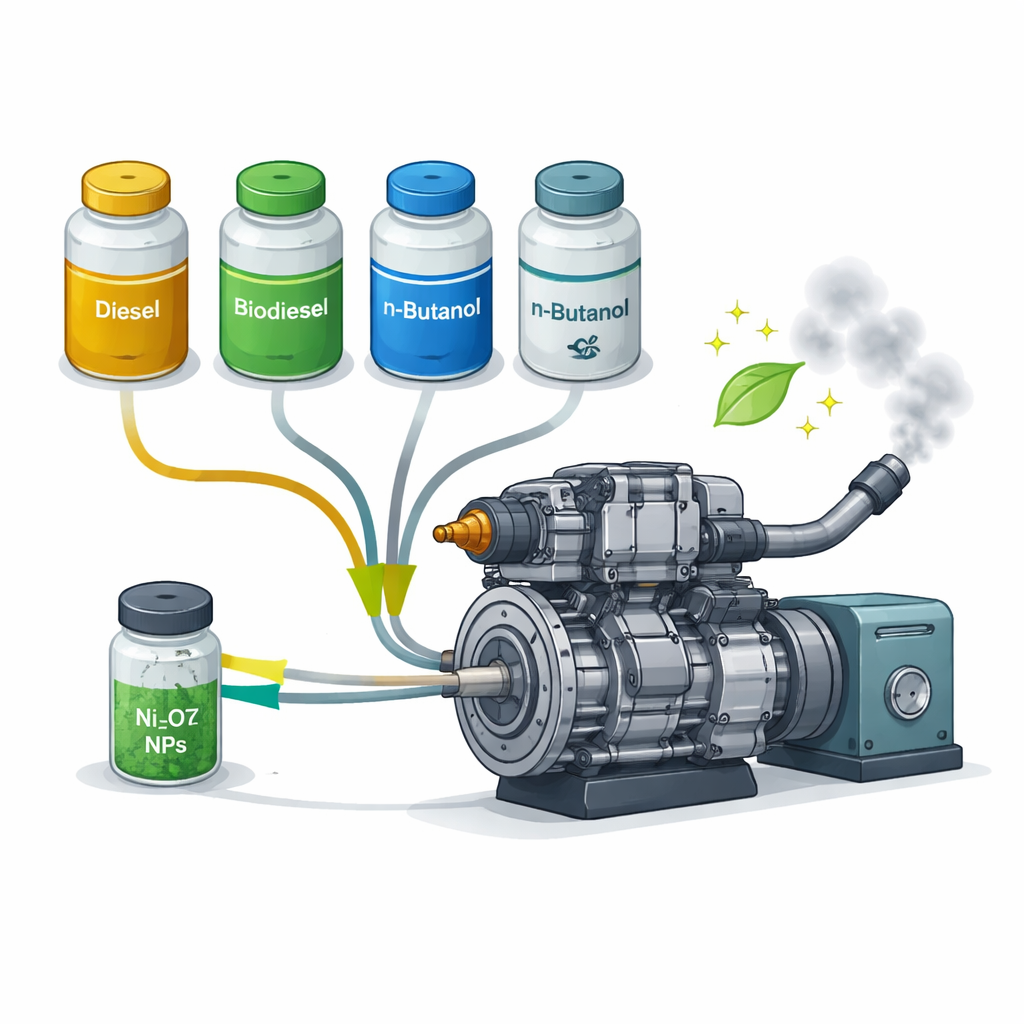
Mixing cleaner fuels with tiny helpers
The researchers focused on fuels that can be used right away in today’s diesel engines. They started with B20, a widely used blend of 20% biodiesel and 80% conventional diesel, and a second blend called B20But10, which adds 10% n-butanol, an alcohol that can be made from biomass. To these fuels they added extremely small particles of nickel(III) oxide (Ni₂O₃), known as nanoparticles, in amounts up to 100 parts per million—just a few drops worth of solid per ton of fuel. Because nanoparticles can act like microscopic combustion catalysts and heat conductors, the team investigated whether they could help the fuel burn more completely and more evenly inside the cylinder.
Putting novel fuel blends to the test
The team ran a single-cylinder diesel engine, similar to those used in generators and small machinery, at a constant speed but with different load levels, from light work to full power. They compared plain B20 and B20But10 with versions doped with various levels of Ni₂O₃. Before testing, they carefully checked that the particles were well dispersed and that the fuel stayed stable for weeks. They then measured how pressure and temperature rose in the cylinder during each firing cycle, how much fuel was needed to produce a unit of power, and what came out of the exhaust—gases such as carbon monoxide (CO), unburned hydrocarbons (HC), nitrogen oxides (NOx), smoke, and carbon dioxide (CO₂). To make sense of the many combinations of load and nanoparticle level, they used a statistical tool called response surface methodology to build mathematical models and search for the best trade-offs between efficiency and emissions.
How nanoparticles change the burn
The in-cylinder measurements showed that adding Ni₂O₃ subtly reshaped the combustion process. At the highest nanoparticle dose and full load, peak cylinder pressure climbed to about 56 bar for both fuel types, and the maximum rate at which heat was released also rose. At the same time, the delay between injecting the fuel and the start of ignition shortened by several crank-angle degrees. In practical terms, the tiny particles appear to help the fuel evaporate and mix with air more quickly, and then burn in a more energetic but still controlled way. Despite this more vigorous burn, the rate at which pressure rose in the cylinder stayed within safe limits, indicating no increase in knocking or mechanical stress. 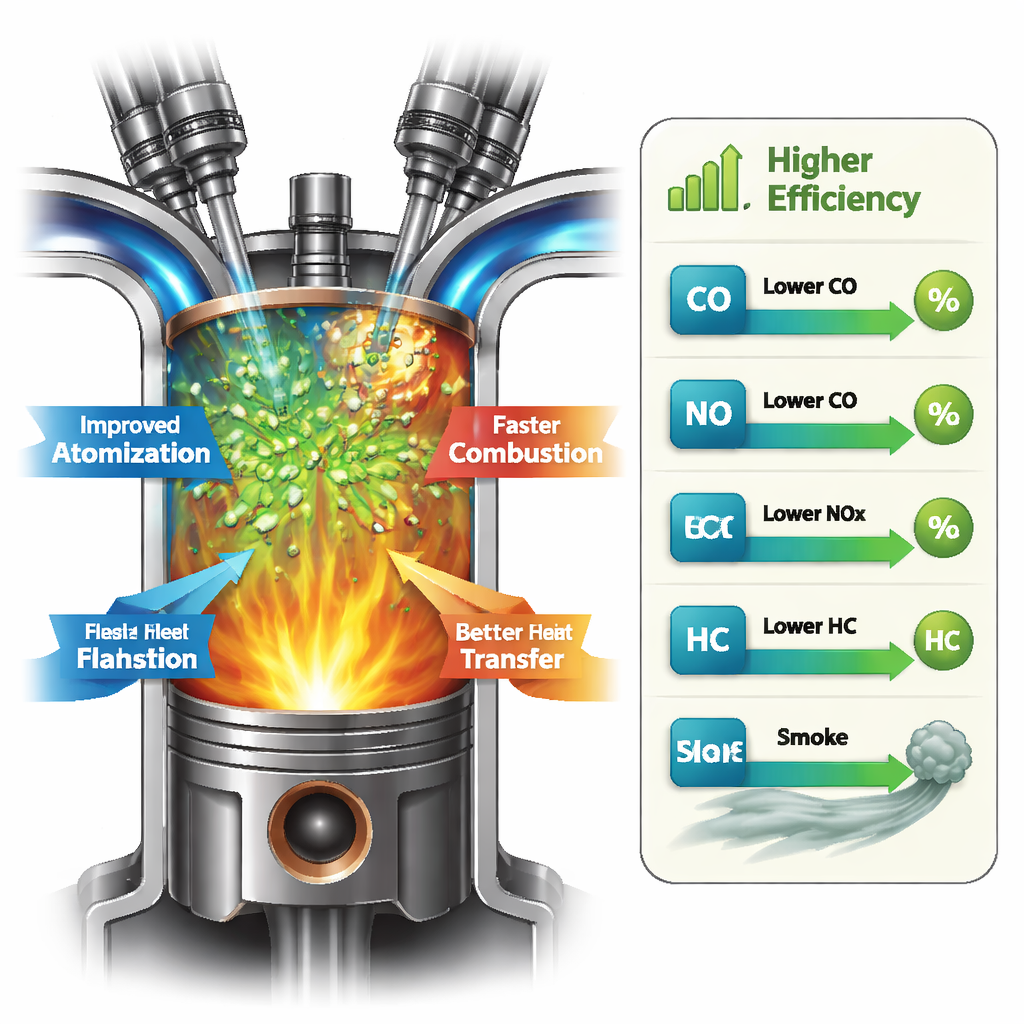
More power per drop and cleaner exhaust
From an energy and fuel-economy standpoint, the results were encouraging. At full load, brake thermal efficiency—the share of fuel energy turned into useful shaft power—rose from about 24.0% to nearly 24.9% for both blends when 100 ppm of Ni₂O₃ was used. Fuel consumption per unit of power dropped by around 7% for B20 and 4% for the butanol-containing fuel at the best nanoparticle levels, with the optimum typically around 50–75 ppm. Exhaust measurements showed that CO fell to roughly one-third of its original value, HC dropped by 13–28%, smoke by 8–43%, and NOx by 12–21%, depending on operating conditions. CO₂ emissions increased slightly, which the authors interpret as a sign that more of the carbon in the fuel was fully burned rather than escaping as more harmful partial combustion products.
Finding the sweet spot and what it means
Because higher nanoparticle doses eventually bring diminishing or even negative returns—such as slight rebounds in some emissions and long-term stability concerns—the team used their statistical models to locate practical "sweet spots." For typical operating loads, they found that Ni₂O₃ levels between about 50 and 75 ppm delivered most of the benefits: better efficiency, cleaner exhaust, and lower overall fuel cost, with an estimated saving of around 15–16% compared with baseline fuel once improved efficiency is included. While questions remain about long-term engine wear and environmental impacts of nickel-based particles, this work suggests that carefully formulated nanofuels based on existing biodiesel blends could be a realistic step toward cleaner trucking and power generation, buying time as fully fossil-free systems scale up.
Citation: Avcı, A.S., Yavaşoğlu, S.F. Performance, combustion, emission and optimization characteristics of biodiesel–n-butanol blends enriched with Ni2O3 nanoparticles in a diesel engine. Sci Rep 16, 5608 (2026). https://doi.org/10.1038/s41598-026-36115-y
Keywords: biodiesel, nanoparticles, diesel engine, butanol, exhaust emissions