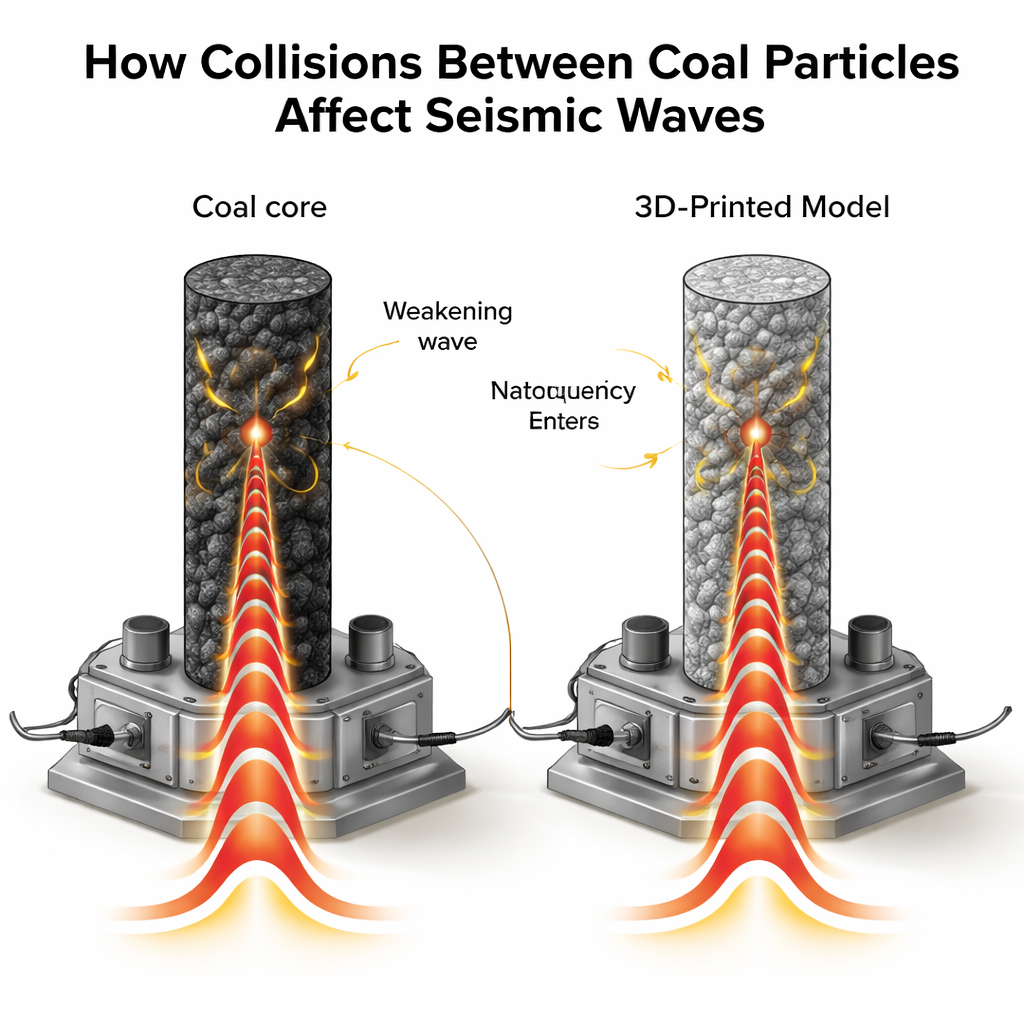
When engineers search for oil, gas, or build tunnels, they rely on seismic waves—small vibrations sent through the ground—to reveal what lies below. But these waves do not travel unchanged: they slow down and lose energy as they pass through different rocks. This study explores how dry coal, especially the tiny grains that make up its skeleton, reshapes those waves. By combining careful lab measurements with computer simulations, the authors show how grain collisions, friction, and grain-size mix in coal control the speed and fading of seismic waves, offering clues for better underground imaging and safer resource extraction. Figure 1.
Shaking small samples to probe big questions
The researchers started with real pieces of coal from two coal basins in China: a high-rank coal that is more compact and mature, and a low-rank coal that is younger and looser. They cut these coals into small cylinders and also made matching cylinders using two 3D-printing materials: a rubbery photosensitive resin and a stiffer plastic called PLA. All samples were carefully dried, sealed, and instrumented with strain gauges, then mounted in a custom low-frequency testing system that gently squeezed them back and forth at frequencies from 1 to 250 hertz—roughly the same band used in seismic surveys. By comparing how much the samples stretched and compressed, the team could calculate how fast compressional waves (P-waves) travel through each sample and how strongly those waves are damped.
What coal looks like under the microscope
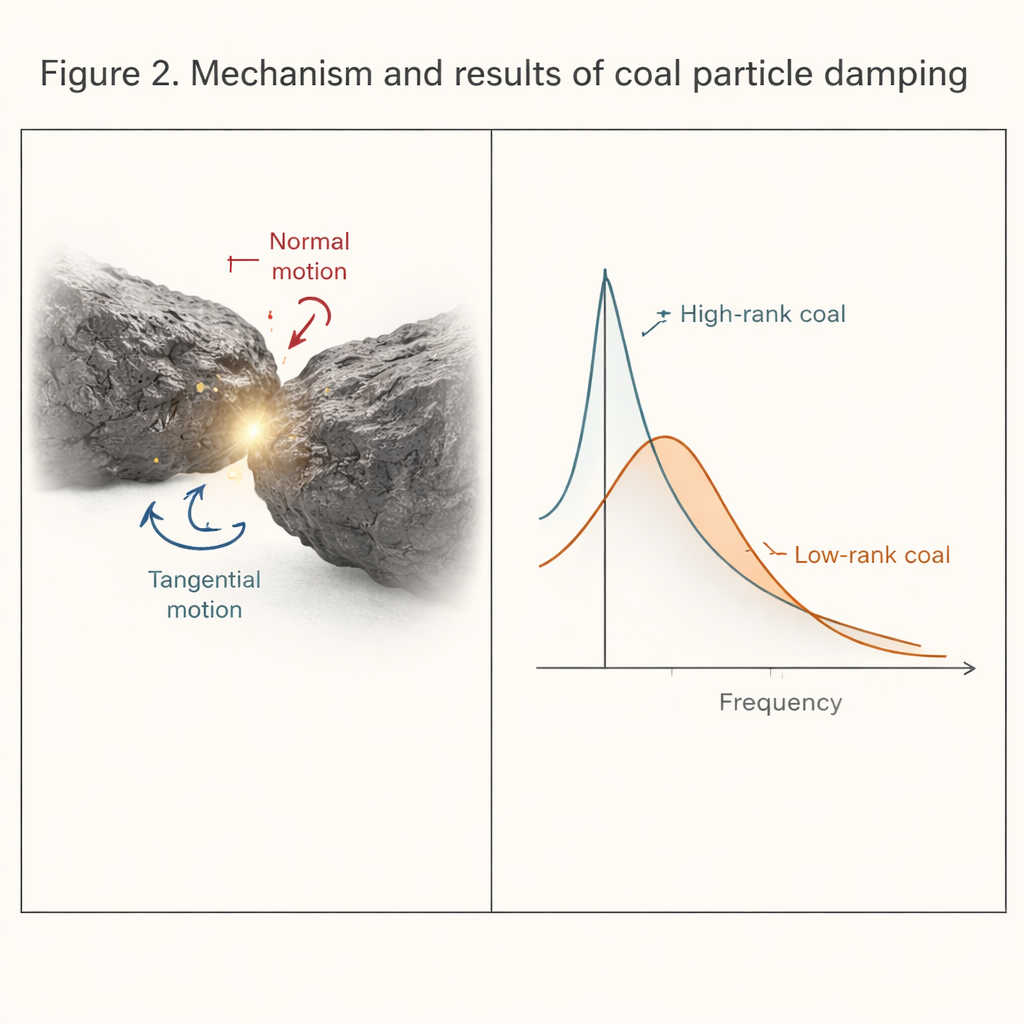
Images of the coal microstructure reveal why different coals treat waves differently. High-rank coal has grains of similar size packed tightly and neatly, leaving mostly tiny, isolated pores. This structure reflects intense compaction and chemical change over time. Low-rank coal, in contrast, shows a wide mix of grain sizes, looser packing, and many larger, well-connected pores. This disordered arrangement allows grains to move, collide, and slide more easily when a wave passes, creating more opportunities to drain energy from the wave. These visual differences help explain why the low-rank coal shows stronger frequency-dependent changes in wave speed and stronger attenuation than the high-rank coal.
Simulating grain collisions one particle at a time Figure 2.
To see inside the process, the authors built a computer model that treats coal not as a smooth block but as thousands of tiny spherical particles bonded together. In this discrete element model, each grain can push, pull, and slide against its neighbors, and special damping terms represent energy loss during normal impacts and tangential (sliding) motion. By running virtual compression tests over a range of frequencies, they found that increasing these damping terms and making the particle-size distribution more uneven both reduced P-wave speed and greatly increased attenuation. Tangential damping—associated with frictional sliding—was especially important, causing roughly three to four times more energy loss than normal damping. When all damping was set to zero, waves traveled fastest and showed almost no dispersion or attenuation.
Printed rocks as controllable testbeds
The 3D-printed models act as simplified, controllable versions of rock. The resin print behaves like a highly viscous, rubbery solid: it has a dense structure, high Poisson's ratio, and strong internal friction, which lead to pronounced frequency dependence of wave speed and high attenuation. The PLA print, made by fused deposition, is more rigid and behaves more like a classic elastic solid, with less internal friction and weaker damping. As a result, it shows smaller changes in wave speed with frequency and lower attenuation. Comparing these synthetic materials with natural coals confirmed that both particle-level damping and how evenly grains are sized play central roles in shaping seismic responses. The simulations using a bonded-particle model reproduced the overall trends in the experiments, even though fine details of attenuation remain challenging to match exactly.
What this means for reading seismic signals
For non-specialists, the key message is that in dry coal, it is the rattling and sliding of solid grains—not just fluids in pores—that can strongly slow and weaken seismic waves, especially at certain frequencies. Low-rank, loosely packed coal with a broad mix of grain sizes acts like a better “shock absorber” than tightly packed, high-rank coal. Understanding how tangential friction, normal impacts, and grain-size distribution control wave behavior helps geophysicists choose better models when interpreting seismic data in coal-rich settings, improving estimates of rock properties and reducing uncertainty in subsurface exploration.
Citation: Chen, H., Zou, G., Feng, X. et al. Experimental and numerical investigation of elastic wave dispersion and attenuation induced by coal particle damping.
Sci Rep16, 6033 (2026). https://doi.org/10.1038/s41598-026-36113-0
Keywords: coal microstructure, seismic wave attenuation, particle damping, discrete element modeling, 3D printed rock samples