Clear Sky Science · en
Maxillary sinus classification for sex and age using 23 artificial intelligence architectures
Why the Sinuses in Your Cheeks Matter
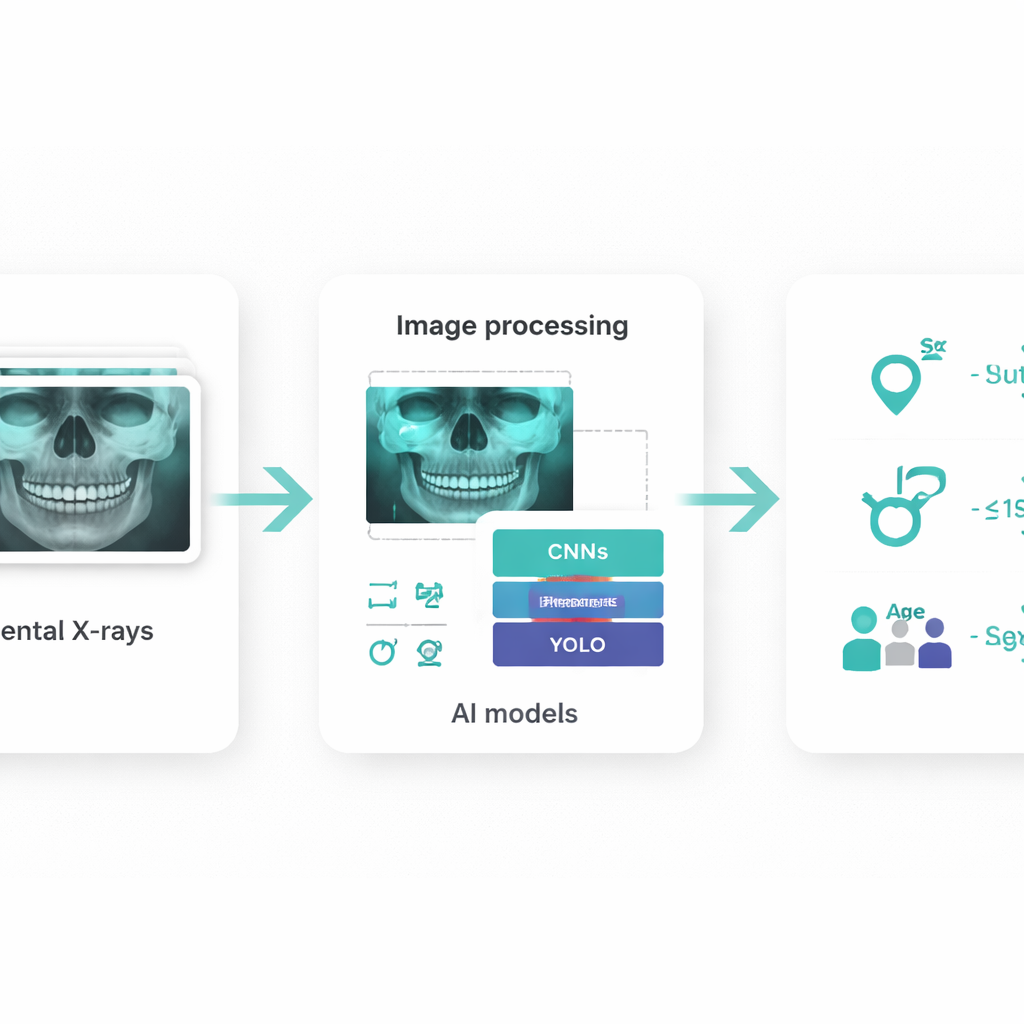
The spaces in your cheeks that help you breathe and lighten your skull may also hold clues about who you are. This study explores whether the shape and size of the maxillary sinuses—air-filled cavities beside the nose—captured on routine dental X-rays can help artificial intelligence (AI) estimate a person’s sex and whether they are younger or older than mid‑teenage years. Such tools could one day assist in forensic investigations and medical record matching, where traditional identification methods are missing or incomplete.
The Hidden Rooms Inside Your Face
The paranasal sinuses are hollow spaces in the bones of the face and skull, including the maxillary bones in the cheeks. They help condition the air we breathe, reduce the weight of the head, and support immune defenses. Because these spaces grow and change from childhood to adulthood, and tend to be somewhat larger in males than females, their outlines on X‑rays may carry information about both age and sex. Previous research measured these sinuses by hand or with conventional software, often in three‑dimensional scans, with moderate success but at considerable cost and effort.
Teaching Computers to Read Dental X‑rays
In this study, researchers assembled nearly 19,000 panoramic dental radiographs from Brazilian patients aged 6 to just under 23 years. These are the wide, curved X‑ray images many people receive at the dentist. Trained forensic dentists manually drew rectangular boxes around each person’s left and right maxillary sinus, defining the region of interest for the computer. The images were then standardized in size and brightness, and lightly altered in ways such as small rotations or flips to help AI models learn robust patterns rather than memorize specific pictures.
Putting 23 Digital “Eyes” to the Test
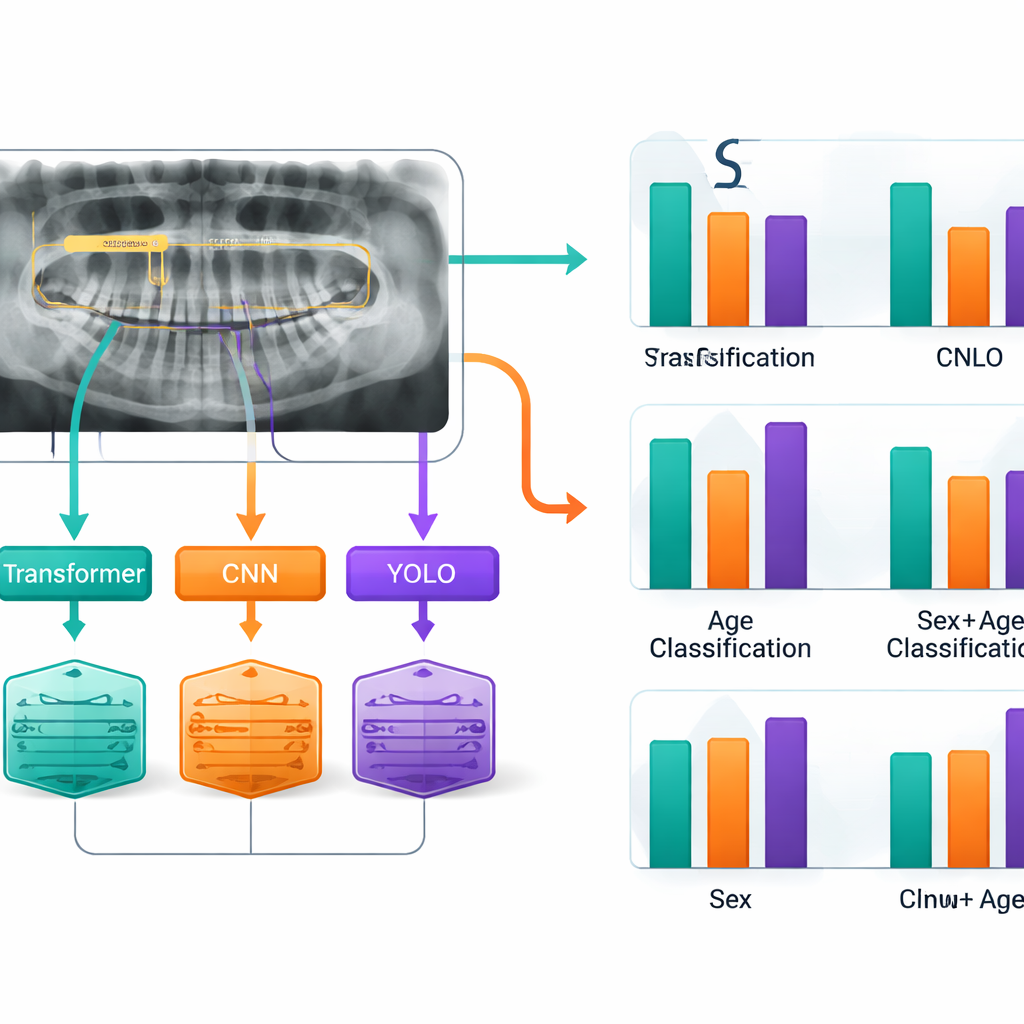
The team evaluated 23 different AI image‑analysis systems, including classic convolutional neural networks (CNNs), newer Vision Transformers (ViT and DeiT), and a modern detection model known as YOLOv11. They challenged these models with three tasks: deciding if a person was male or female; classifying them as 15 years old or younger versus older than 15; and sorting them into four groups that combine sex and age (younger girls, older women, younger boys, older men). To keep the evaluation fair, the data were split into training, validation, and strictly separate test sets, and a technique called five‑fold cross‑validation ensured that every image was used for testing exactly once.
How Well the Machines Performed
For estimating sex alone, the best models—two Transformer systems and one advanced CNN—correctly classified about 78–81% of cases. This is roughly in line with the best earlier methods, but still means that about one in five individuals would be misclassified, which is too uncertain for the sinuses to be used as the only clue. Age turned out to be easier: when the task was simply to decide whether someone was 15 or younger or older than 15, the top models got the answer right around 95% of the time, with excellent performance for both younger and older groups. However, when sex and age had to be guessed together into four categories, accuracy dropped to around 73–75%, showing that the more detailed the question, the harder it is for AI to tease apart subtle differences in sinus appearance.
What This Means for Forensics and Dentistry
Across all three tasks, the newer Transformer‑based models consistently outperformed most traditional CNNs, likely because they are better at taking in the whole X‑ray and spotting long‑range patterns in the sinuses. YOLOv11, a model originally designed to find objects in images, also did particularly well, especially for age‑related tasks. Even so, the authors emphasize that these tools should currently be viewed as helpful assistants rather than stand‑alone solutions in real‑world forensic casework. They might, for example, quickly suggest whether unknown remains belong to a person likely under or over 15, or provide a preliminary sex estimate to be checked against stronger evidence such as teeth or bones. Future work with more diverse datasets, finer age groups, and possibly three‑dimensional scans will be needed before AI‑based reading of cheek sinuses can play a central role in identifying who we are.
Citation: Anees, W., Silva, R., Khan, A. et al. Maxillary sinus classification for sex and age using 23 artificial intelligence architectures. Sci Rep 16, 5716 (2026). https://doi.org/10.1038/s41598-026-36112-1
Keywords: forensic odontology, maxillary sinus, age estimation, sex estimation, deep learning