Clear Sky Science · en
Adaptive anti-synchronization of transcendental alternated system of Julia sets
Why strange patterns can help protect information
On a computer screen, Julia sets appear as delicate, snowflake-like patterns born from simple math rules repeated many times. Beyond their beauty, these patterns can behave chaotically in ways that are hard to predict, which makes them promising for hiding and protecting data. This paper explores a new way to make two such fractal-generating systems move in opposite lockstep—an effect called anti-synchronization—while also keeping the process fast and stable enough for future secure communication and image encryption technologies.
From simple formulas to wild fractal shapes
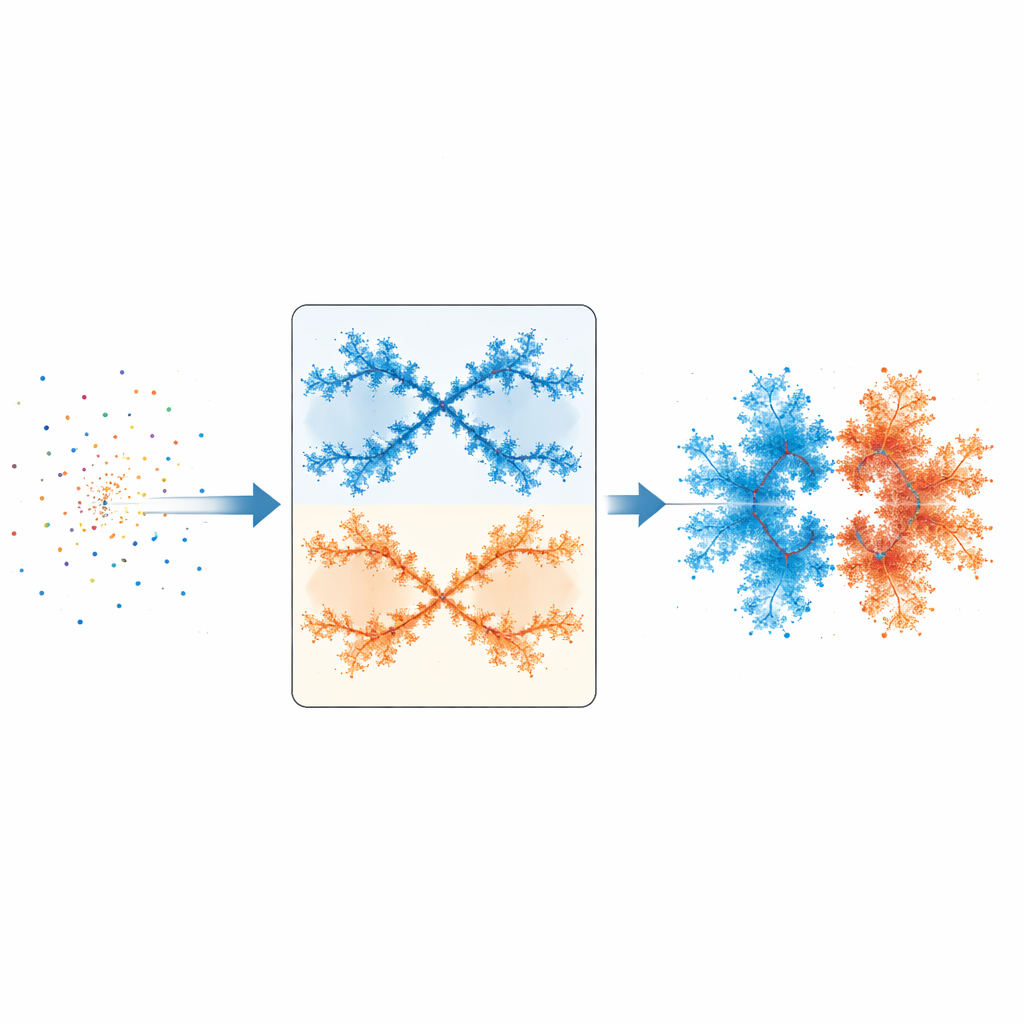
Julia sets arise when a simple rule is applied again and again to complex numbers, producing swirling, branching boundaries between points that escape to infinity and those that stay bounded. Earlier work mostly used polynomial rules—based on powers of a variable—to generate and control these sets. Here, the authors turn to transcendental rules built from cosine functions, which can twist space more strongly and create richer, more intricate fractal structures. They focus on an "alternated" setup: one rule is applied on even steps of the iteration and a slightly different rule on odd steps. This alternating scheme produces a transcendental alternated Julia system whose behavior is more complex, but also more flexible, than classical versions.
Making two chaotic worlds move in opposite ways
The core idea is to run two related fractal-generating systems side by side. One acts as the driving system; the other responds. Instead of forcing them to match each other, the authors design them to evolve as mirror opposites—when one goes one way, the other goes the other way, so that their combined state cancels out. This is anti-synchronization. To achieve it, they introduce an adaptive control input that is updated at each iteration based on the current mismatch between the two systems. When the system parameters are fully known, the control can be chosen so that the mismatch steadily shrinks, no matter where the two systems start.
Learning the hidden knobs on the fly
Real systems often have unknown or drifting parameters, such as gains or offsets inside the mathematical rule. To deal with this, the authors extend their method to the more demanding cases where some or all of the key parameters of the two Julia generators are unknown. They attach simple update rules that adjust the parameter estimates at each step using only the observed mismatch between the two systems. With carefully chosen tuning constants, they prove that both the mismatch and the parameter errors fade away over time. In other words, the response system not only becomes a perfect opposite twin of the driver, but it also "learns" the true internal settings that produced the fractal in the first place.
Testing speed and efficiency on digital fractals
To see how well the method works in practice, the authors run computer simulations on a grid of complex starting points and track how quickly each point reveals its fate—whether it escapes or stays bounded. They summarize this using the Average Number of Iterations (ANI): the smaller the ANI, the faster the method decides. By varying a key parameter in the cosine-based rule, they find that higher values lead to both lower ANI and shorter computation times, meaning the algorithm converges more quickly and runs more efficiently. They also show how the tuning constants in the controller affect the rate at which the mismatch between the two systems dies away: smaller combined values of these constants lead to faster anti-synchronization.
What this means for future secure systems
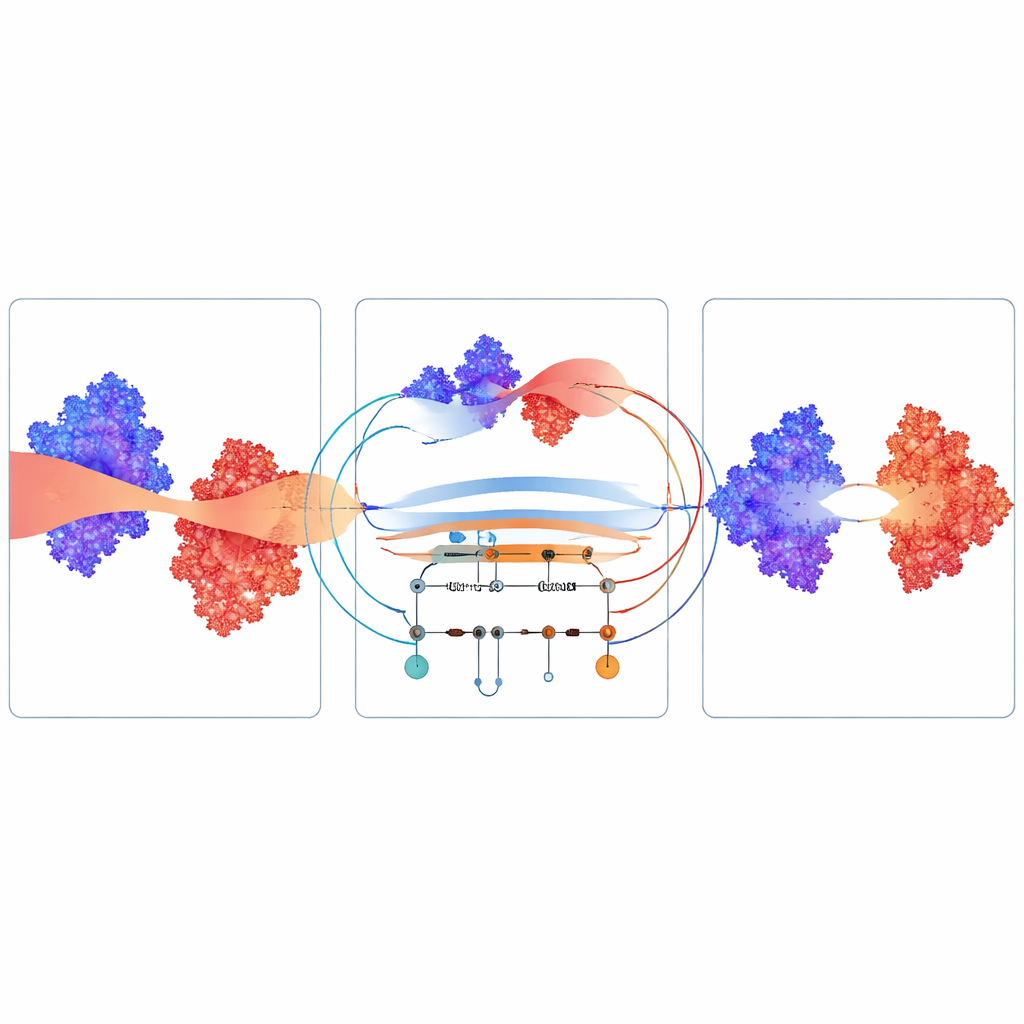
In simple terms, this work shows how to make two highly complex fractal-generating machines behave like perfect opposites while automatically learning any unknown internal settings. The approach keeps the evolution stable, drives the difference between the two systems down to zero, and does so with relatively few computational steps. Because Julia-based fractals are already used in proposed image and data encryption schemes, a fast, adaptive way to control their behavior—especially one that works with richer transcendental rules—opens the door to more secure and efficient cryptographic designs built on the hidden order of chaos.
Citation: Ravikumar, V., Konar, P. Adaptive anti-synchronization of transcendental alternated system of Julia sets. Sci Rep 16, 8028 (2026). https://doi.org/10.1038/s41598-026-36108-x
Keywords: Julia sets, chaotic synchronization, adaptive control, fractal encryption, complex dynamics