Clear Sky Science · en
AI-enabled smart farming framework for sustainable date palm cultivation in arid regions using machine learning and IoT integration
Smart Help for Thirsty Farms
Feeding a growing world while using less water is one of agriculture’s toughest balancing acts, especially in deserts. This study shows how combining sensors in the field with artificial intelligence can help farmers grow date palms—a staple crop in arid regions such as Saudi Arabia—more efficiently, using every drop of water wisely while keeping trees healthier.
Why Desert Trees Need a Digital Upgrade
Date palms are far more than a traditional symbol of oasis life: they provide food, jobs, export income, and cultural value across the Middle East and beyond. Global demand for dates is rising, and Saudi Arabia’s exports have more than doubled in recent years. Yet farmers still struggle with extreme heat, scarce water, and salty or degraded soils. Traditional methods—watering on fixed schedules and visually checking trees for stress or disease—are slow, labor-intensive, and often imprecise. The authors argue that, to keep pace with climate change and market growth, date palm farms must evolve into “smart” systems that continuously measure field conditions and act on clear, data-based advice rather than guesswork.
Turning Palms into Data Sources
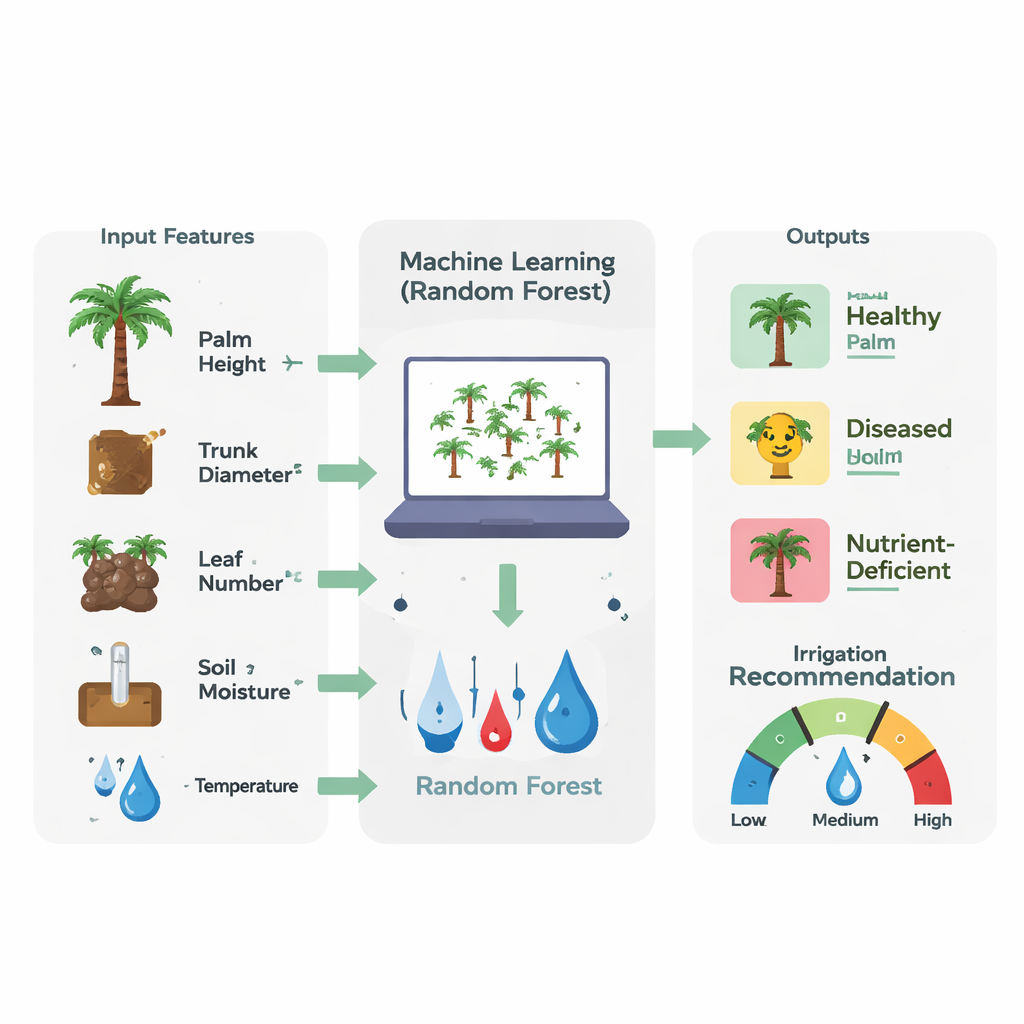
The research team built a detailed picture of how date palms behave by collecting 500 real-world records from plantations in Saudi Arabia’s arid zones. For each tree they measured simple body traits—height, trunk thickness, and number of leaves—alongside surrounding conditions: soil moisture, temperature, and humidity. They also recorded the variety of palm and whether it was healthy, diseased, or suffering from nutrient problems. Before any analysis, the data were carefully cleaned, missing values were filled in, and all measurements were scaled so that no single feature would dominate the calculations. This structured, “multimodal” dataset allowed the scientists to explore how plant growth and microclimate interact in shaping palm health.
How the Smart Farm Brain Works
On top of this data, the researchers tested four types of machine learning tools—computer programs that learn patterns from examples—to see which could best recognize palm health and support irrigation decisions. These included Random Forests, Gradient Boosting, Artificial Neural Networks, and Support Vector Machines. Each model was tuned through systematic parameter searches and checked with cross-validation, a procedure that trains and tests on different slices of the data to avoid overfitting. The clear winner was the Random Forest model, which correctly classified palm health in about 95 out of 100 cases and achieved very high scores on other quality checks such as precision and recall. It also turned out to be excellent at predicting key soil conditions, like moisture, temperature, and pH, with errors so small that predictions closely tracked real sensor readings.
Layers of a Connected Farm
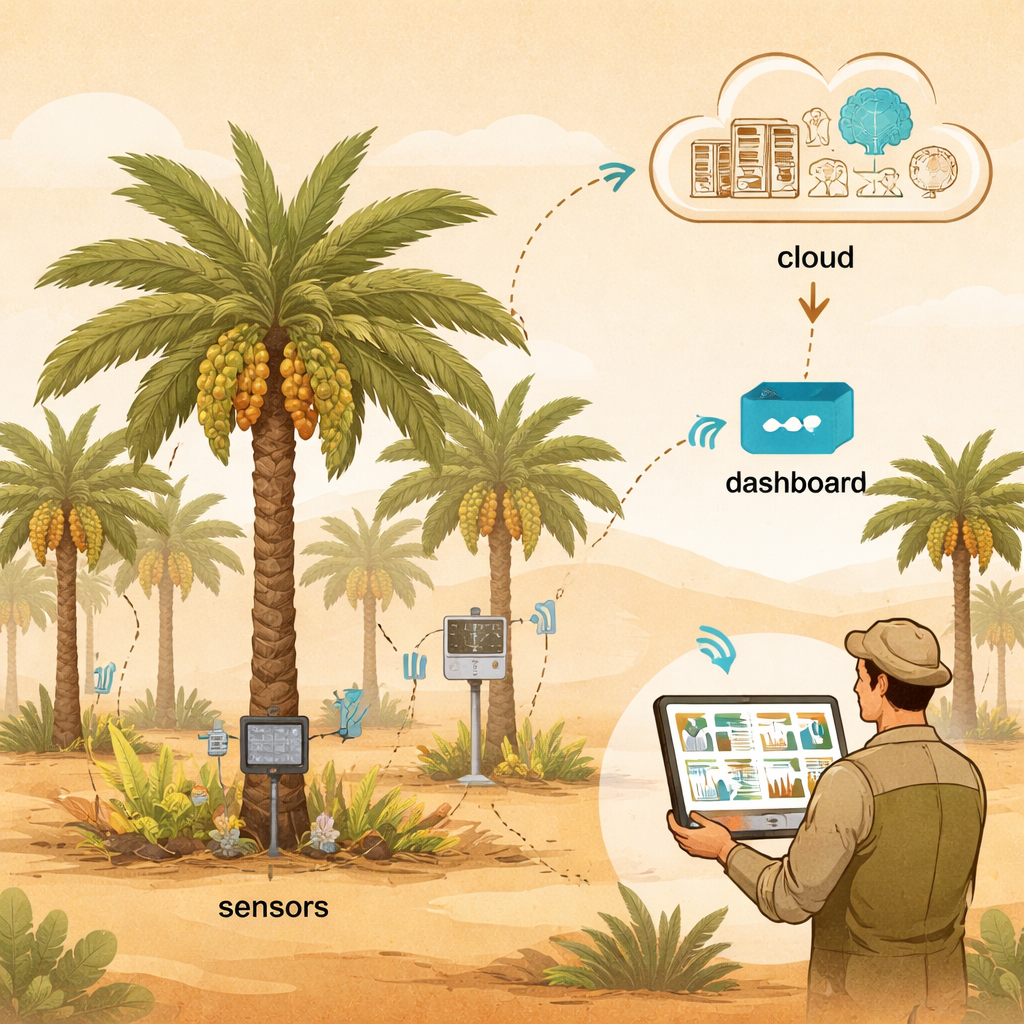
Using these results, the authors designed a four-layer smart farming framework. In the field, sensors placed around each palm’s root zone and canopy measure moisture, temperature, and humidity in real time. Their signals travel wirelessly to a gateway device and then to cloud servers. A processing layer cleans and organizes the incoming stream, after which the trained models estimate each tree’s health and the state of the soil. Finally, a decision layer turns these estimates into clear actions: adjust irrigation schedules, flag early signs of disease or stress, and deliver alerts and dashboards to farmers’ phones or web portals. Tests showed that the system remained accurate even when sensor readings were slightly disturbed, and that the sensors themselves could be calibrated to high precision for long-term field use.
What This Means for Farmers and the Future
In everyday terms, the study suggests that a date palm farm can be managed more like a well-instrumented factory line than a field of guesswork. By continually measuring how trees and soils respond to the harsh desert environment and letting AI sift through the numbers, farmers can water only when and where it is needed, catch problems before they spread, and maintain stable yields with less waste. The authors see this AI-and-sensor toolkit as a practical step toward the goals of Saudi Vision 2030: smarter agriculture, stronger food security, and more sustainable use of scarce water. With further work—such as adding satellite or drone imagery and farmer-friendly apps—the same approach could be adapted to many other climate-sensitive crops around the world.
Citation: Qwaid, M.A., Sarker, M.T., Shawon, S.M. et al. AI-enabled smart farming framework for sustainable date palm cultivation in arid regions using machine learning and IoT integration. Sci Rep 16, 5125 (2026). https://doi.org/10.1038/s41598-026-36106-z
Keywords: smart farming, date palm, precision irrigation, agricultural AI, IoT sensors