Clear Sky Science · en
High-resolution in situ imaging reveals size-specific moonlight responses in zooplankton diel vertical migration
Moonlight and the Nightlife of Tiny Lake Creatures
The largest daily animal migration on Earth happens not in the savannah or the skies, but in lakes and oceans, as billions of tiny drifting animals called zooplankton move up and down in the water column. This study reveals that even the soft glow of the Moon can reshape where these creatures spend the night, and that small and large individuals respond very differently. Understanding these hidden movements matters because zooplankton feed on algae and in turn feed fish, helping to keep freshwater ecosystems stable and clear.
Why Little Drifters Travel Up and Down
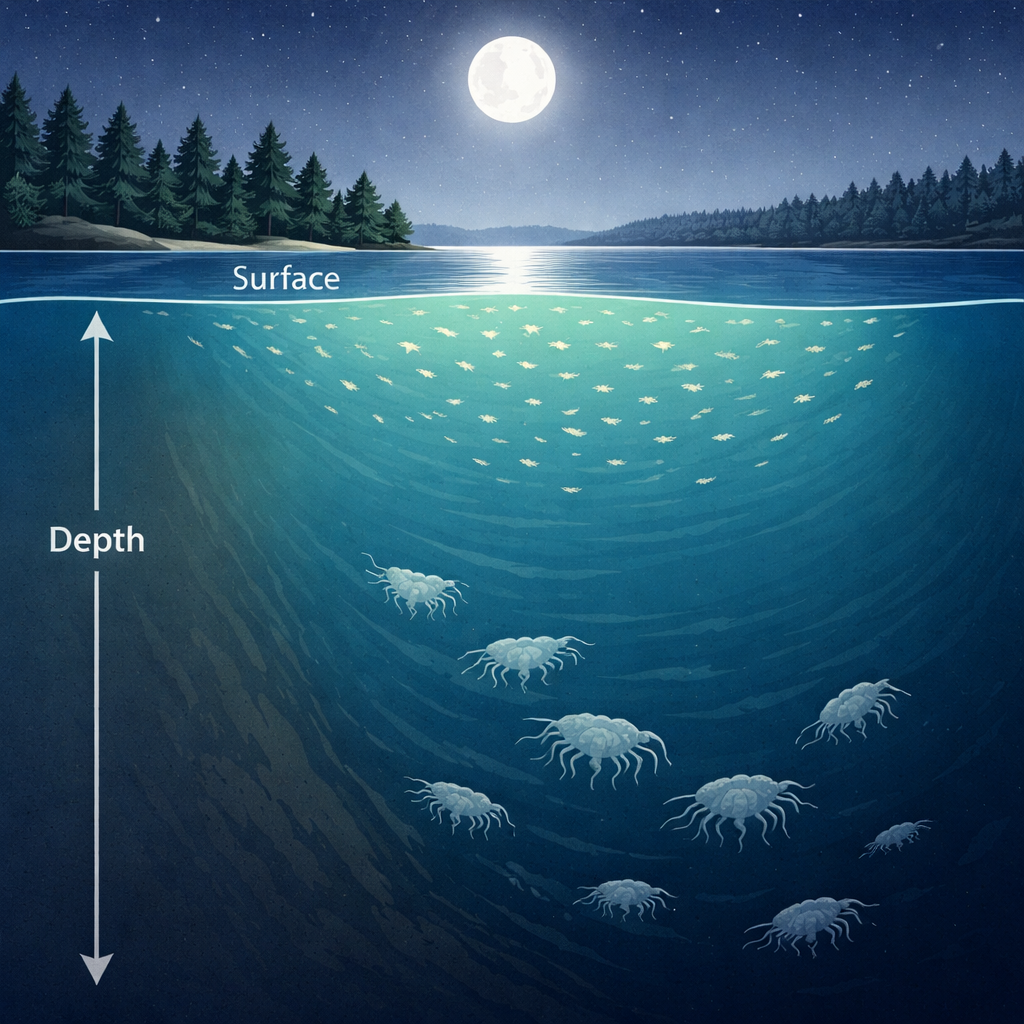
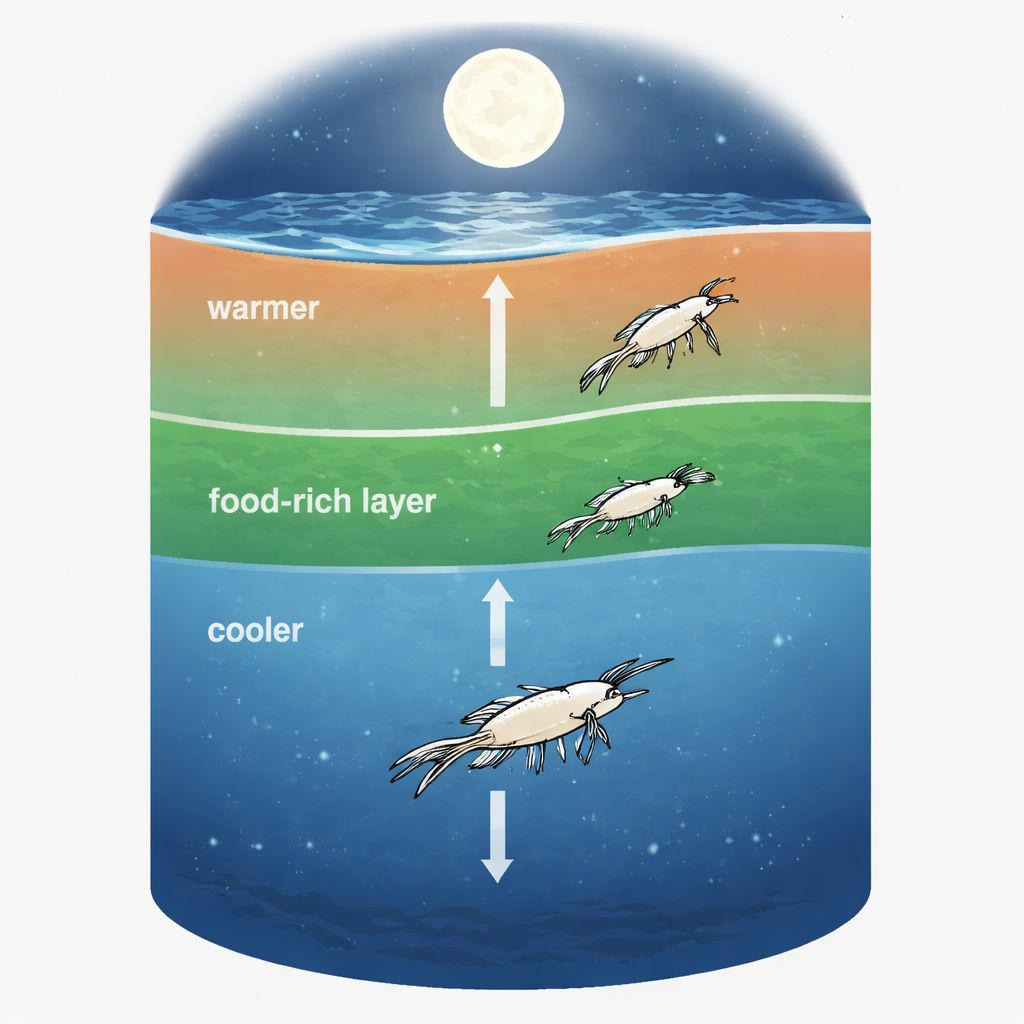
Zooplankton practice what scientists call diel vertical migration: they sink into deeper, darker layers during the day and rise toward the surface at night. This daily commute helps them avoid being eaten by fish that hunt by sight, while still letting them reach warmer, food-rich surface waters under cover of darkness. But the classic picture of a whole community moving in unison is too simple. Different species, and even different life stages of the same species, face different trade‑offs. Smaller animals are harder for predators to spot but swim less powerfully. Larger ones are easier targets but better escape artists. The challenge has been that traditional tools, like nets or sonar, could not track these fine‑scale, size‑specific movements in real time, especially in small freshwater lakes.
A New Underwater Camera for the Night Shift
To overcome this, the researchers deployed a high‑resolution underwater imaging system, the modular Deep‑focus Plankton Imager, in Lake Stechlin, a clear, low‑light‑pollution lake in northeastern Germany. The instrument uses near‑infrared backlighting to capture sharp silhouettes of individual zooplankton without disturbing their natural behavior. Combined with machine‑learning image recognition, it allowed the team to automatically identify two major groups—cladocerans (such as water fleas) and copepods—and to sort them into small, medium, and large size classes. The camera was lowered through the water column every 30 minutes from late afternoon into the night, during both new‑moon and nearly full‑moon periods, while other instruments measured temperature, oxygen, and chlorophyll‑a, a pigment used here as a proxy for edible algae.
Moonlit Trade‑Offs: Safety Versus Food and Warmth
Across all conditions, familiar patterns emerged: by day, both cladocerans and copepods stayed deeper; by night they shifted shallower. But when the Moon rose and brightened the upper water layers, behavior became more nuanced. Larger individuals of both groups strongly avoided illuminated layers, sinking into darker, deeper water as moonlight intensified—apparently choosing safety from visually hunting fish over access to warmer temperatures or food. Smaller individuals did almost the opposite. Under brighter nighttime conditions, small zooplankton were more likely to occupy warmer, shallower layers, and for cladocerans in darkness, the smallest animals tracked food‑rich layers most closely. Copepods, in particular, followed the depth of the chlorophyll‑a maximum—where algal food was densest—whether or not moonlight was present, reflecting their strong dependence on steady food supplies for growth and reproduction.
Size Matters in a Patchy, Moonlit World
These patterns suggest that moonlight reshapes not only predator–prey interactions, but also competition among zooplankton of different sizes. When the Moon brightened the lake’s surface, large, vulnerable individuals retreated downward, effectively freeing up warm, shallow habitat for their smaller counterparts, which are harder for fish to detect. In this way, the lunar cycle may indirectly promote size‑based layering within the community. The study also shows that temperature and food do not act alone: their influence depends on how much light is present and on the body size and taxonomic group of the animals. Only with high‑resolution, in situ imaging were the researchers able to disentangle these overlapping effects over tens of centimeters and minutes, rather than the coarse depth bands and daily averages common in older studies.
From Natural Moonlight to City Glow
By revealing how zooplankton of different sizes respond to natural moonlight, this work offers a crucial baseline for understanding what might happen as artificial light at night spreads across lakes and reservoirs. If even faint lunar changes are enough to push large zooplankton deeper, persistent shoreline lighting could keep them exposed to predators or squeezed into ever‑thinner dark refuges. That, in turn, could favor smaller forms and alter how efficiently zooplankton control algae and feed fish. In short, the way moonlight sculpts the nightly movements of tiny drifters may foreshadow how our own lights could quietly reshape freshwater food webs.
Citation: Dickerson, A.L., Jechow, A., Nößler, M. et al. High-resolution in situ imaging reveals size-specific moonlight responses in zooplankton diel vertical migration. Sci Rep 16, 4086 (2026). https://doi.org/10.1038/s41598-026-36105-0
Keywords: diel vertical migration, zooplankton, moonlight, freshwater ecosystems, artificial light at night