Clear Sky Science · en
Characterisation of pelagic seascapes through micronektonic and zooplanktonic scattering layers
Hidden Life Highways in the Open Ocean
Far from coasts and coral reefs, the open ocean can look like a blue desert. But beneath the surface, vast “highways” of small animals quietly rise and fall every day, carrying energy and carbon through the sea. This study uses ship‑mounted sonar and detailed water measurements to reveal how these hidden layers of life are organized across the tropical Atlantic and Pacific—and how changing ocean conditions could reshape them.
Invisible Layers Revealed by Sound
Instead of nets or cameras, the researchers relied on sound. They crossed from the Canary Islands to Ecuador with sensitive echosounders that send pulses of sound into the water. Swarms of small swimming creatures—micronekton and large zooplankton—reflect this sound, forming broad “Sound Scattering Layers” that show up as glowing bands on sonar screens. These layers, often tens to hundreds of meters thick and stretching for hundreds of kilometers, are a key link between microscopic algae at the surface and larger predators such as tuna, seabirds, and marine mammals.
Three Very Different Blue Worlds
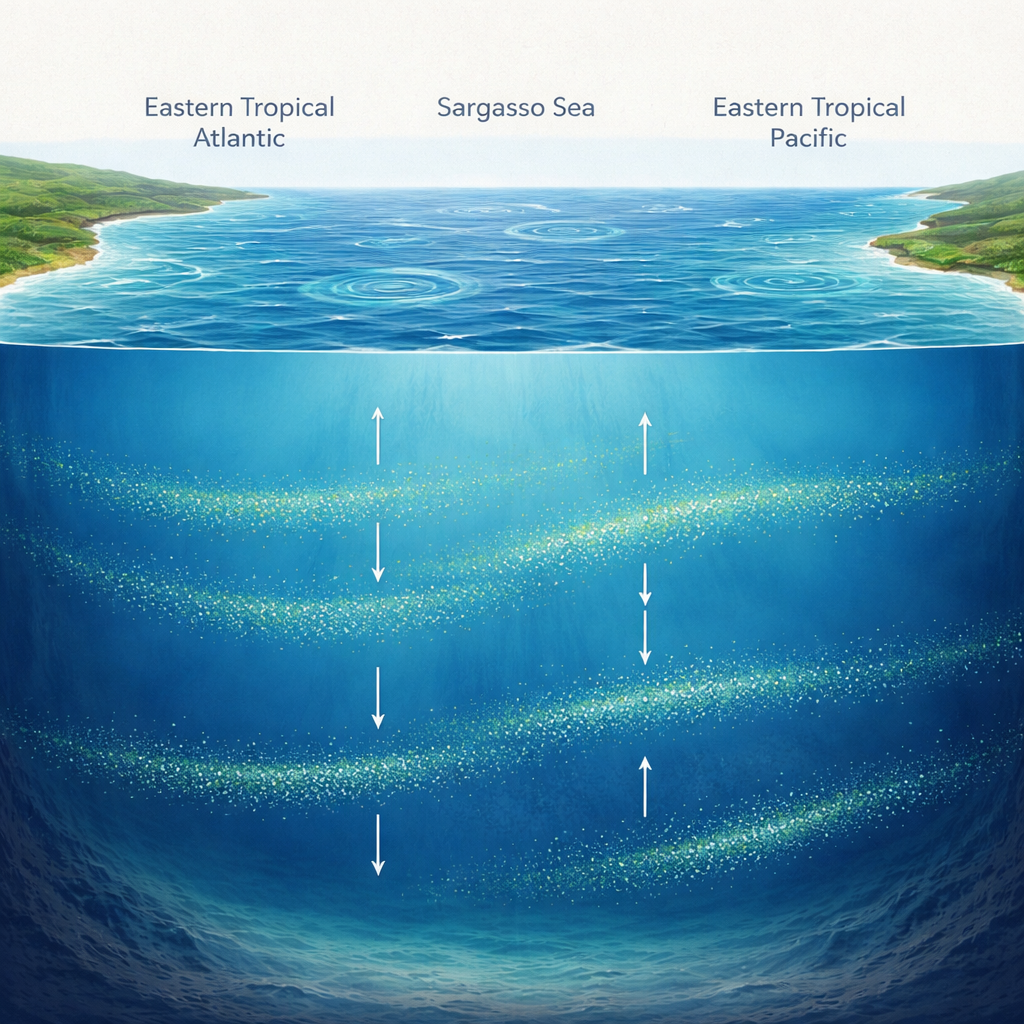
By clustering the sonar data, the team found three distinct “pelagic seascapes”: the Eastern Tropical North Atlantic, the Sargasso Sea, and the Eastern Tropical Pacific. Each had its own fingerprint. In the Pacific, scattering layers were shallow and thick, with strong echoes, pointing to dense communities of animals close to the surface. The Sargasso Sea, often described as an oceanic desert, showed thinner, weaker layers, matching its low nutrient and plankton levels. The Eastern Tropical North Atlantic, influenced by upwelling off West Africa, hosted the deepest layers, sometimes around 400 meters, reflecting different water masses and oxygen conditions.
Daily Commutes Through the Water Column
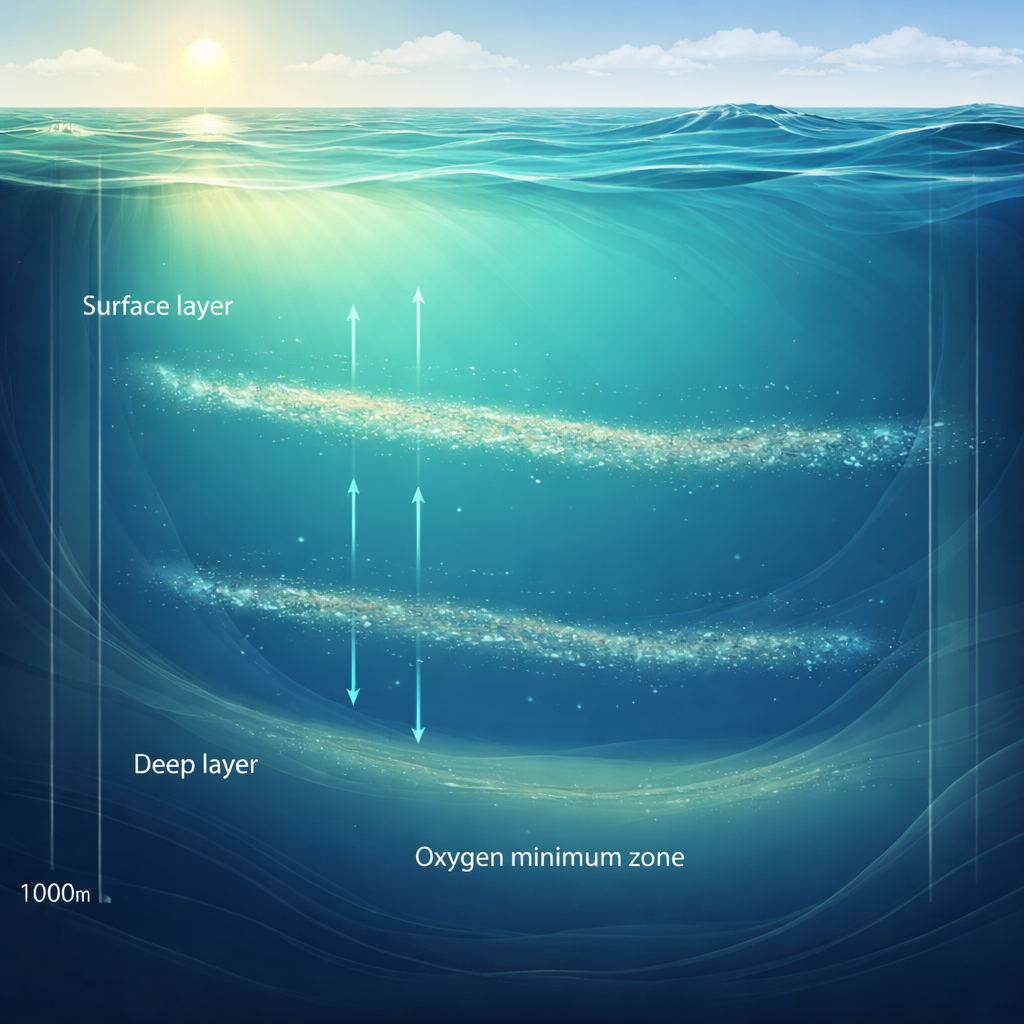
Across all regions, the layers were not fixed. Many animals carried out a daily commute known as diel vertical migration. During the day, they stayed in darker, deeper waters, likely hiding from visual predators. At night, they rose toward the surface to feed, shifting acoustic backscatter upward into the upper few hundred meters. In the Pacific, a surface layer persisted both day and night, with some animals remaining shallow while others shuttled between this layer and deeper zones. This behavior helps move carbon from the surface, where food is abundant, to deeper waters where it can be stored, making these migrations a key part of the ocean’s “biological pump.”
How Water Shapes Where Creatures Can Live
The researchers combined the sonar record with detailed measurements of temperature, saltiness, oxygen, light, and chlorophyll—a proxy for plant‑like plankton. They found that the depth and intensity of the scattering layers were strongly linked to warm or cold layers in the water, the position of the sharp temperature jump called the thermocline, oxygen levels, and how much food and light were available. Mesoscale eddies—large rotating water features—also played a big role. Anticyclonic eddies tended to gather dense animal layers in their centers, acting like moving oases, while cyclonic eddies often shifted animals toward their edges, where upwelling boosts productivity.
What This Means for a Changing Ocean
By treating sound scattering layers as the living structure of pelagic “seascapes,” this work offers a practical way to track how open‑ocean ecosystems respond to climate‑driven change. As warming, deoxygenation, and shifting currents alter temperature profiles, oxygen minimum zones, and productivity, the depth and density of these migrating layers—and the predators that depend on them—are likely to change. The authors show that a relatively simple acoustic approach, combined with key environmental measurements, can be applied across ocean basins to monitor these hidden communities over large areas and long periods, improving our ability to understand and manage life in the vast, seemingly empty open ocean.
Citation: Diogoul, N., Brehmer, P., Jouanno, J. et al. Characterisation of pelagic seascapes through micronektonic and zooplanktonic scattering layers. Sci Rep 16, 6378 (2026). https://doi.org/10.1038/s41598-026-36104-1
Keywords: sound scattering layers, open ocean ecosystems, diel vertical migration, mesopelagic animals, ocean climate change