Clear Sky Science · en
A Lightweight Sequential AI Framework for Real Time Intrusion Detection in Dynamic Vehicular Networks
Why Smarter Car Networks Matter
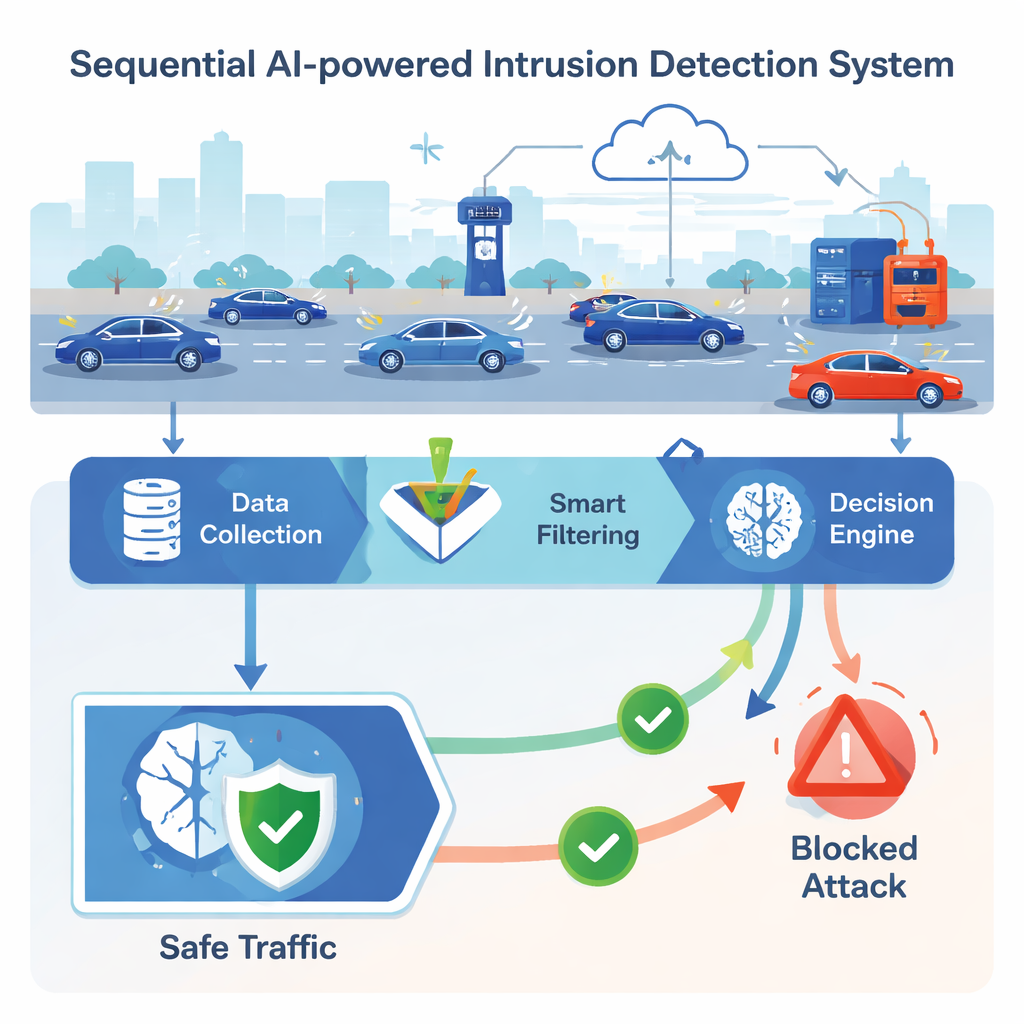
Modern cars are turning into rolling computers that constantly talk to one another and to roadside equipment, helping to prevent crashes, ease traffic jams, and support self-driving features. But this wireless chatter also opens the door to hackers who might inject fake messages, jam signals, or impersonate other vehicles. This article presents a new artificial intelligence (AI) based security system designed to spot such attacks quickly and accurately, without overloading the limited computing power available in vehicles.
Cars That Talk—and Can Be Tricked
Vehicular ad-hoc networks, or VANETs, let nearby cars share information such as position, speed, and sudden braking, while also linking to roadside units and the wider internet. This connectivity underpins many advanced driver-assistance and future autonomous driving functions. However, because these networks are open and constantly changing as vehicles move, they are hard to defend. Attackers can launch denial-of-service floods, pretend to be many fake cars (Sybil attacks), or drop important messages like accident alerts (blackhole attacks). Traditional intrusion detection systems either react too slowly or demand too much processing power to work well in fast-moving traffic.
A Step-by-Step AI Security Assistant
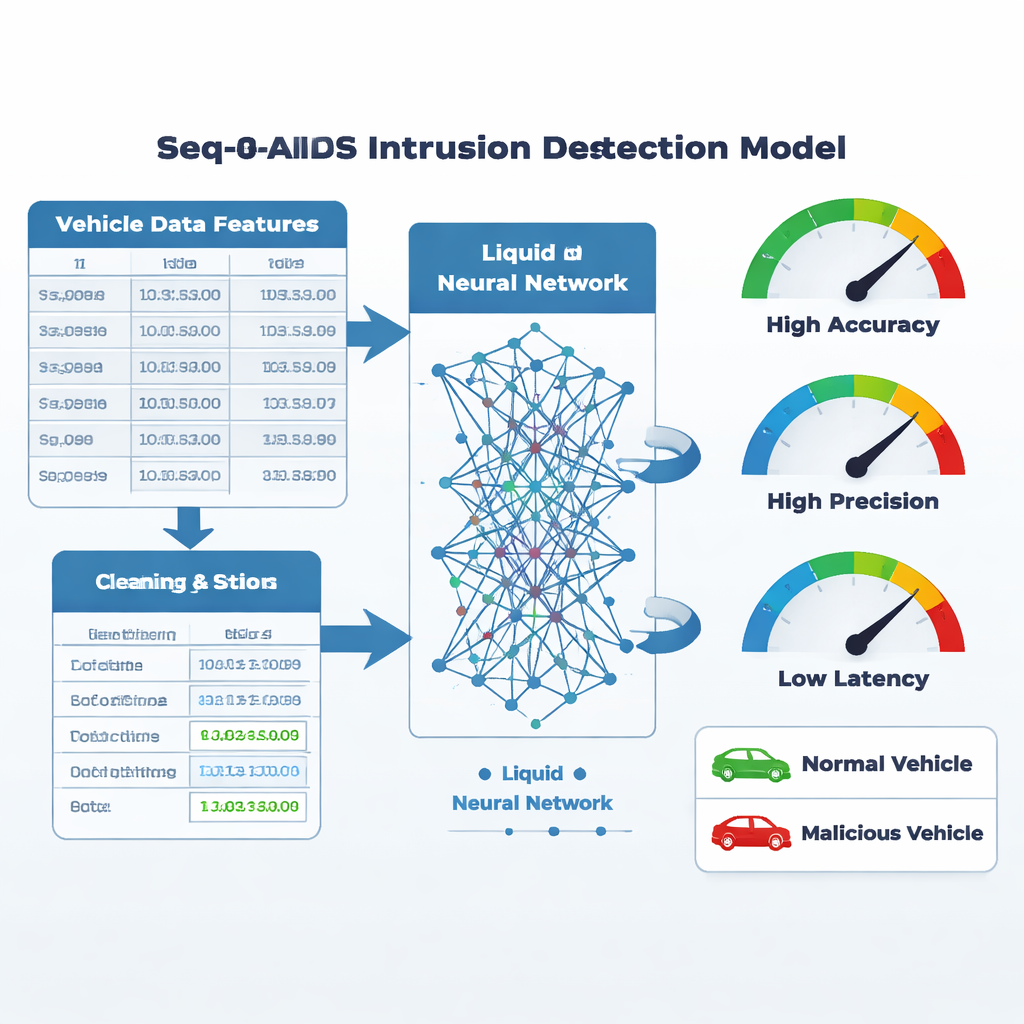
The authors propose a Sequential AI-Powered Lightweight Intrusion Detection System, dubbed Seq-AIIDS, tailored to the realities of moving vehicles. It works in a pipeline of stages. First, it collects driving and communication data from a realistic public dataset containing 5,000 vehicle records with variables such as location, speed, signal strength, trust scores, and counts of suspicious behaviors. Next comes “data scrubbing”: missing values are filled in using statistical relationships between features, and clearly abnormal outliers are removed using a deviation test. This cleaning step trims the dataset size and reduces noise so later AI steps can focus on meaningful patterns instead of random glitches.
Picking the Signals That Really Matter
After cleaning, Seq-AIIDS narrows down which pieces of information are truly useful for deciding whether a vehicle is behaving normally or maliciously. It uses a correlation-based method to measure how strongly each feature is tied to the final label (benign or attack). Features with high association—such as certain trust scores or counts of fake packets—are kept, while weak or redundant ones are discarded. This “feature selection” cuts the original 20 variables down to 12 key indicators. With fewer, more informative signals, the system needs less computation and can react faster, which is crucial when vehicles are moving at highway speeds.
An Adaptive AI That Learns Over Time
The refined data is then fed into a type of neural network designed for time-varying signals, known as a liquid neural network. Unlike simpler models that treat each data snapshot in isolation, this network can track how a vehicle’s behavior evolves over time, improving its ability to distinguish a brief anomaly from a sustained attack. A logistic (yes/no) decision layer converts the network’s internal patterns into a simple verdict: malicious or normal. To avoid slow or unstable training, the authors apply a spiral-inspired optimization method that repeatedly tweaks the network’s internal weights, hunting for settings that minimize misclassifications while keeping processing time low.
What the Tests Show for Road Safety
When tested on the vehicular dataset, Seq-AIIDS is compared against several popular deep-learning approaches, including LSTM, convolutional neural networks, graph neural networks, and a combined CNN–GRU model. Across many different sample sizes, the new system achieves about 98% accuracy, with similarly high precision and recall, meaning it rarely misses attacks and seldom flags honest vehicles by mistake. Just as important for real traffic, its detection latency averages around 29 milliseconds—noticeably faster than competing methods—thanks to its compact feature set and efficient optimization. In plain terms, the study suggests that a carefully designed, lightweight AI pipeline can give connected cars a quick, sharp “security sense,” helping them spot and block digital ambushes before they translate into real-world danger on the road.
Citation: Jeyaram, G., Vidhya, V., Dhanaraj, R.K. et al. A Lightweight Sequential AI Framework for Real Time Intrusion Detection in Dynamic Vehicular Networks. Sci Rep 16, 5217 (2026). https://doi.org/10.1038/s41598-026-36103-2
Keywords: connected vehicles, cybersecurity, intrusion detection, intelligent transportation, vehicle networks