Clear Sky Science · en
In vitro comparative evaluation of the flexural strength of acrylic denture bases reinforced with nano-PEEK and PEEK–zirconia composites
Stronger Dentures for Everyday Life
Many people around the world still rely on full dentures to eat, speak, and smile with confidence. Yet these plastic plates, usually made from a material called acrylic (PMMA), can crack or snap—often right down the middle—after years of bending during chewing. This study explores a new way to make denture bases tougher and less likely to break by mixing in ultra-tiny reinforcing particles, with the goal of giving wearers longer-lasting, more reliable dentures.
Why Dentures Break So Often
Traditional denture bases are made from a pink acrylic that is easy to shape, looks natural, and is affordable. However, during daily use, dentures flex repeatedly under biting forces. Over time, that constant bending creates tiny cracks within the material, especially in the upper denture midline, which can eventually lead to sudden fracture. To reduce these failures, researchers worldwide have tried strengthening acrylic with different types of microscopic fillers and fibers, aiming to keep the material lightweight and comfortable while making it more resistant to breakage.
Testing Tiny Helpers Inside the Plastic
In this study, the researchers focused on two advanced materials used in modern medicine: zirconia, a very hard and tough ceramic, and PEEK, a high-performance plastic already used in bone and spine implants. Both were ground down to the nanoscale—thousands of times smaller than the width of a human hair—and their surfaces were chemically treated so they would bond better with the acrylic. The team created three types of flat test pieces: pure acrylic (control), acrylic with 5% nano-PEEK only, and acrylic with a 5% hybrid mix of 2.5% nano-zirconia plus 2.5% nano-PEEK. These samples were processed in the same way dentures are made and then soaked in artificial saliva for a month to mimic the mouth environment. 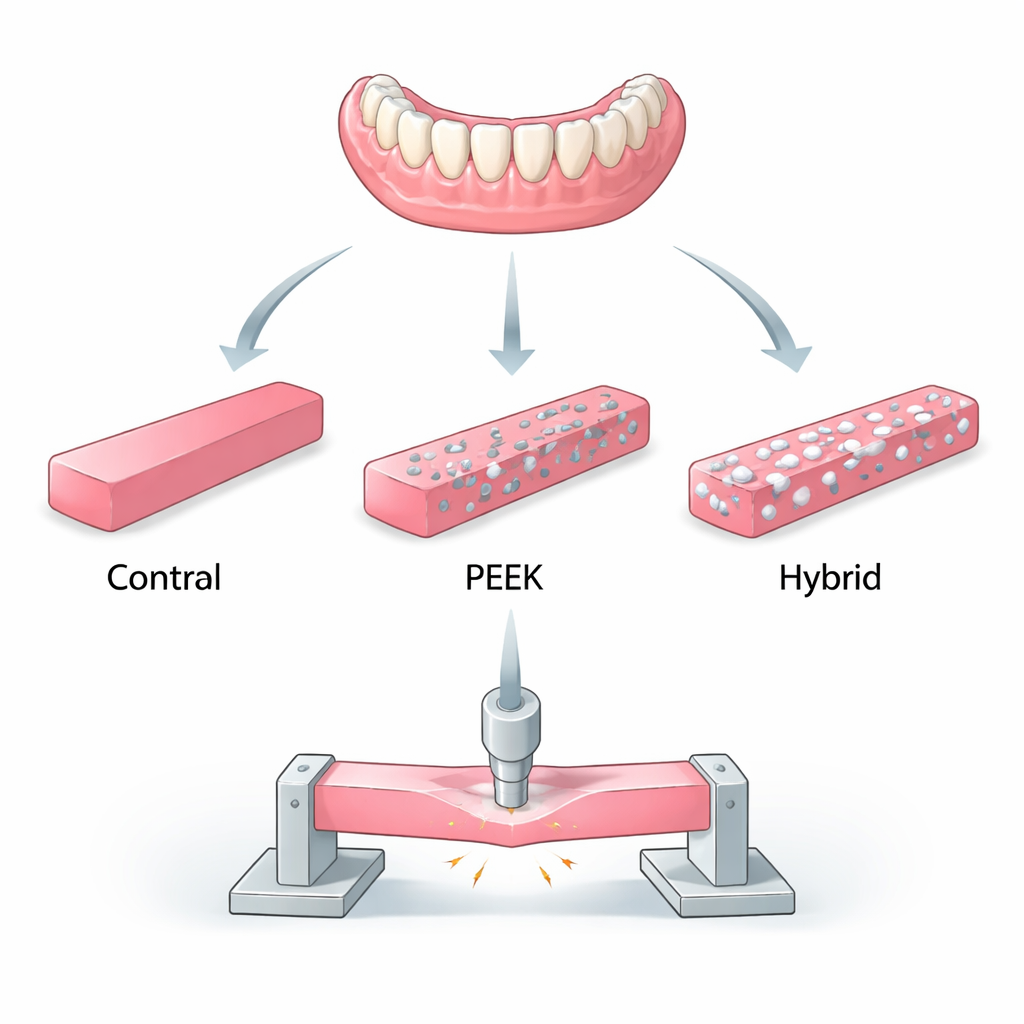
Bending Until They Break
To see which material was strongest, each specimen was placed on two supports and pressed in the center until it snapped—the standard “three-point bending” test. The pure acrylic showed moderate resistance to bending, as expected. Surprisingly, the acrylic reinforced with nano-PEEK alone did not perform better than the plain material. In contrast, the hybrid group, containing both zirconia and PEEK nanoparticles, showed a clear jump in strength, with the highest average flexural strength values among all groups. Statistical analysis confirmed that this improvement was not due to chance: the hybrid material was significantly stronger than both the control and the PEEK-only versions.
What the Material Looks Like Up Close
The team then examined the broken surfaces using powerful electron microscopes. The plain acrylic appeared porous, with tiny voids that act as weak spots where cracks can start. In the PEEK-only group, the nano-PEEK tended to clump into clusters rather than spread out evenly. These clumps became stress hot spots, explaining why this version failed to improve strength. The hybrid group told a different story: zirconia and PEEK nanoparticles were evenly dispersed, the material looked denser and more uniform, and internal voids were largely filled. This even distribution allowed the hard zirconia particles to block crack growth while the PEEK contributed toughness, helping the material share and spread biting forces more effectively. Chemical tests (FTIR) also suggested that the acrylic, zirconia, and PEEK interact at the molecular level, further improving how well they work together under load. 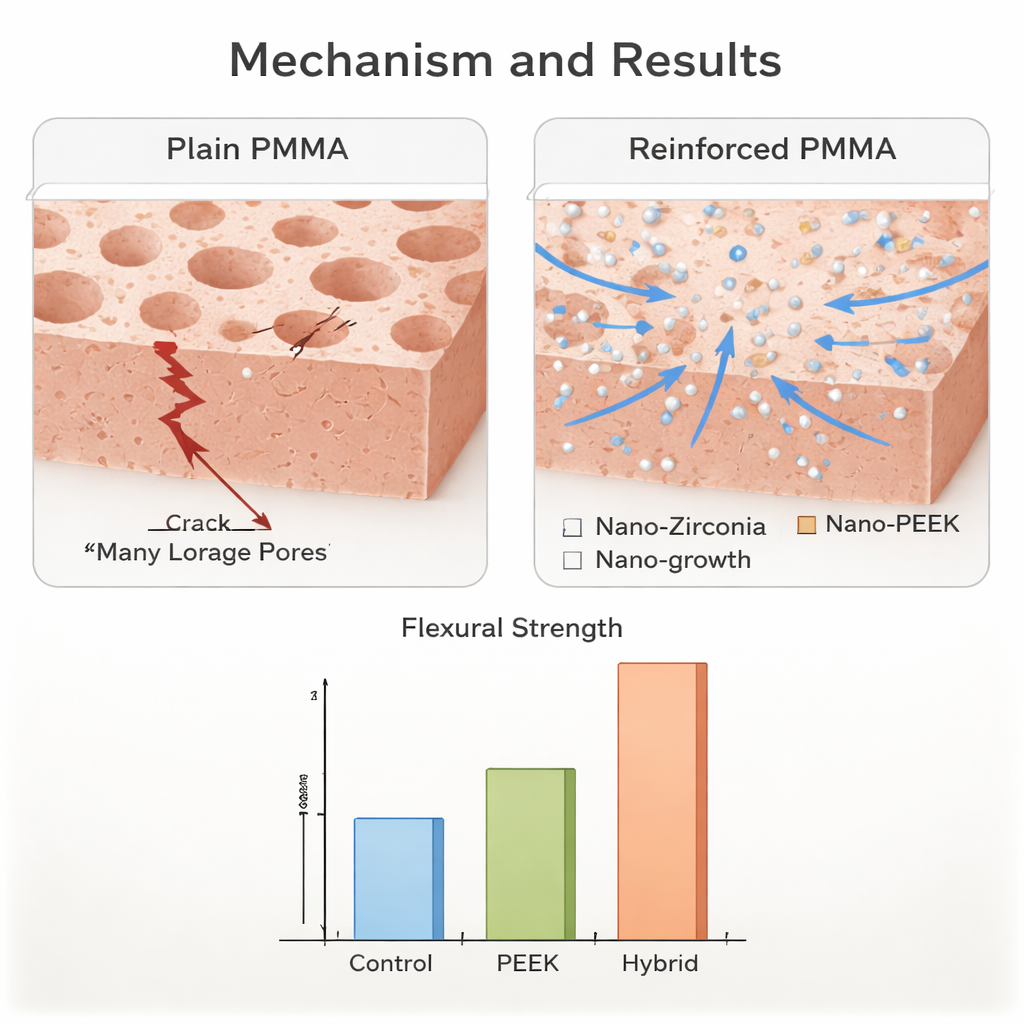
What This Means for Denture Wearers
For someone who depends on dentures every day, a break can be painful, embarrassing, and costly to repair. This research shows that carefully engineered nano-scale reinforcements—using a balanced mix of zirconia and PEEK—can make acrylic denture bases noticeably more resistant to bending and fracture than the standard material. While nano-PEEK alone is not enough, the combination of zirconia and PEEK, properly treated and evenly spread, appears to create a stronger, more durable base. With further long-term and clinical studies, this approach could lead to dentures that last longer, fail less often, and offer patients greater comfort and confidence in their daily lives.
Citation: Alrais, S., Alghoraibi, I. & Salloum, A. In vitro comparative evaluation of the flexural strength of acrylic denture bases reinforced with nano-PEEK and PEEK–zirconia composites. Sci Rep 16, 7601 (2026). https://doi.org/10.1038/s41598-026-36102-3
Keywords: denture strength, acrylic nanocomposite, zirconia reinforcement, PEEK dental materials, prosthetic durability