Clear Sky Science · en
Athletes’ origin trends in participation and performance of master runners in the New York City marathon (1999–2024): a sex- and age-group analysis
Who Really Rules the Marathon Road?
Fans of big-city marathons know that the front of the pack is often filled with astonishingly fast runners from Kenya and Ethiopia. But what happens farther back in the field, and what about runners in their 40s, 50s, 60s and beyond? This study digs into 25 years of New York City Marathon results—more than one million finishers—to reveal how age, sex and country of origin shape who runs, who excels, and how that changes across a lifetime.
A Quarter-Century of Growing Crowds
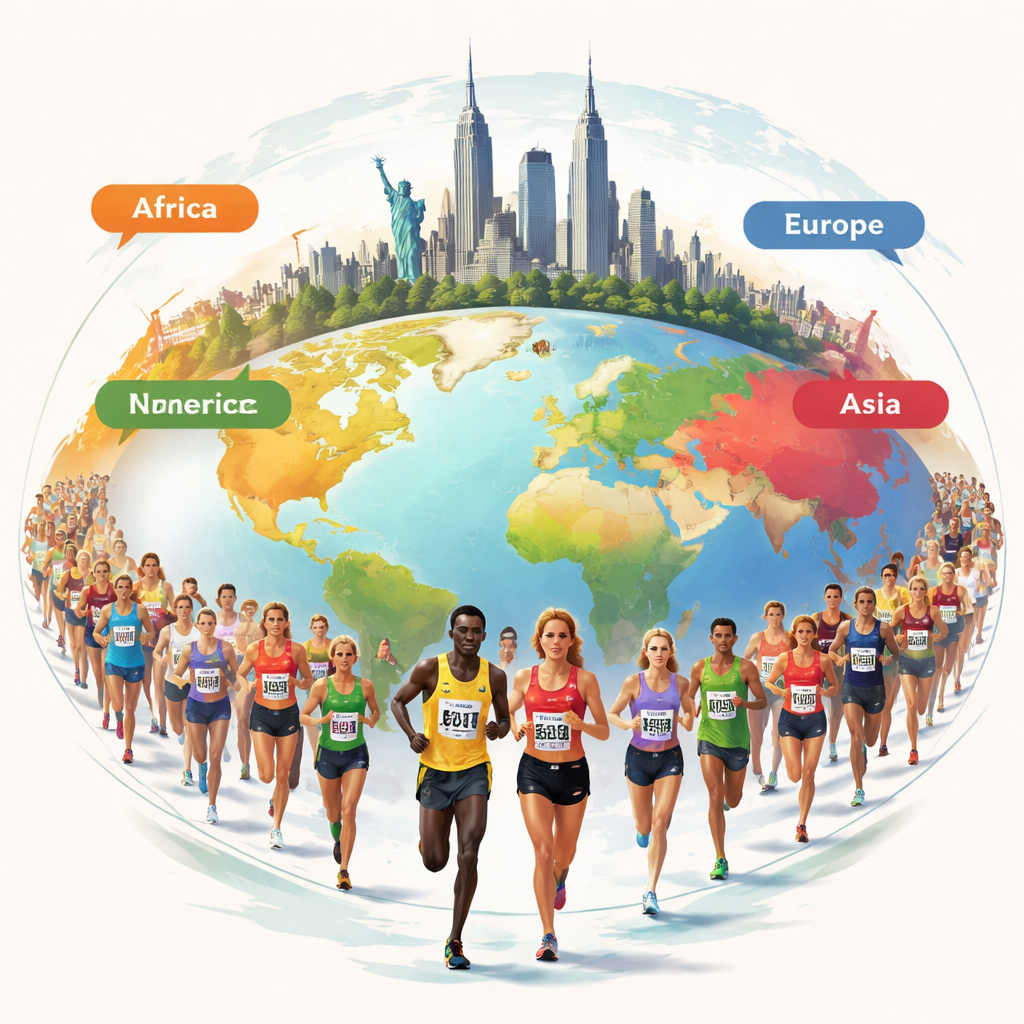
The New York City Marathon has grown into a global mass-participation event. Between 1999 and 2024, over 1,009,000 runners crossed its finish line, with men (about 626,000) outnumbering women (about 384,000) every year. Participation climbed steadily, dipped sharply during the COVID-19 disruption and then rebounded. The most common age group on the start line was 40–44 for both sexes, reflecting today’s large, fitness-minded middle-aged population. By contrast, very young runners under 20 and the oldest runners over 75 made up only a small slice of the field, showing that the marathon remains a challenge most people tackle in midlife rather than at the extremes of age.
Where the Runners Come From
Not surprisingly, the United States supplied by far the largest share of finishers every year, with tens of thousands of domestic runners turning the race into a national as well as international event. For many years, large contingents arrived from Western European countries such as France, Germany, the United Kingdom and the Netherlands; Italy, in particular, became the second-biggest source of runners. Over time, more participants began traveling from Latin America and East Asia, including Mexico and Japan, underscoring how this single race has become a showcase of recreational running from around the world.
Young Speed, Older Staying Power
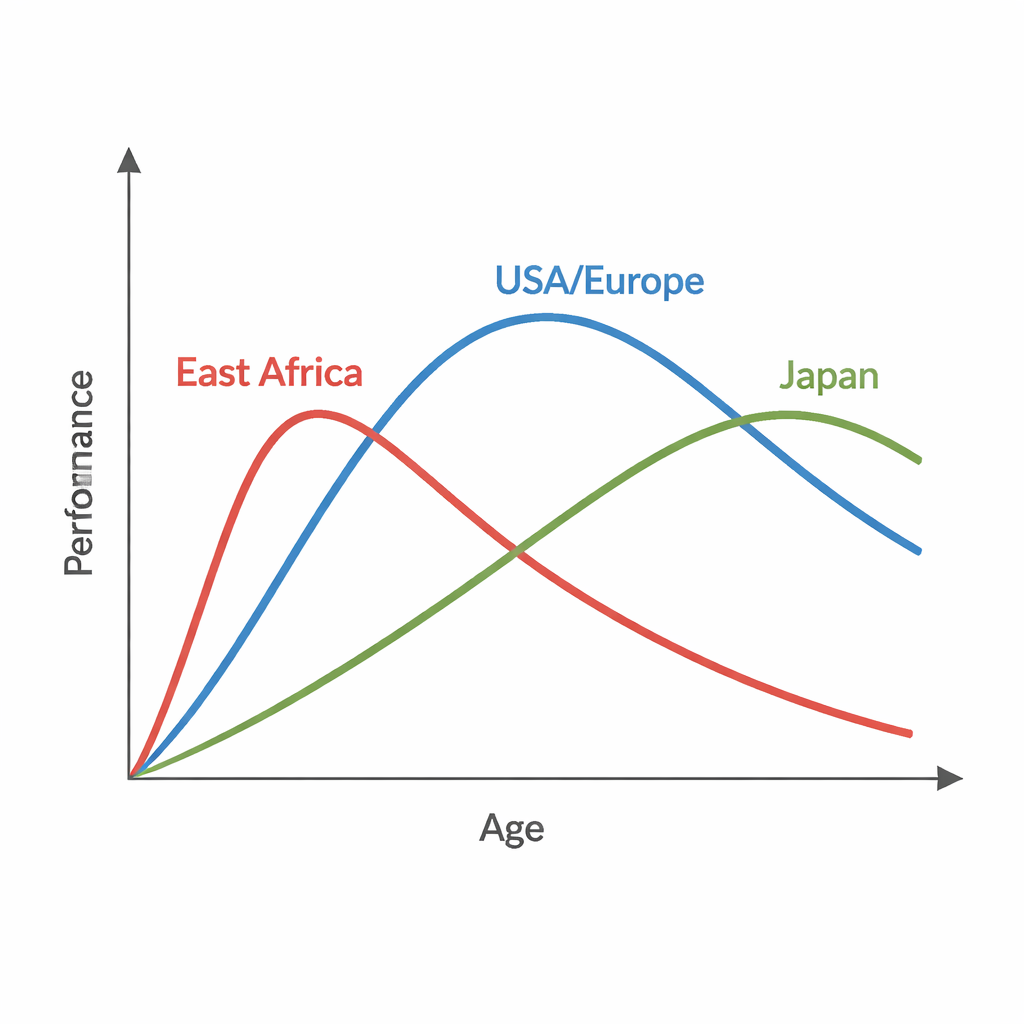
When the researchers shifted from counting runners to timing them, clear patterns emerged. Among young adults aged roughly 20 to 39, men and women from Kenya and Ethiopia recorded the fastest average finishing times, whether the team looked at all finishers, the top 100, or the very top 10 per age group. This mirrors what is seen in professional races: East African runners dominate at the sharp end. Interestingly, the handful of runners under 20 who raced well often came from European countries such as Poland, Switzerland and Italy—perhaps reflecting strong youth development systems and smaller but dedicated junior fields.
A Changing Map of Excellence with Age
Beyond age 50, the geography of marathon excellence changes. In these master age groups, the fastest averages no longer come from East Africa but from runners based in the United States, Japan, Germany and Switzerland. In the 60s and 70s, Japanese men, for example, feature prominently, while Swiss and German runners, especially women, appear frequently among the quickest. This suggests that while early-life advantages—like growing up at altitude or in strong running cultures—may fuel young champions, long-term success in later life depends more on access to health care, safe training environments, social support and traditions of recreational sport that encourage people to keep running for decades.
Beyond Passports: What Predicts Performance?
To see how much age and nationality actually “explain” marathon times, the authors used statistical models. Across all finishers, these simple demographics accounted for only a small slice of the variation in performance, hinting that everyday runners differ more because of training, lifestyle and motivation than because of their passport or birthday. However, among the top 100 finishers in each age group, age and nationality together explained about half of the differences in finish times. In other words, at higher competitive levels, where runners are more serious and training is more alike, national patterns and age bands become much more visible.
What This Means for Runners and Races
For the casual reader—or aspiring marathoner—this study offers an encouraging message. Yes, young stars from East Africa still set the pace in their 20s and 30s. But in the later decades of life, the fastest runners increasingly come from countries where ordinary people have strong support to stay active into old age. The New York City Marathon thus becomes a living map of how societies nurture lifelong fitness. It shows that with the right environment and culture, runners can achieve remarkable performances well past midlife, turning the marathon from a once-in-a-lifetime challenge into a decades-long journey.
Citation: Duric, S., Villiger, E., Andrade, M.S. et al. Athletes’ origin trends in participation and performance of master runners in the New York City marathon (1999–2024): a sex- and age-group analysis. Sci Rep 16, 5136 (2026). https://doi.org/10.1038/s41598-026-36101-4
Keywords: marathon running, master athletes, age and performance, nationality patterns, New York City Marathon