Clear Sky Science · en
A neural network framework for selecting real-time video enhancement algorithms on mobile devices
Sharper Videos in Your Pocket
From video calls with family to streaming movies and using augmented reality apps, we now expect our phones to deliver crisp, clear video anywhere, anytime. Yet every mobile device is a juggling act: it must improve image quality without draining the battery or slowing everything down. This article explores a smart decision system that helps phones automatically choose the “best” video enhancement method in real time, striking a balance between visual quality, speed, and energy use.
Why Better Video Is Hard on Phones
Modern video enhancement techniques can remove noise, boost resolution, and make dark or low-contrast scenes more visible. But many of the most powerful methods are computationally heavy, which is bad news for small processors and limited batteries. Mobile devices must weigh several competing needs at once: how fast the algorithm runs, how good the video looks, how much power it consumes, and how hard it is to implement on modest hardware. Manually choosing among several candidate algorithms for every situation is complex and error-prone, especially when conditions change from frame to frame.
Blending Human Judgement with Smart Math
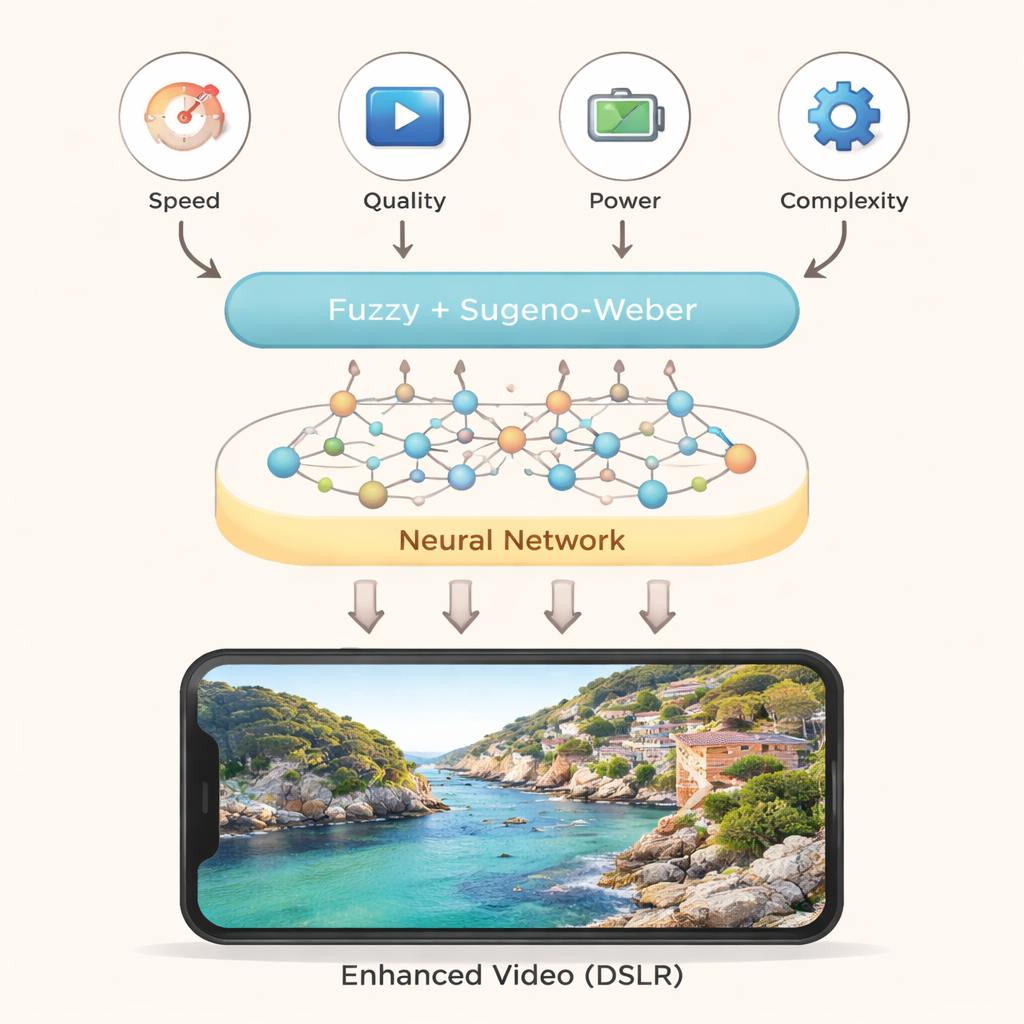
The authors propose a new decision-making framework that merges two ideas: fuzzy logic and neural networks. Fuzzy logic is a way of handling imprecise, human-style judgments such as “this method is fairly fast but somewhat power-hungry,” instead of rigid yes-or-no ratings. Neural networks, inspired by the way brain cells connect, are powerful pattern recognizers. In this framework, experts first rate each video enhancement method on four simple criteria: processing speed, visual quality improvement, power consumption, and implementation complexity. These ratings are not treated as fixed scores but as “fuzzy” values that can express shades of preference and uncertainty.

A Lean, Layered Decision Engine
To combine these fuzzy ratings, the authors use a mathematical family of tools called Sugeno–Weber norms. These norms act like adjustable mixers that aggregate different pieces of information while capturing how they interact. The fuzzy inputs from several experts are first blended into a hidden layer using a specialized averaging step. A second aggregation step produces an overall score for each candidate algorithm. Simple activation functions—mathematical filters often used in deep learning—then turn these combined values into final outputs. The authors compare two such functions (sigmoid and swish) and show that they produce very similar rankings, which suggests that the decision engine is stable and reliable.
Putting Four Video Methods to the Test
The framework is applied to four common mobile video enhancement techniques. Adaptive histogram equalization boosts local contrast, especially in uneven lighting; deep learning super resolution tries to reconstruct fine detail from low-resolution input using neural networks; wavelet-based denoising reduces noise by analyzing the image at multiple scales; and frequency-domain filtering manipulates patterns in the frequency domain to emphasize or suppress certain features. Each method is rated, combined across experts, and passed through the fuzzy neural network. The system consistently ranks deep learning super resolution as the top choice, striking the best overall balance of speed, quality, power, and complexity under the given expert assessments.
Robust Choices for Real-World Devices
The authors also vary key internal parameters to test how sensitive the rankings are to tuning. While the exact numerical scores shift slightly, the overall ordering of the four methods does not change, indicating that the model’s conclusions are robust. They then compare their fuzzy neural approach against several other established decision-making techniques and find that these, too, point to deep learning super resolution as the best option. For a lay reader, the takeaway is simple: by carefully blending expert opinion with a compact, efficiently computed neural network, this framework can help phones and other small devices automatically pick the most suitable video enhancement strategy in real time—delivering clearer, sharper video without sacrificing responsiveness or battery life.
Citation: Khan, M., Rahman, M.I. & Ziar, R.A. A neural network framework for selecting real-time video enhancement algorithms on mobile devices. Sci Rep 16, 5257 (2026). https://doi.org/10.1038/s41598-026-36099-9
Keywords: mobile video enhancement, fuzzy neural networks, deep learning super resolution, real-time image processing, decision-making models