Clear Sky Science · en
Effects of long term canopy change on regulating ecosystem services in a tropical urban park
Why city trees matter to everyday life
In hot, crowded cities, parks do far more than offer a bit of shade. The trees in these green spaces quietly clean the air, soak up stormwater to reduce flooding, and pull climate-warming carbon dioxide out of the atmosphere. This study followed every tree in a landmark urban park in central Bangkok over five years to see how changes in the leafy canopy—through growth, pruning, and loss—altered these hidden benefits and their money value to society.
A living laboratory in the heart of Bangkok
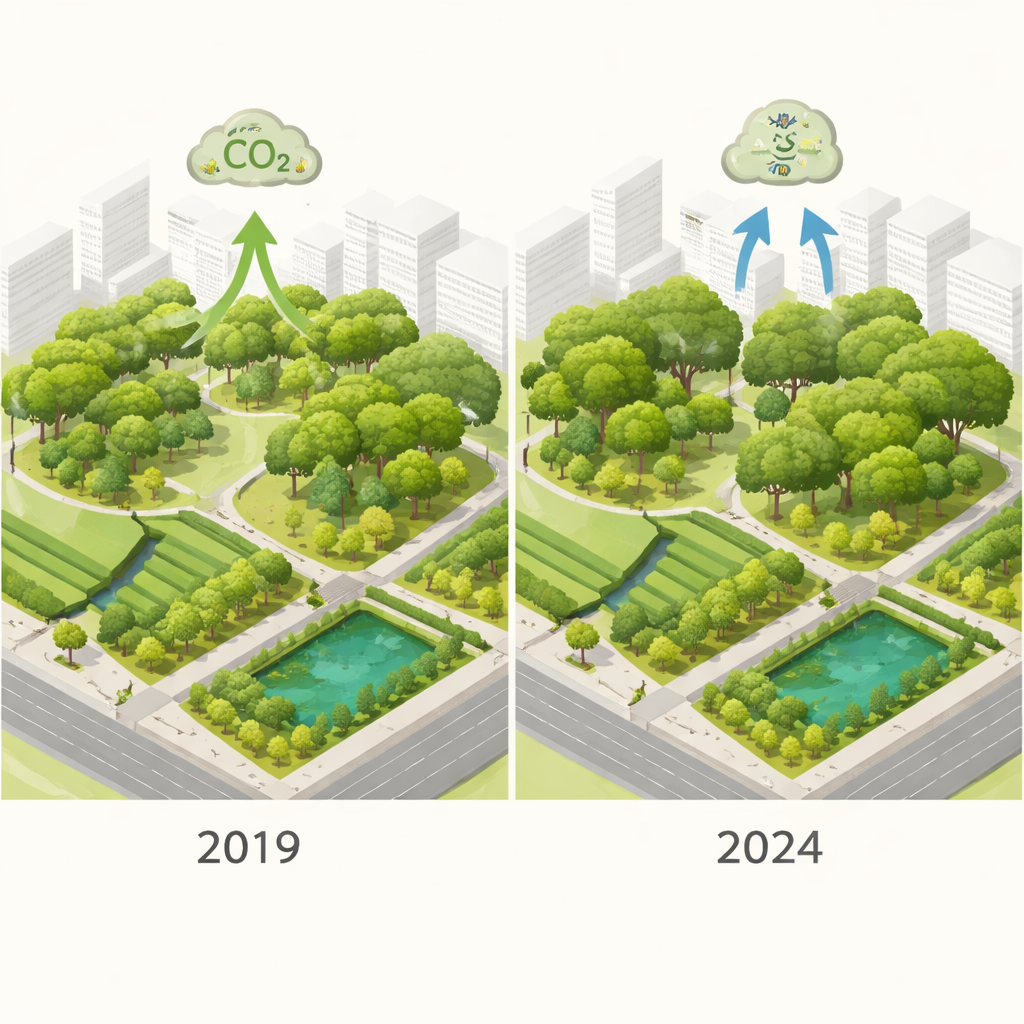
The research took place in Chulalongkorn University Centenary Park, a 4.48-hectare park built with climate resilience in mind. The park’s sloped green roof and retention pond are designed to capture heavy tropical rains, while tree-lined paths and open lawns give residents space to walk, meditate, and relax. In 2019, scientists recorded detailed measurements of 694 planted trees representing 54 species, both deciduous (which shed leaves) and evergreen (which stay green year-round). They returned in 2024 to re-measure each tree’s size and canopy and to calculate how much pollution, stormwater, and carbon the park’s trees handled in each year using a widely used tool called the i-Tree Eco model.
What five years of change looked like
Over five years, the park’s tree population shrank sharply: 260 trees—about 37 percent of the original total—were gone by 2024, including 15 mostly rare species. Yet the 434 surviving trees grew substantially. On average, their trunks became nearly 60 percent thicker, their height increased by about one-fifth, and their leaf area nudged upward. Evergreen trees, such as the spreading rain tree Samanea saman, tended to put on more height and trunk girth than deciduous trees. A few large, fast-growing evergreens contributed disproportionately to this growth, meaning that a handful of species now carry much of the park’s ecological workload.
Hidden services, counted in dollars
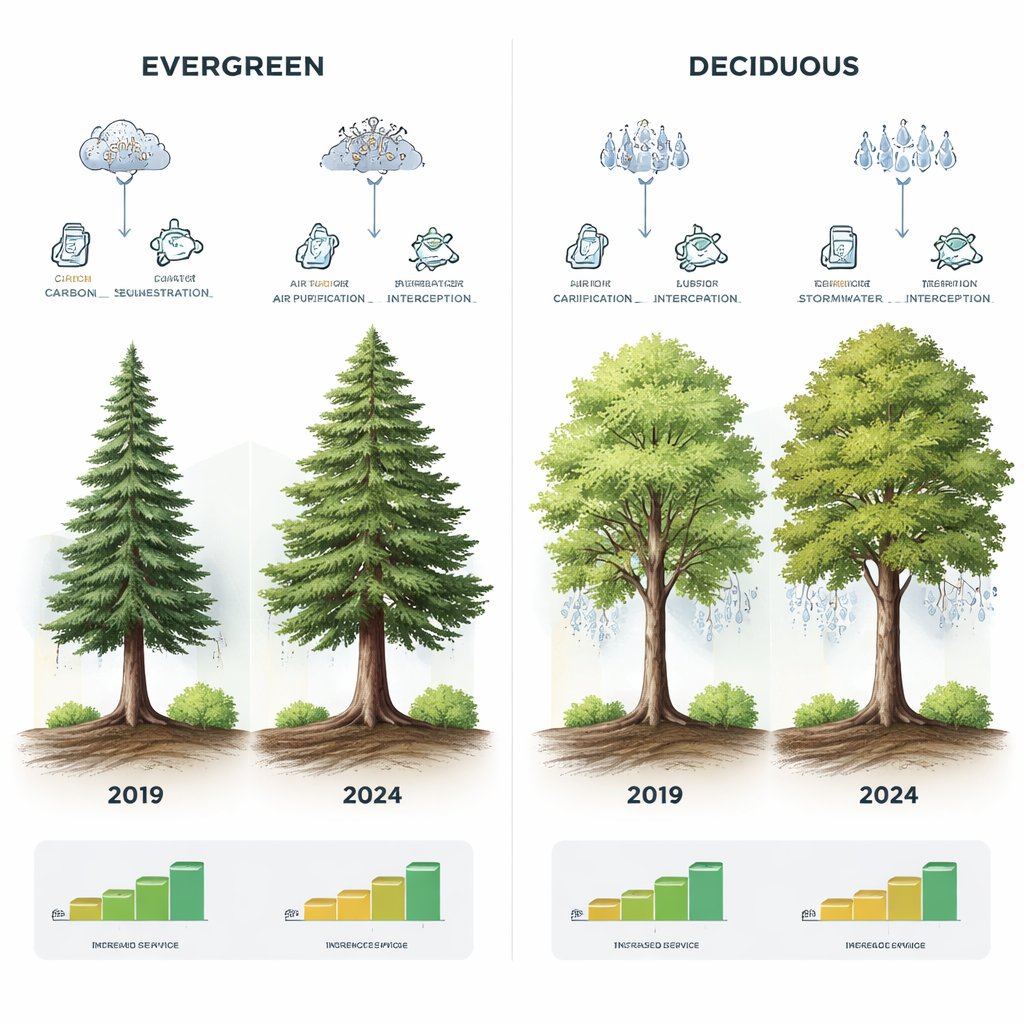
Using the tree measurements, the team estimated three key “regulating ecosystem services”: carbon sequestration (how much CO₂ trees locked away), air purification (pollutants captured by leaves), and stormwater runoff reduction (rain intercepted and slowed before it could flood streets). For the surviving trees, the total annual value of these services more than doubled between 2019 and 2024, rising from about 1,545 to 3,491 U.S. dollars—a 126 percent increase. The biggest jump came from stormwater control, followed by cleaner air and then carbon storage. Evergreen trees showed larger gains in all three services than deciduous trees, largely because they kept their leaves year-round and experienced stronger growth.
The cost of losing and mistreating trees
Despite this headline growth in benefits, the story is not entirely positive. The loss of 260 trees translated into an annual loss of roughly 886 U.S. dollars in services that those trees could otherwise have provided. Field observations suggested that many deaths were not caused by old age or disease, but by human practices—especially severe “topping” cuts that remove most of a tree’s crown. Such pruning can weaken trees, trigger dieback, and ultimately kill them, wiping out both current and future benefits. The measured five-year mortality rate of 37 percent was more than double the rate assumed in common forecasting models used by planners, which typically build in only 15 percent tree loss over the same period.
Rethinking how we care for urban parks
The study concludes that well-designed parks in tropical cities can deliver growing environmental and economic benefits over surprisingly short periods, as long as trees are allowed to mature. However, poor management—especially aggressive pruning and high tree turnover—can sharply erode those gains. For city residents, this means that the shade, cleaner air, and reduced flooding they expect from green spaces depend not just on planting trees, but on keeping them alive and healthy. For planners and park managers, the findings underscore the need to account for real-world human impacts when predicting future benefits and to prioritize gentler, science-based tree care so that urban forests can thrive for decades.
Citation: Kasikam, N., Yarnvudhi, A., Leksungnoen, N. et al. Effects of long term canopy change on regulating ecosystem services in a tropical urban park. Sci Rep 16, 5077 (2026). https://doi.org/10.1038/s41598-026-36098-w
Keywords: urban trees, ecosystem services, urban parks, Bangkok, stormwater and air quality