Clear Sky Science · en
A multifunctional graphene oxide–ZnO nanohybrid for rapid and highly efficient malachite green adsorption and strong broad-spectrum antimicrobial activity
Cleaning up colorful but dangerous water
Sparkling blue rivers and clear drinking water can hide an invisible mix of industrial dyes and disease‑causing microbes. One such dye, malachite green, is cheap and vivid, but even tiny amounts can damage organs and disrupt hormones. At the same time, bacteria and fungi in wastewater are becoming harder to kill with antibiotics. This study explores a single new material that can both grab this stubborn dye from water and kill a wide range of germs in just minutes, offering a glimpse of future water treatment systems that are simpler, faster, and more sustainable.
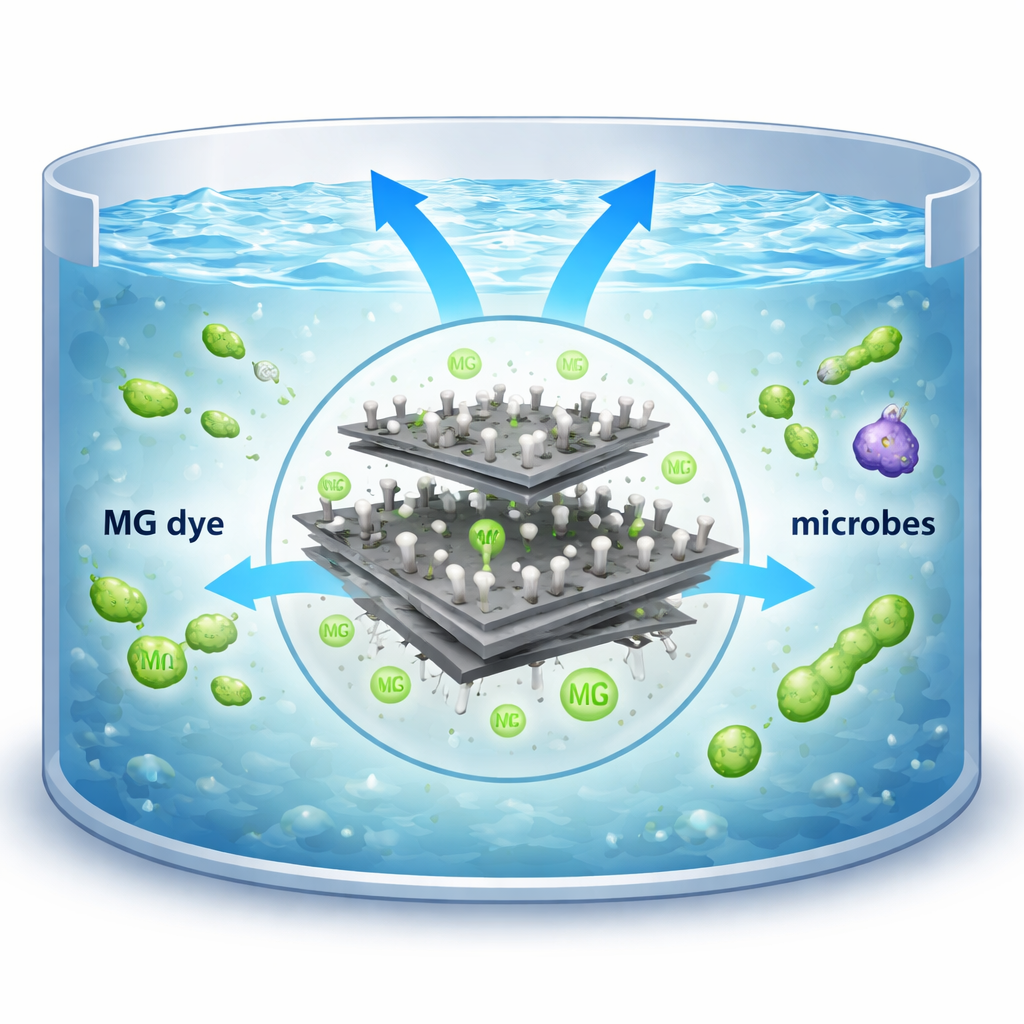
A smart sponge made of sheets and rods
The researchers built a “nanohybrid” by combining two well‑known materials at the nanoscale: graphene oxide and zinc oxide. Graphene oxide is a thin, sheet‑like form of carbon covered with oxygen‑containing groups, giving it a very large surface area and plenty of spots where molecules can stick. Zinc oxide forms tiny crystals that are famous for their germ‑killing ability. On their own, each material has drawbacks—graphene sheets clump together and have weak antimicrobial power, while zinc oxide particles can stick to each other and do not bind dyes very well. By chemically anchoring zinc oxide nanorods onto flexible graphene oxide sheets, the team created a stable, porous network that keeps both components well dispersed and active in water.
Grabbing a toxic dye in minutes
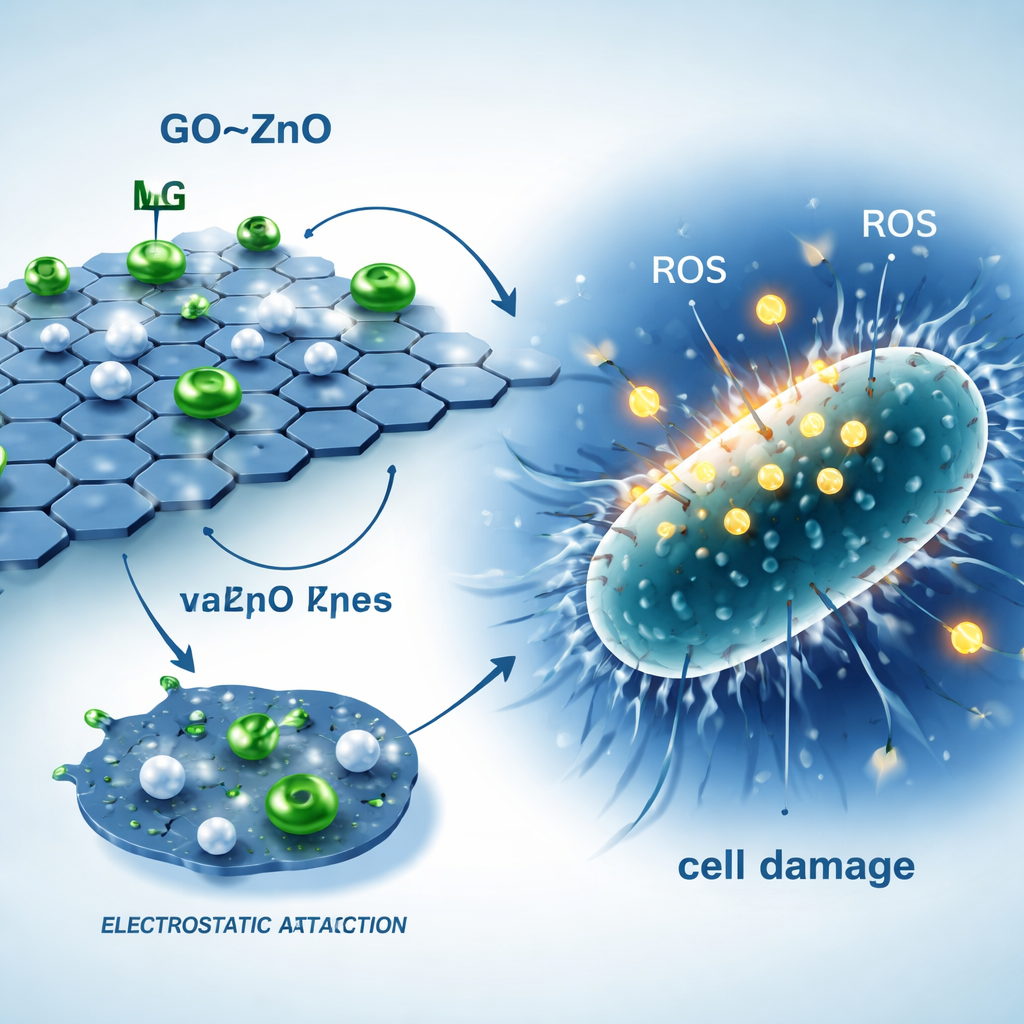
To test how well this hybrid acts as a “sponge” for malachite green, the authors carefully varied key conditions such as dye concentration, water acidity (pH), temperature, contact time, and how much material they added. Instead of running thousands of experiments, they used a statistical approach to home in on the most informative combinations. Under mild conditions—room temperature, slightly alkaline water (pH 9), and just 12 minutes of contact—the material removed about 96–99% of the dye. The data showed that dye molecules pack into a single, dense layer on the surface, and that the process is driven by multiple forces: electrical attraction between negatively charged sites on the sheets and the positively charged dye, stacking between flat dye rings and the carbon surface, and hydrogen bonds. The reaction becomes more favorable as temperature rises and is fast enough to be practical in real treatment systems.
Fighting bacteria and fungi at the same time
Beyond dye removal, the nanohybrid also acts as a powerful disinfectant. The team tested it against several microbes, including common culprits in hospital infections—Escherichia coli, Staphylococcus aureus, and Acinetobacter baumannii—as well as the yeast Candida albicans, including drug‑resistant strains. In laboratory tests, relatively low amounts of the material were enough to stop growth of all these organisms. The zinc oxide component generates highly reactive oxygen species that attack cell walls, proteins, and DNA, while the razor‑sharp edges of the graphene sheets physically damage cell membranes. Because this attack is both chemical and mechanical, and does not rely on traditional antibiotics, it is less likely to push microbes toward new drug resistance.
Built to last and ready for real water
A common weakness of advanced treatment materials is that they work only once or fail in dirty, real‑world water. Here, the researchers showed that their hybrid can be rinsed with small amounts of methanol and reused multiple times while keeping most of its performance: after four cycles it still removed more than 87% of the dye. When tested in actual tap water, river water, mineral water, and industrial wastewater, the material still captured more than 88% of malachite green, even in the presence of other salts and organic matter that usually interfere with cleanup. Its porous structure and large surface area appear to help dye molecules reach active sites quickly, supporting ultrafast treatment.
What this means for safer water
For non‑specialists, the main message is that a single, carefully engineered nanoscale material can now both strip out a hazardous industrial dye and kill tough bacteria and fungi in a single step, using modest amounts of material and short contact times. The graphene‑oxide–zinc‑oxide hybrid works like a smart, reusable filter that not only traps toxic color but also disinfects the water without relying on antibiotics or harsh chemicals. While more work is needed to test long‑term safety and scale‑up, this approach points toward compact, energy‑efficient systems that could help protect communities from chemical and microbial water pollution at the same time.
Citation: Ebrahimi, S., Zanganeh, P., Nouripour-Sisakht, S. et al. A multifunctional graphene oxide–ZnO nanohybrid for rapid and highly efficient malachite green adsorption and strong broad-spectrum antimicrobial activity. Sci Rep 16, 7316 (2026). https://doi.org/10.1038/s41598-026-36097-x
Keywords: water purification, nanomaterials, wastewater treatment, antimicrobial surfaces, dye pollution