Clear Sky Science · en
Genetic diversity and transmission dynamics of SARS-CoV-2 in East Africa
Why this story of viral travel matters
When COVID-19 swept across the globe, it did not move randomly. It followed people along roads, trade routes, and flight paths. This study looks closely at how the coronavirus spread and evolved in East Africa between 2020 and 2022, using genetic clues from the virus itself. By retracing the virus’s journey through countries such as Kenya, Uganda, Rwanda, Burundi, South Sudan, and the Democratic Republic of Congo (DRC), the researchers show how everyday movement of truck drivers, traders, and refugees helped shape the pandemic—and what that means for protecting the region from future outbreaks.
Following the virus through its genetic fingerprints
Every copy of the coronavirus carries a genetic code that changes slightly as it spreads from person to person. By collecting and comparing more than 11,000 high-quality virus genomes from East Africa, the team could tell which versions of the virus appeared where and when. Most of the sequences came from Kenya and the DRC, with Uganda also well represented; Rwanda, Burundi, and South Sudan had far fewer samples, reflecting weaker testing and sequencing capacity. Still, the combined data provided a powerful snapshot of how the pandemic unfolded across the region and how international movements fed local outbreaks.
Waves of new variants across the region
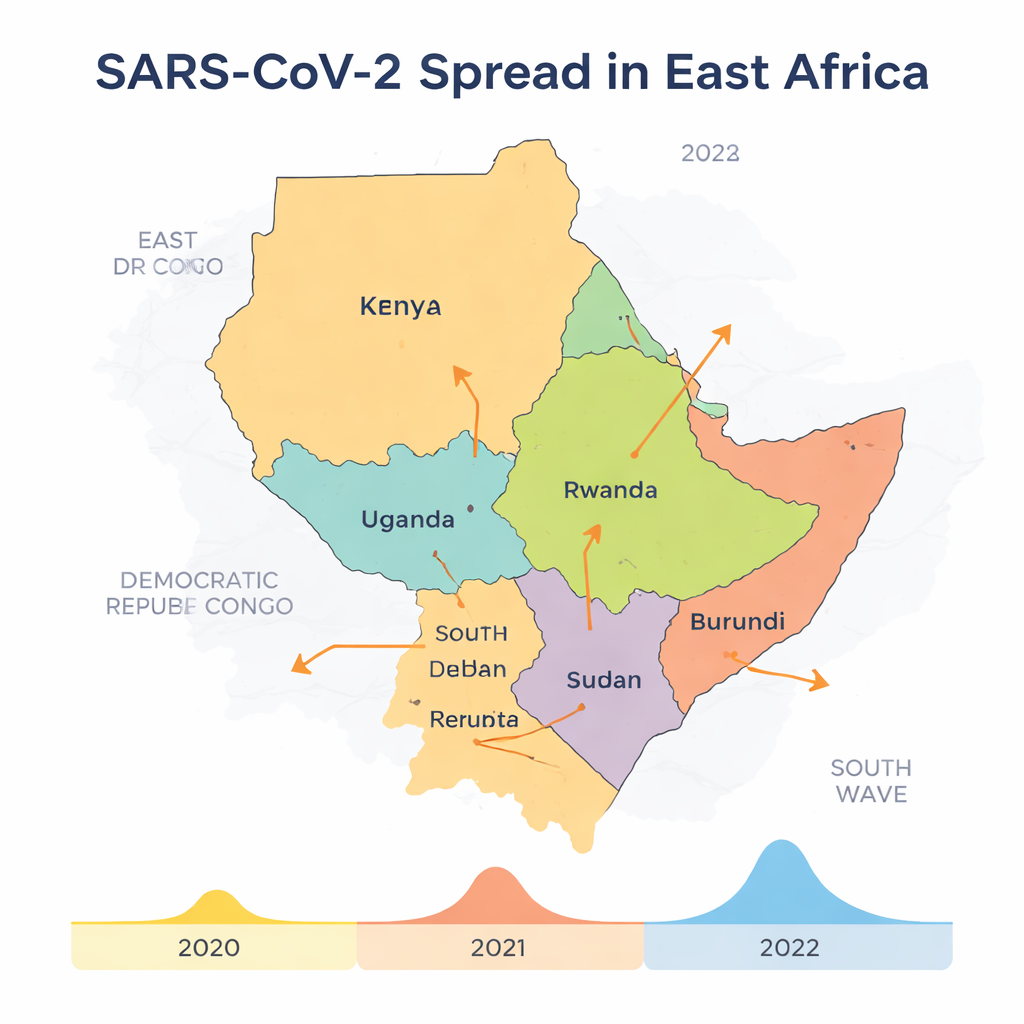
Using these sequences, the researchers charted how different COVID-19 variants rose and fell over time. Early forms of the virus were soon replaced by better-adapted versions such as Beta, Delta, and later Omicron, mirroring global trends. Kenya consistently recorded the largest number and widest mix of variants, with clear spikes during the Delta wave in 2021 and the Omicron surge in 2022. Uganda and the DRC showed noticeable but smaller waves, while Rwanda, Burundi, and South Sudan reported only limited variant diversity—likely a mix of fewer infections detected and fewer samples sequenced. Overall, the region experienced broadly synchronized waves, suggesting that once a new variant arrived in one country, it did not stay put for long.
A tangled family tree that ignores borders
To understand how these variants were related, the team built a large “family tree” of the virus genomes. Instead of tidy clusters limited to one country, they found branches where sequences from Kenya, Uganda, Rwanda, Burundi, South Sudan, and the DRC were thoroughly mixed. Five major genetic clusters contained samples from multiple countries, pointing to repeated introductions and cross-border spread rather than isolated national epidemics. Kenya and Uganda, which contributed the most sequences, appeared throughout the tree, while smaller countries appeared in fewer places but still shared lineages with their neighbors. The picture that emerges is of a regional epidemic woven together by movement along roads and through border towns, not by separate, sealed-off outbreaks.

Roads, trucks, and refugees as hidden highways
By combining this genetic family tree with maps and timelines, the researchers traced likely directions of spread. Kenya emerged as a key source of infections for the DRC, Uganda, and South Sudan, with additional virus movements between the DRC and Uganda and from Rwanda into South Sudan. This pattern fits Kenya’s role as East Africa’s main trade and transport hub, with busy highways, ports, and airports that stayed at least partly active even during lockdowns. Long-distance truck drivers and cargo handlers, who were often exempt from strict travel bans, became unintentional carriers of the virus across borders. At the same time, porous land borders, informal crossing points, and refugee movements—especially between the DRC, Uganda, Rwanda, and South Sudan—created many opportunities for the virus to slip past official checkpoints and health screens.
Lessons for the next pandemic
For non-specialists, the key message is simple but powerful: viruses pay close attention to how we move. In East Africa, COVID-19 did not stop at border posts; it flowed along trade corridors and migration routes, with Kenya acting as a major relay station. The study shows that tracking the virus’s genetic changes can reveal these hidden routes of spread and highlight where stronger cooperation is needed. The authors argue that future pandemic preparedness in the region must focus on shared border health systems, better data sharing, and wider access to genomic testing, so that countries can quickly spot new threats and act together. In a world where an infection can cross a continent in days, no country’s health security can be separated from that of its neighbors.
Citation: Nabisubi, P., Kanyerezi, S., Agasi, H. et al. Genetic diversity and transmission dynamics of SARS-CoV-2 in East Africa. Sci Rep 16, 5235 (2026). https://doi.org/10.1038/s41598-026-36094-0
Keywords: COVID-19, SARS-CoV-2 variants, East Africa, genomic surveillance, cross-border transmission