Clear Sky Science · en
Deep learning based individual identification and population estimation of the yellow spotted mountain newt (Neurergus derjugini)
Why tiny mountain newts matter
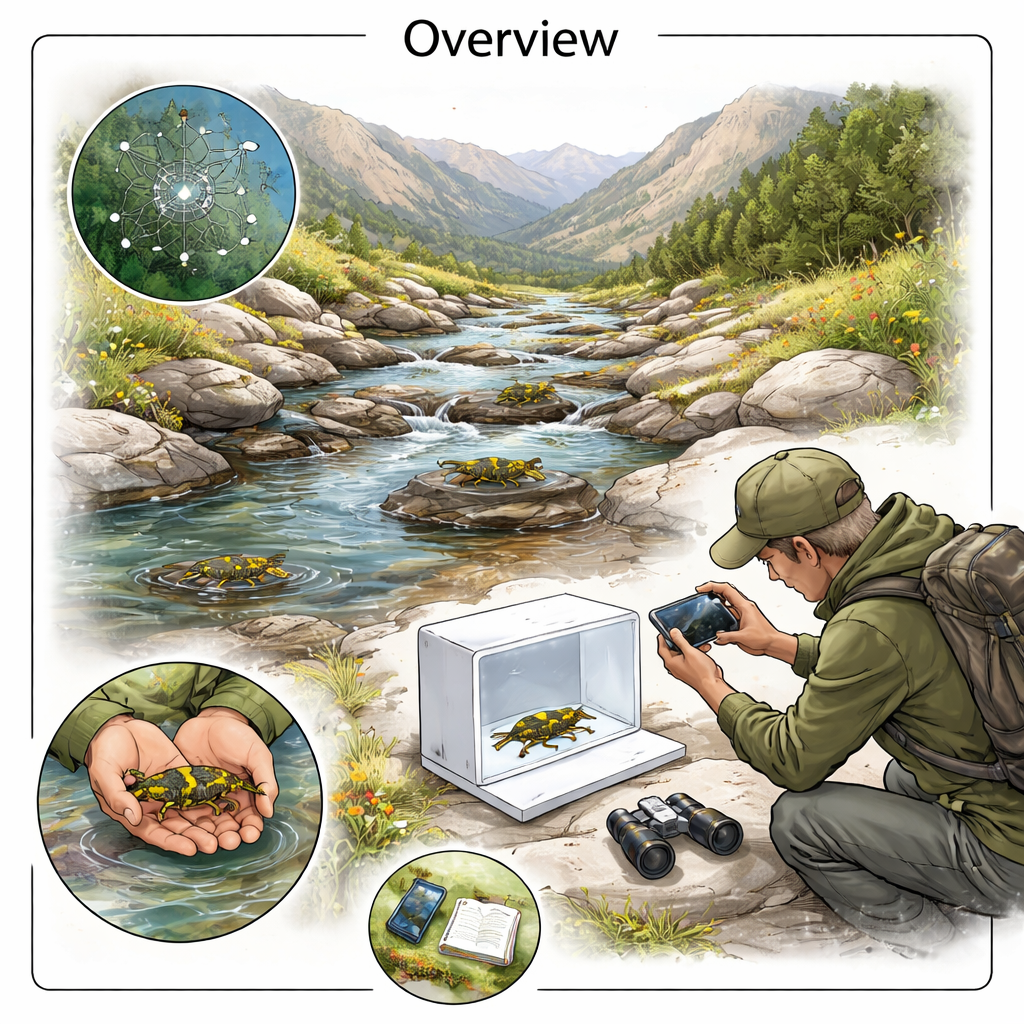
High in the streams of Iran’s Zagros Mountains lives a small, endangered amphibian: the yellow-spotted mountain newt. Like many of the world’s frogs and salamanders, its numbers are under pressure from pollution, habitat loss, and climate change. To protect such a fragile species, scientists must know how many animals are out there and whether their populations are shrinking or recovering—yet traditional techniques for tagging and tracking individuals can harm the very creatures they aim to save. This study shows how ordinary smartphone photos, paired with modern artificial intelligence, can recognize individual newts from their unique spot patterns and estimate their population in a gentle, hands-off way.
From harmful tags to harmless photos
Conservation biologists have long relied on methods such as toe clipping, implanted microchips, or colored bands to tell animals apart over time. Although effective, these approaches can be painful, stressful, and impractical for small, delicate amphibians that already face many threats. The researchers behind this study set out to replace these invasive methods with a simple photographic technique. Yellow-spotted mountain newts naturally wear a distinctive coat of bright yellow spots on dark skin, much like a fingerprint or a constellation in the night sky. By carefully photographing these patterns in the wild, the team aimed to build a system that could recognize each animal on sight and track it over repeat surveys.
Turning spots into data
Working at a mountain stream known as a breeding hotspot, the team captured 549 adult newts during the 2024 season. Each animal was briefly placed in a small white imaging box, illuminated with soft natural light, and photographed from above with a standard smartphone. The newts were then released exactly where they were found. Back in the lab, the scientists first used classic image-processing steps to “teach” the computer what counted as a yellow spot and what was background. By converting color images into a form that highlights hue and brightness, and by cleaning away visual noise, they could measure how many spots each newt had, how large and round the spots were, and how much of the body they covered. This geometric method alone correctly detected spots in about nine out of ten cases, even when images were cropped to focus on just the head or trunk.
How artificial intelligence learns a face
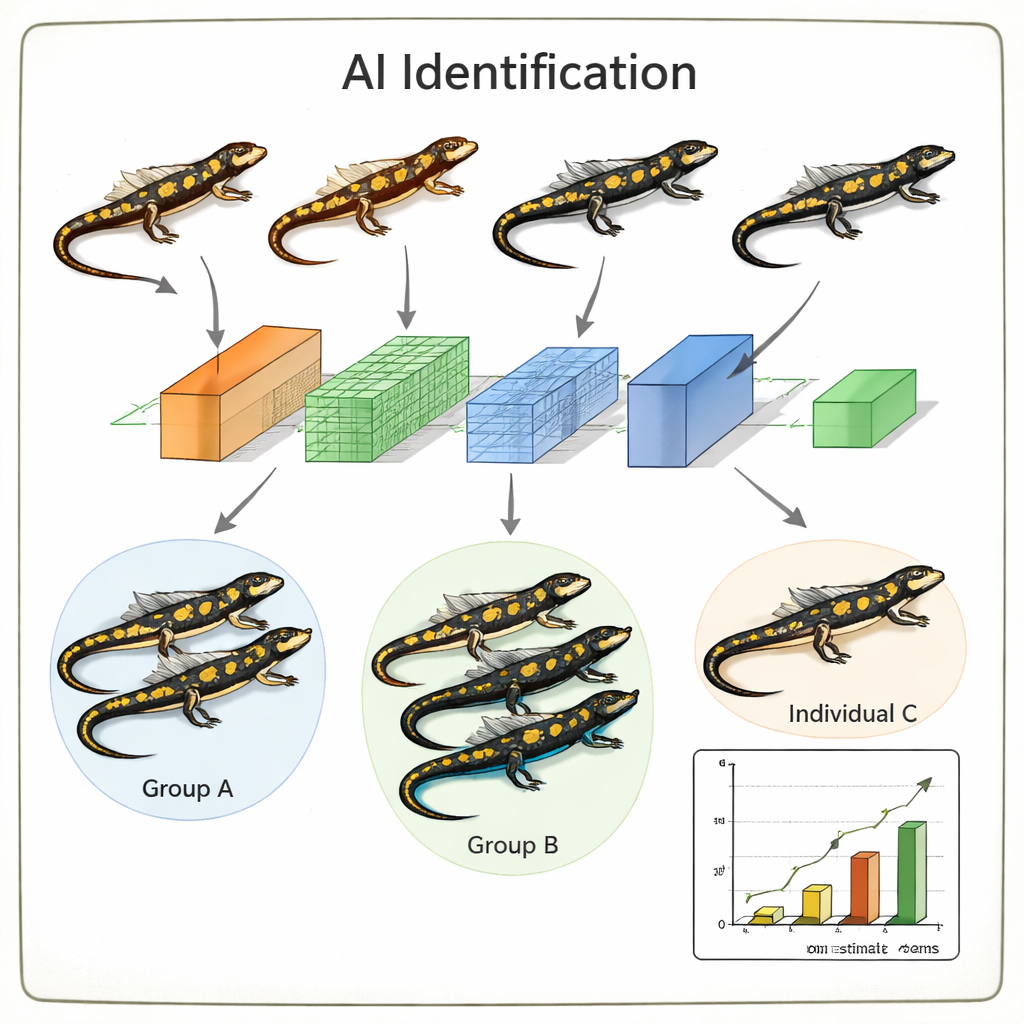
To go beyond counting spots and truly recognize individuals, the researchers turned to deep learning, a form of artificial intelligence inspired by how brains process visual information. They trained three different convolutional neural networks—computer models that excel at image recognition—using the newt photos and their known identities. Without being told what specific features to look for, these networks learned to distinguish subtle differences in the arrangement and shape of yellow spots. All three models performed impressively, correctly identifying almost every newt, with the best network reaching over 99% accuracy. The system worked especially well when it analyzed both the head and trunk together, suggesting that combining several body regions gives the AI more reliable “clues” about who is who.
Counting a hidden population
Individual recognition is powerful because it unlocks a classic ecological tool called mark–recapture, in which animals detected on a first visit are “marked” and then searched for again later. Instead of physical marks, this study used image matches from the deep learning system as virtual tags. In two surveys 13 days apart, the team photographed 332 newts the first time and 217 the second, discovering 65 individuals that appeared in both sets of images. Feeding these numbers into a standard formula produced an estimated local population of about 1,100 yellow-spotted mountain newts in the stream. While this number carries some uncertainty—real animals can move in and out of the study area—it offers a non-invasive snapshot of how many are present and provides a baseline for tracking future changes.
What this means for saving species
For a non-specialist, the key message is simple: by using photographs and AI instead of scalpels and tags, scientists can watch over vulnerable animals with far less risk of harming them. In this case, the unique yellow spots of a mountain newt become a natural barcode that a computer can read with remarkable reliability. This fast, low-cost approach could be rolled out with smartphones and laptops in remote field sites, helping conservationists monitor threatened amphibians as climates warm and habitats shift. Beyond this one species, the study offers a blueprint for using modern image recognition to safeguard a wide range of shy, fragile creatures whose survival may depend on being seen—but never touched—by the people trying to protect them.
Citation: Rahmdel, Z., Vaissi, S., Faramarzi, P. et al. Deep learning based individual identification and population estimation of the yellow spotted mountain newt (Neurergus derjugini). Sci Rep 16, 6475 (2026). https://doi.org/10.1038/s41598-026-36092-2
Keywords: amphibian conservation, photo identification, deep learning, population monitoring, endangered species