Clear Sky Science · en
Eco-efficient symbio-pozzolanic hydrophobic cementitious binders for sustainable and durable infrastructure
Keeping Buildings Safe from Water and Decay
Bridges, ports, and high-rise buildings all rely on concrete, but this everyday material has two big problems: it lets water and corrosive salts sneak in, and making its main ingredient—cement—pumps large amounts of carbon dioxide into the air. This study explores a new type of cement binder that aims to tackle both issues at once, helping structures last longer in harsh conditions while cutting their climate impact. 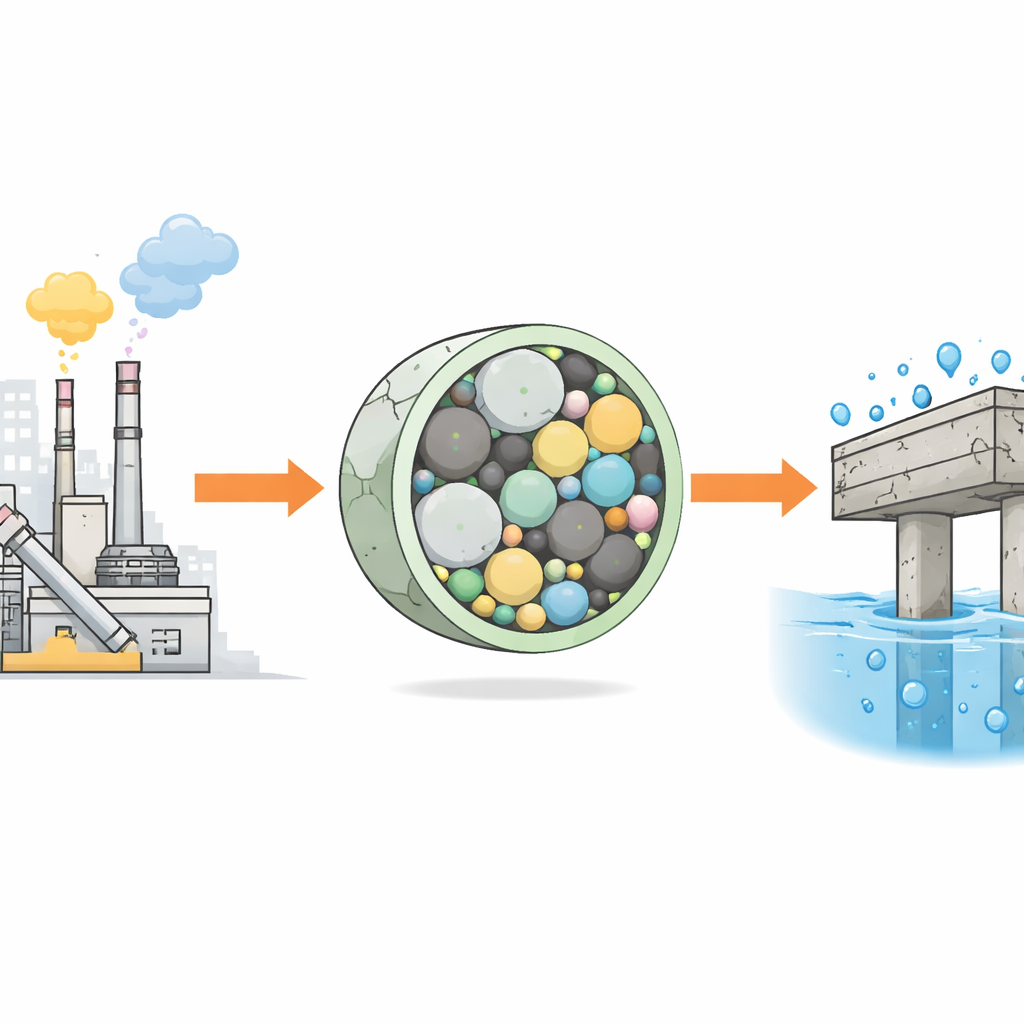
Why Ordinary Cement Falls Short
Standard cement is strong but thirsty. Its tiny pores soak up water, carrying in salts, acids, and other aggressive chemicals that slowly attack steel reinforcement and the surrounding material. At the same time, producing ordinary Portland cement is responsible for nearly 8% of human-made carbon dioxide emissions. Engineers already blend in industrial by-products such as fly ash, silica fume, and calcined clay (metakaolin) to reduce emissions and refine the pore structure. However, even these “greener” blends still behave like a sponge: they remain wettable and allow water to move through their pores.
A Powder That Makes Concrete Shed Water
The research team developed a new composite powder, called a symbio-pozzolanic hydrophobic powder, that combines three mineral additives with a small amount of zinc stearate, a wax-like substance. The minerals help form extra binding gel and pack the particles more tightly, while zinc stearate lines the inner surfaces of the pores with water-repelling films. This powder is produced by carefully grinding and gently heating the ingredients so they mix evenly and the hydrophobic component is activated. The powder then replaces between 5% and 40% of the cement in a paste, allowing the scientists to measure how different doses affect workability, strength, and resistance to damage.
Finding the Sweet Spot Between Strength and Protection
When the hydrophobic powder was added, the fresh paste became a bit less fluid and took slightly longer to set, because the fine particles and water-repelling surfaces interfered with the easy spread of water. As the material hardened, strength first dipped slightly, then improved, and finally dropped again at very high replacement levels. A mix with 25% of the powder struck the best balance: it kept about three-quarters of the compressive strength of the plain cement paste and more than 85% of its bending and pulling strength. At the same time, its surface started to behave more like a waterproof jacket than a sponge, with water droplets forming beads instead of soaking in. 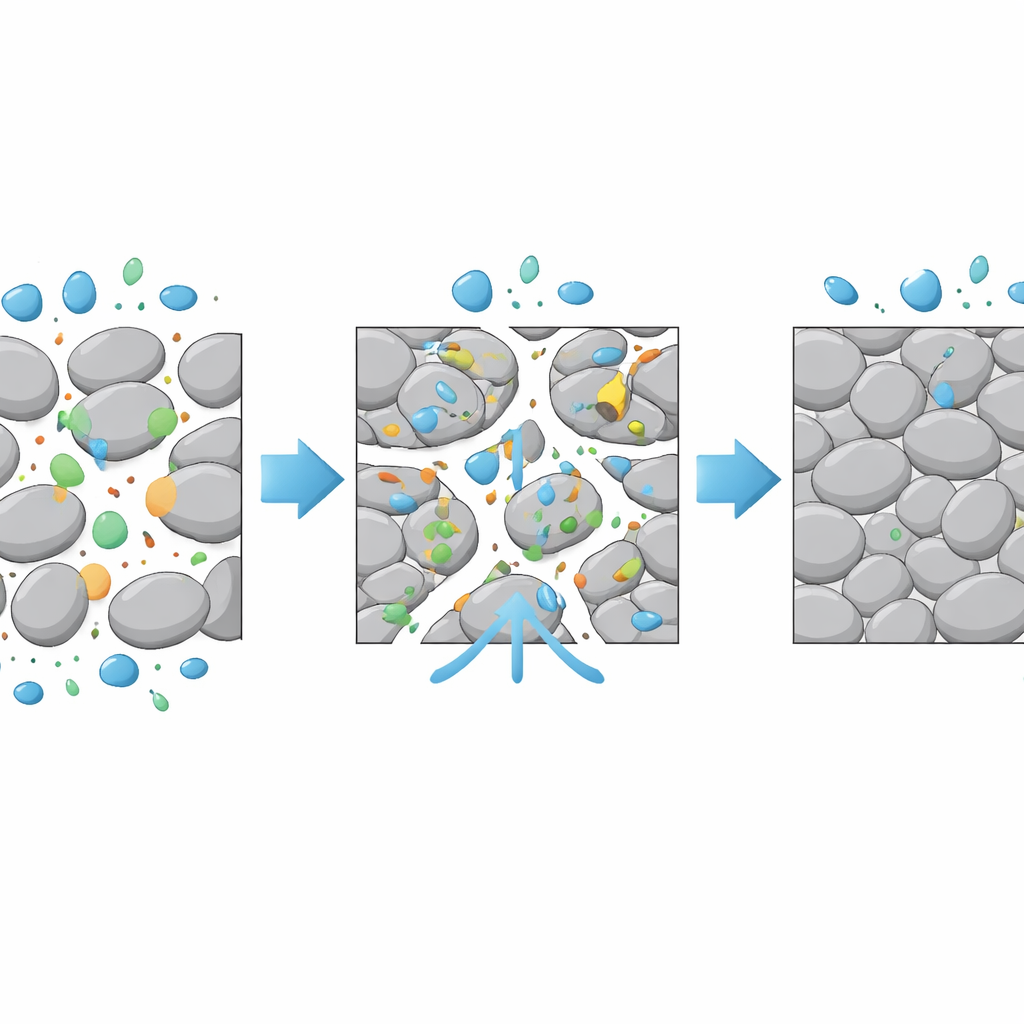
Standing Up to Water, Salts, and Acids
The 25% mix did far more than simply repel surface water. It absorbed about one-third less water overall, cut the flow of chloride ions (a major cause of steel corrosion in marine environments and de-icing conditions) by more than half, and showed much higher stability when soaked in acidic and sulfate-rich solutions. Non-destructive pulse tests revealed that sound waves traveled faster through this mixture, a sign of a denser, less cracked internal structure. Microscopic and chemical analyses confirmed what the performance data suggested: the composite powder encouraged the formation of additional binding gel that filled pores, while the hydrophobic component coated pore walls and interrupted easy pathways for liquids and ions.
Lower Climate Impact at Comparable Cost
Because the new binder replaces a quarter of the cement with materials that are less carbon-intensive, it reduces the greenhouse-gas footprint of the paste by about 21% per cubic meter. A cost analysis showed that although the material with the hydrophobic powder is slightly more expensive per unit strength than plain cement, it delivers better durability per unit cost. In other words, for structures exposed to harsh environments such as seawater, industrial effluents, or de-icing salts, this mix is likely to last longer and require fewer repairs, making it an attractive option over the full life of a project.
What This Means for Future Concrete
Overall, the study shows that it is possible to design a cement-based material that is both more climate-friendly and far more resistant to water-driven damage from salts and acids. The most promising recipe replaces 25% of the cement with the specially engineered hydrophobic powder, achieving strong, dense, and water-repellent paste while cutting emissions. Before it can be widely adopted in real-world projects, this approach still needs to be tested in full concrete with aggregates and under varied field conditions. But the results point toward a future where critical infrastructure can be built to last longer and tread more lightly on the planet.
Citation: S, J., V, H., Anil, A. et al. Eco-efficient symbio-pozzolanic hydrophobic cementitious binders for sustainable and durable infrastructure. Sci Rep 16, 9290 (2026). https://doi.org/10.1038/s41598-026-36091-3
Keywords: hydrophobic concrete, supplementary cementitious materials, durable infrastructure, low carbon cement, chloride and acid resistance