Clear Sky Science · en
Subjective slow walking speed is associated with locomotive syndrome severity in 34,935 adults undergoing medical checkups
Why how fast you walk matters
Many of us have noticed that we walk a little faster or slower than the people around us, but we rarely think of that as a health signal. This study suggests we should. Japanese researchers analyzed data from more than 34,000 adults and found that simply feeling you walk more slowly than your peers is linked to more serious problems with everyday movement, such as difficulty climbing stairs or getting out of a chair. Because this single question is easy to ask during routine checkups, it could become a powerful early warning sign for mobility trouble later in life.
Everyday movement and a graying society
Japan has one of the world’s oldest populations, and doctors there use the term “locomotive syndrome” to describe a state where muscles, joints, and bones have weakened enough to threaten independence. People with this syndrome may struggle with basic tasks like walking to the store, going up steps, or standing up from low seats. Catching such problems early is crucial, because once walking and balance decline, the risks of falls, disability, and needing long-term care rise sharply. The question is how to screen large numbers of mostly working-age adults quickly, cheaply, and accurately.
Turning a simple question into a screening tool
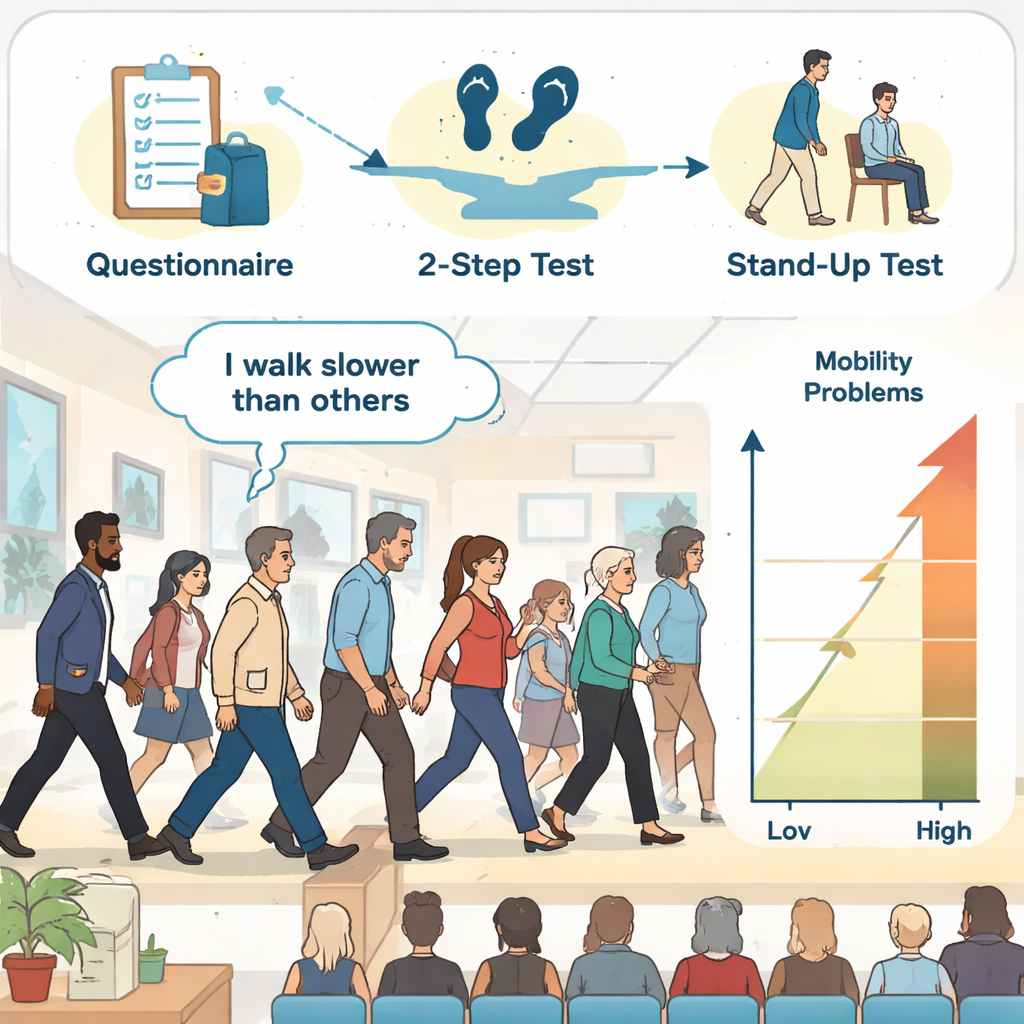
At a large clinic in Saitama, Japan, more than 40,000 adults came for their annual health checkups in 2023. After excluding those with missing information, the researchers studied 34,935 people aged 19 to 90. Everyone answered a simple yes-or-no question: “Is your walking speed faster than the speed of others of your age and sex?” Those who answered “yes” were placed in the fast group; those who answered “no” were labeled as having slow walking speed. All participants also took three established tests of mobility: a 25-question survey about pain and daily activities, a “two-step” test that measures how far a person can stride in two steps relative to their height, and a stand-up test that checks leg strength and balance at different seat heights.
Slow walkers and higher mobility trouble
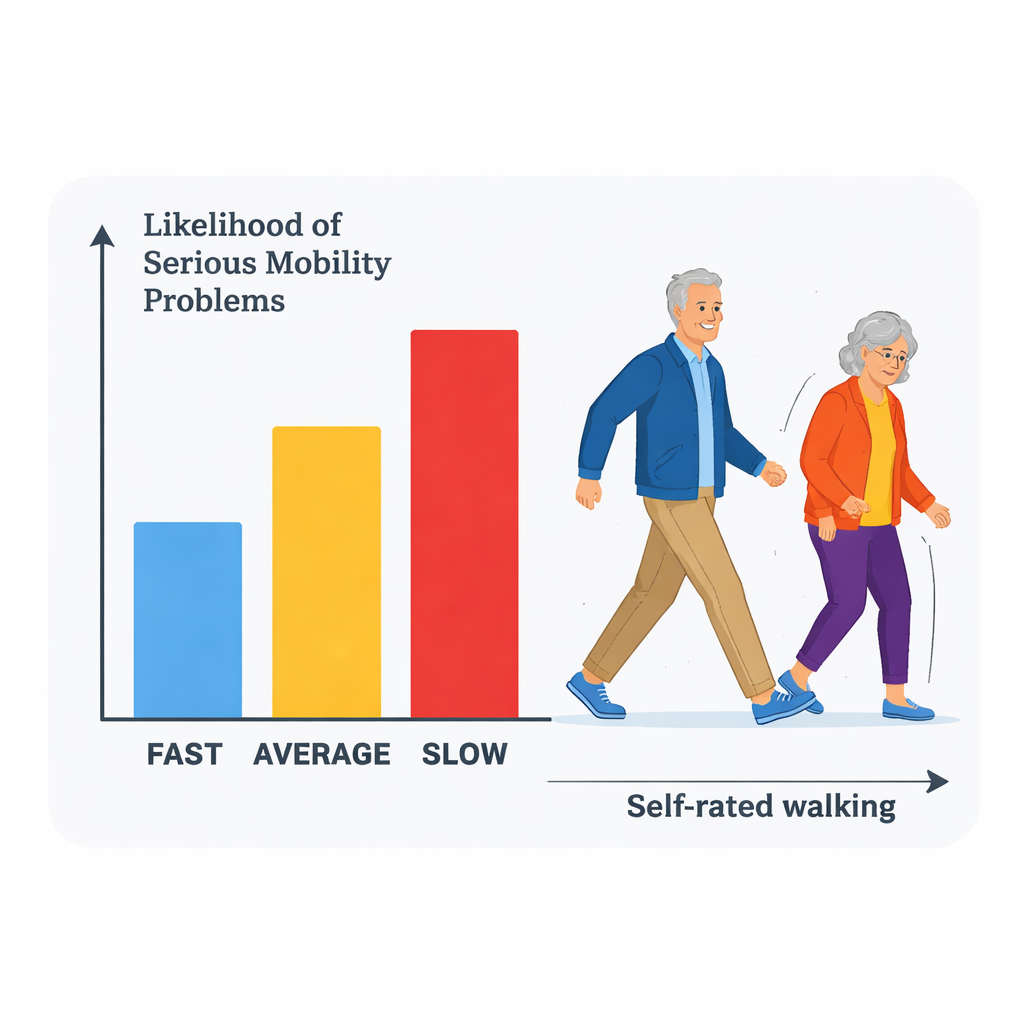
When the researchers compared the two groups, clear patterns emerged. Almost half of all participants rated themselves as slow walkers. These individuals were more likely to show signs of locomotive syndrome on all three tests. For example, higher scores on the questionnaire, shorter two-step distances, and poorer performance on the stand-up test all became more common as people reported slower walking. Using statistical models that accounted for age, sex, body weight, smoking, drinking, exercise habits, and major diseases, the team found that people who felt they walked slowly were about one and a half times more likely to have at least mild locomotive problems, and roughly two and a half times more likely to have more severe problems.
Results held true across age groups
One might expect walking speed to matter only in older age, but the study tells a different story. The researchers repeated their analyses separately for adults younger than 65 and those 65 and older. In both age groups, people who said they walked more slowly than their peers were more likely to show clear signs of locomotive syndrome. In other words, feeling slow on your feet is a meaningful warning sign even for people in midlife, not just for retirees. There were a few technical exceptions in one of the tests among the oldest participants, but the overall message remained consistent.
What this means for your daily life
For the average reader, the takeaway is straightforward: how fast you feel you walk is more than a casual observation—it reflects the health of your muscles, joints, and balance. If you notice that friends or coworkers your age routinely outpace you, it may be wise to bring this up during a checkup and consider simple movement tests to look for early trouble. Because this single question is quick, costs nothing, and can be added to routine health surveys, it offers doctors a practical way to flag people who might benefit from targeted exercise, weight management, or other interventions to protect their mobility and independence as they age.
Citation: Kobayashi, T., Yamada, K., Yamaguchi, S. et al. Subjective slow walking speed is associated with locomotive syndrome severity in 34,935 adults undergoing medical checkups. Sci Rep 16, 5189 (2026). https://doi.org/10.1038/s41598-026-36083-3
Keywords: walking speed, mobility problems, locomotive syndrome, healthy aging, medical checkups