Clear Sky Science · en
Deciphering a novel RP-HPLC based bioanalytical method for Estimation of xanthohumol in rat plasma and postbiotic-based nanostructured lipid carriers
A beer molecule with medical promise
Xanthohumol is a natural compound from hops, best known for giving beer some of its bitterness. In recent years, it has drawn attention for a surprising range of health-related effects, from anti-inflammatory and antioxidant actions to potential benefits against cancer and neurodegenerative diseases. To turn such a promising molecule into a real medicine, scientists first need a reliable way to measure tiny amounts of it in the bloodstream. This study describes a new laboratory test that does exactly that, even when xanthohumol is packaged inside advanced nano-sized fat droplets designed to help it travel through the body.
Why measuring tiny traces matters
Any drug candidate must pass a basic test: how much of it actually reaches the blood, how long does it stay there, and how quickly is it cleared? For xanthohumol, existing analytical methods were either slow, expensive, or difficult to run routinely. Some needed complex instrument settings, long measurement times, or labor‑intensive sample preparation, and a few even caused xanthohumol to partly change into a related compound during handling. The authors set out to build a simpler, faster, and more affordable method that could still detect the compound at extremely low levels in rat plasma, a standard animal model for early drug-development studies.
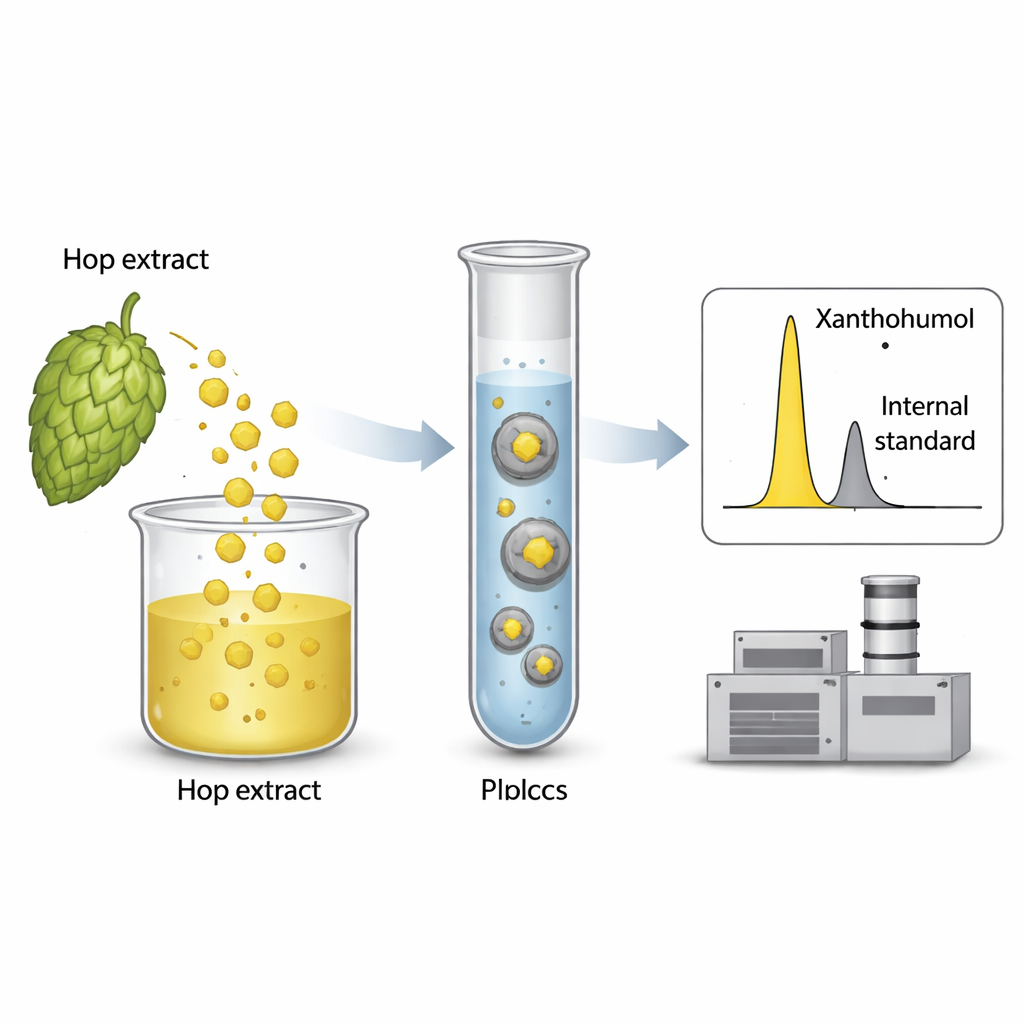
A streamlined laboratory test
The team used a common separation technique called high‑performance liquid chromatography, pairing it with a light‑sensing detector. They optimized the conditions so that xanthohumol and a helper compound, curcumin, emerge from the instrument at distinct times, producing clear peaks with no interference from blood components or other additives. The method works over a very narrow range of concentrations—just 2 to 10 billionths of a gram per milliliter of plasma—yet still gives an almost perfectly straight calibration line. Key performance checks showed that repeated measurements were highly consistent, errors stayed within a few percent, and the signal remained stable even after freeze‑thaw cycles or hours at room temperature.
Nano-sized carriers built for the bloodstream
Because xanthohumol does not dissolve in water, the researchers also created nanostructured lipid carriers: tiny spheres made of solid and liquid fats, surfactants, and supporting powders. These particles, roughly 120 nanometers across, can hold xanthohumol in their oily interior and help it mix with watery plasma. The formulation includes a “postbiotic,” sodium butyrate, and plant‑based polysaccharides, which together are intended to improve stability, solubility, and slow release. The new test was challenged with these complex mixtures, both alone and after being mixed into rat plasma, and still produced clean, interference‑free signals for xanthohumol.
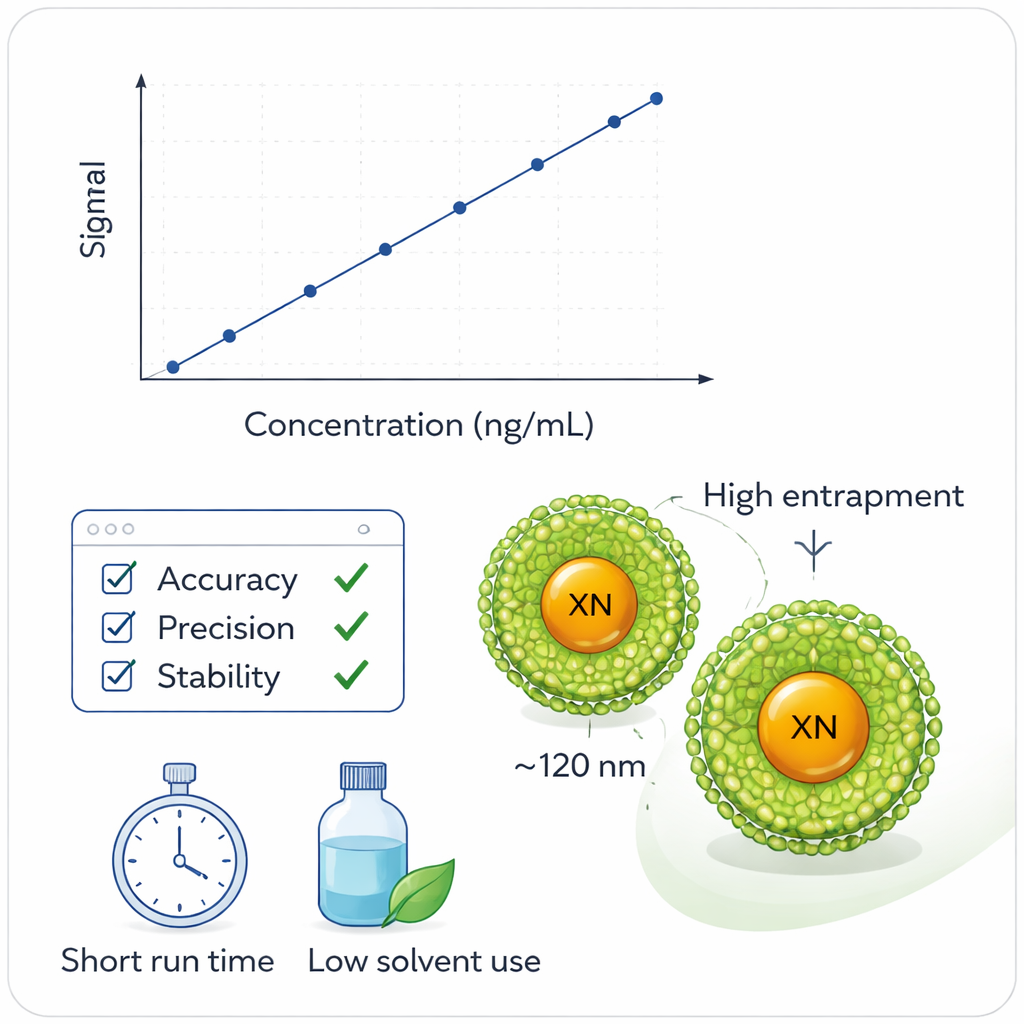
Built for stability and sustainability
Beyond basic accuracy, the authors examined how well the nano‑carriers survive in plasma over time. Particle size, electrical surface charge, and the fraction of drug trapped inside remained largely unchanged for at least a month at freezer temperatures, suggesting that the formulation is physically robust. The analytical method itself was also designed with “green” and “white” analytical chemistry in mind: it uses less solvent, shorter run times (around seven minutes instead of 15–20), and constant pressure, which together lower cost, energy use, and operator burden. These features make the method attractive not just for research labs but also for larger testing settings.
What this means for future medicines
For non-specialists, the main message is that the study delivers a practical measuring tool and a stable nano‑carrier system for a promising natural molecule. With a fast, precise, and environmentally conscious method now available to track xanthohumol in blood, researchers are better equipped to run pharmacokinetic and bioavailability studies—those that reveal how the body handles a candidate drug. This work does not prove that xanthohumol will become a medicine, but it removes key technical obstacles on the path from an interesting beer ingredient to a carefully tested therapeutic option.
Citation: Bashir, B., Gulati, M., Vishwas, S. et al. Deciphering a novel RP-HPLC based bioanalytical method for Estimation of xanthohumol in rat plasma and postbiotic-based nanostructured lipid carriers. Sci Rep 16, 6841 (2026). https://doi.org/10.1038/s41598-026-36078-0
Keywords: xanthohumol, nanostructured lipid carriers, bioanalytical method, rat plasma, green chromatography