Clear Sky Science · en
A numerical appraisal of the ‘fault-valve’ model of origin of lode-type gold deposits
Why earthquakes might be key to hidden gold
Many of the world’s richest gold veins formed more than 2.5 billion years ago, deep in Earth’s crust, where hot fluids squeezed through cracks and faults. For decades, geologists have leaned on a popular idea called the “fault‑valve” model to explain how these fluids moved and dropped their gold. This study takes that influential picture and stress‑tests it with detailed computer simulations, asking a deceptively simple question: do the physics actually work out the way the classic story claims?
The classic picture of a crustal valve
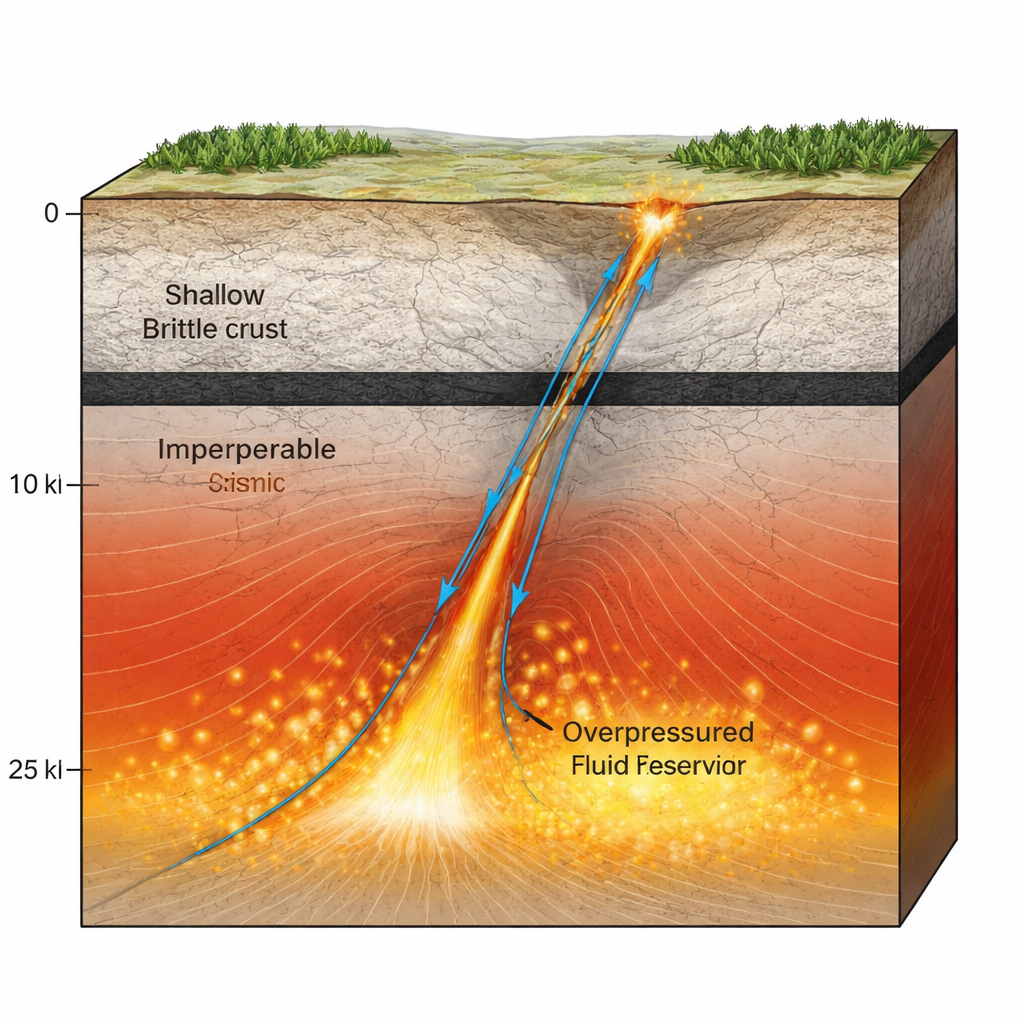
In the standard model, gold‑bearing fluids are released when buried rocks are cooked and squeezed during mountain‑building. These fluids rise until they hit a nearly impermeable barrier at mid‑crustal depths, sometimes called a “seismic lid,” where rocks shift from brittle to ductile behavior. Fluid pressure builds up beneath this lid until it exceeds the weight of the overlying rocks. At some critical point, a locked, steeply inclined fault ruptures, like a valve suddenly popping open. High‑pressure fluid rushes upward, pressure and temperature drop, and quartz veins rich in gold are deposited. Over time, minerals seal the fault, pressure builds again, and the cycle supposedly repeats many times to create large lode‑type gold deposits.
Putting the gold valve to the numerical test
The authors built a two‑dimensional slice of the crust in the COMSOL Multiphysics software, 50 kilometers long and 25 kilometers deep, with realistic rock properties, heat flow, and fluid behavior that changes with temperature. They explored different setups: with and without a seismic lid; lids that are perfectly flat or gently curved; and faults that dip gently or steeply. They also tested how easily fluids could leak through the lid and what happens when broad regional compression—the slow squeeze from plate tectonics—adds stress to the system. By tracking how pressure and fluid flow evolve over hundreds of years, the model lets them see which configurations can really generate the extreme overpressures needed to break faults and drive rapid fluid pulses.
When seals leak and faults drain too well
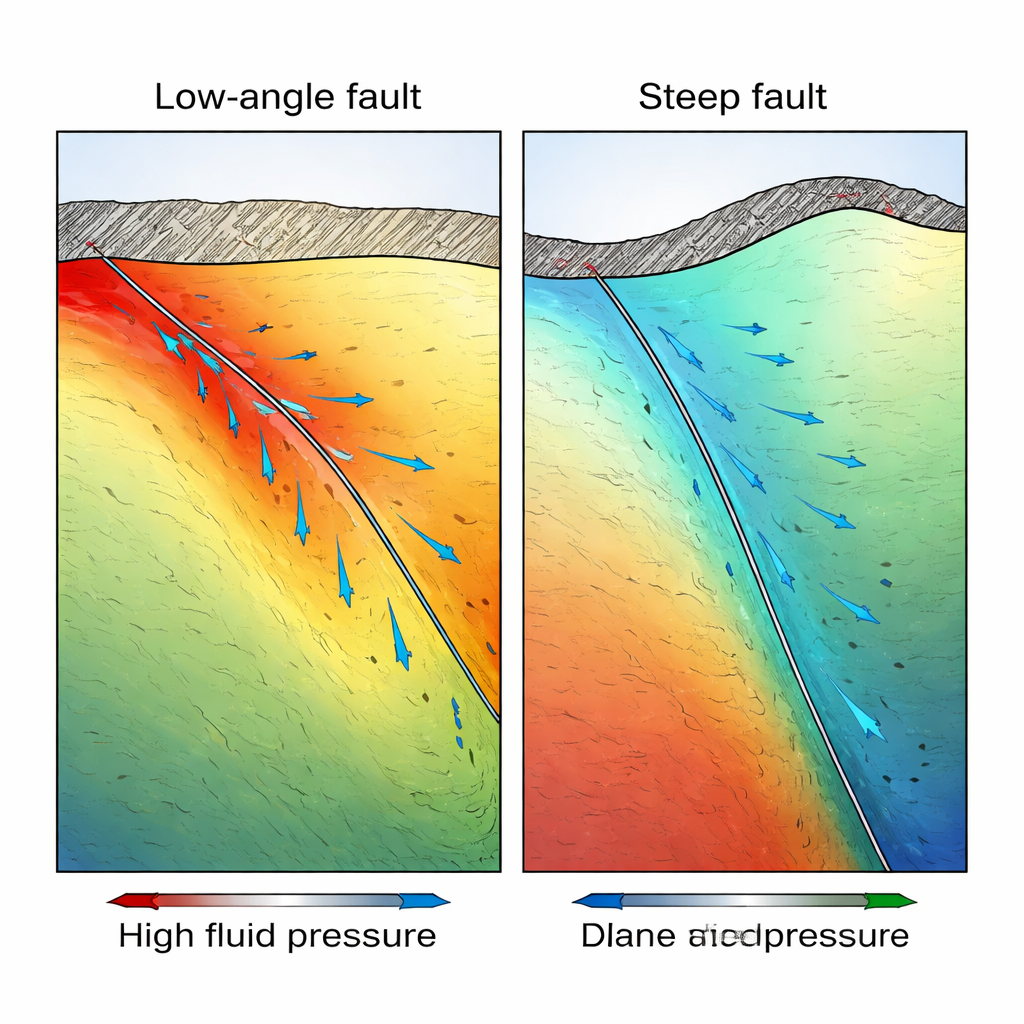
The simulations show that a perfectly tight, horizontal seismic lid can indeed trap fluids and build very high pressures below it. But once a fault cuts through that lid, pressure beneath it drops sharply and fluid drains upward along the fault. High‑angle faults, which the classic model treats as barriers that help pressure build, actually work in the opposite way here: they become efficient vertical drains that relieve overpressure more effectively than gently dipping faults. If the lid is even slightly leaky, pressure never rises enough to rupture it in the first place. The shape of the lid also matters: a curved barrier can concentrate pressure more strongly than a flat one, but this is just one of many possible geometries and is not yet supported by direct evidence in real crustal sections.
Can the crust keep pumping gold again and again?
A crucial promise of the fault‑valve idea is that it can run through many earthquake‑fluid cycles, each one depositing another layer of quartz and gold. The new models cast doubt on this. Every time fluid is released, the source region beneath the lid is depleted a bit more, and minerals seal up some of the pore space and fractures. The simulations show that with each cycle, peak fluid pressure drops, while the strength of the fault and surrounding rock increases. The threshold pressure needed to reactivate the fault creeps upward, and the time between potential rupture events lengthens from decades toward centuries. After only a handful of cycles, the system stalls: fluid pressures no longer exceed the growing failure threshold, and fast, earthquake‑driven pumping gives way to slow, diffuse percolation that is less capable of forming thick, vein‑style lodes.
An alternative driver: slow squeezing instead of a tight lid
The authors also model a different scenario: a steep fault in a crust compressed by far‑field tectonic forces, but without any seismic lid at all. In this case, the regional squeeze compacts rocks, reduces their pore space, and drives fluid pressures above the normal rock‑weight values—enough to promote rupture and fluid release along the fault tip. Comparing different pressure profiles, they find that tectonic compression alone can generate substantial overpressure, with or without a lid, and that lids mainly steepen pressure gradients where they block upward escape. This suggests that seismicity may often be the cause, not the consequence, of fluid release, and that widely cited “fault‑valve” behavior may not require a special, impermeable mid‑crustal seal.
What this means for finding and understanding gold
To a non‑specialist, the takeaway is that Earth’s deep plumbing for gold is more complex than a simple on‑off valve beneath a rigid lid. The study concludes that high‑angle reverse faults are actually good fluid highways, not pressure traps; that long‑lived, repetitive pumping cycles are hard to sustain physically; and that large‑scale tectonic squeezing can by itself generate the overpressures needed to move and deposit gold, even without a seismic lid. Rather than discarding the fault‑valve idea outright, the authors argue it should be blended or replaced with alternative concepts—such as “mode‑switching” between different kinds of fracturing, or slow waves of changing porosity moving through the crust—to better match both field observations and the physics of crustal fluids. For explorers and researchers alike, this means rethinking where and how the crust stores and releases the fluids that ultimately concentrate one of humanity’s most prized metals.
Citation: Bhuyan, S., Panigrahi, M.K. A numerical appraisal of the ‘fault-valve’ model of origin of lode-type gold deposits. Sci Rep 16, 5594 (2026). https://doi.org/10.1038/s41598-026-36077-1
Keywords: orogenic gold deposits, fault-valve model, crustal fluid flow, seismic lid, numerical geoscience