Clear Sky Science · en
Research on spatial differentiation, source decomposition and convergence of agricultural carbon emission efficiency in China
Why farm emissions matter to everyone
Agriculture feeds China, but it also releases a large share of the country’s climate‑warming gases. This study asks a deceptively simple question with big consequences: how efficiently do China’s farms produce food for each unit of carbon they emit, and how does that differ from place to place? By tracking 266 cities over two decades, the authors reveal unexpected geographic patterns and explain why some regions are learning to grow more with less carbon, while others lag behind.
Measuring more than just tons of carbon
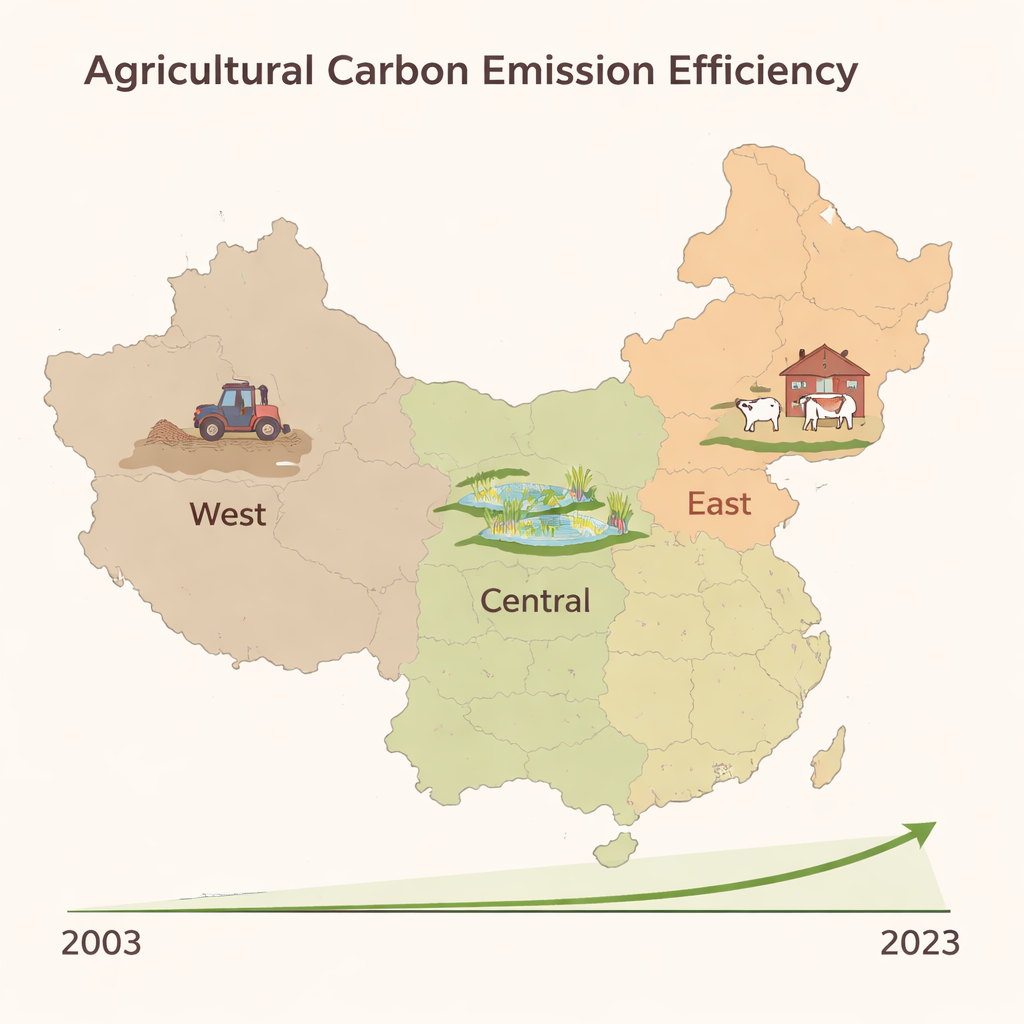
Instead of only counting emissions, the researchers focus on agricultural carbon emission efficiency—how much economic value farms create for each unit of greenhouse gas released. To capture this, they build a detailed picture of farming in each city, including land under crops, farm labor, machinery, fertilizer and pesticide use, electricity for irrigation and processing, and the value of crops, livestock, forestry, and fisheries. They then estimate emissions from fertilizer and fuel use, rice paddies, and animals. Using advanced efficiency models, they compare how well cities turn these inputs into high farm output with the least possible carbon, year by year from 2003 to 2023.
A surprising map: cleaner West, dirtier East
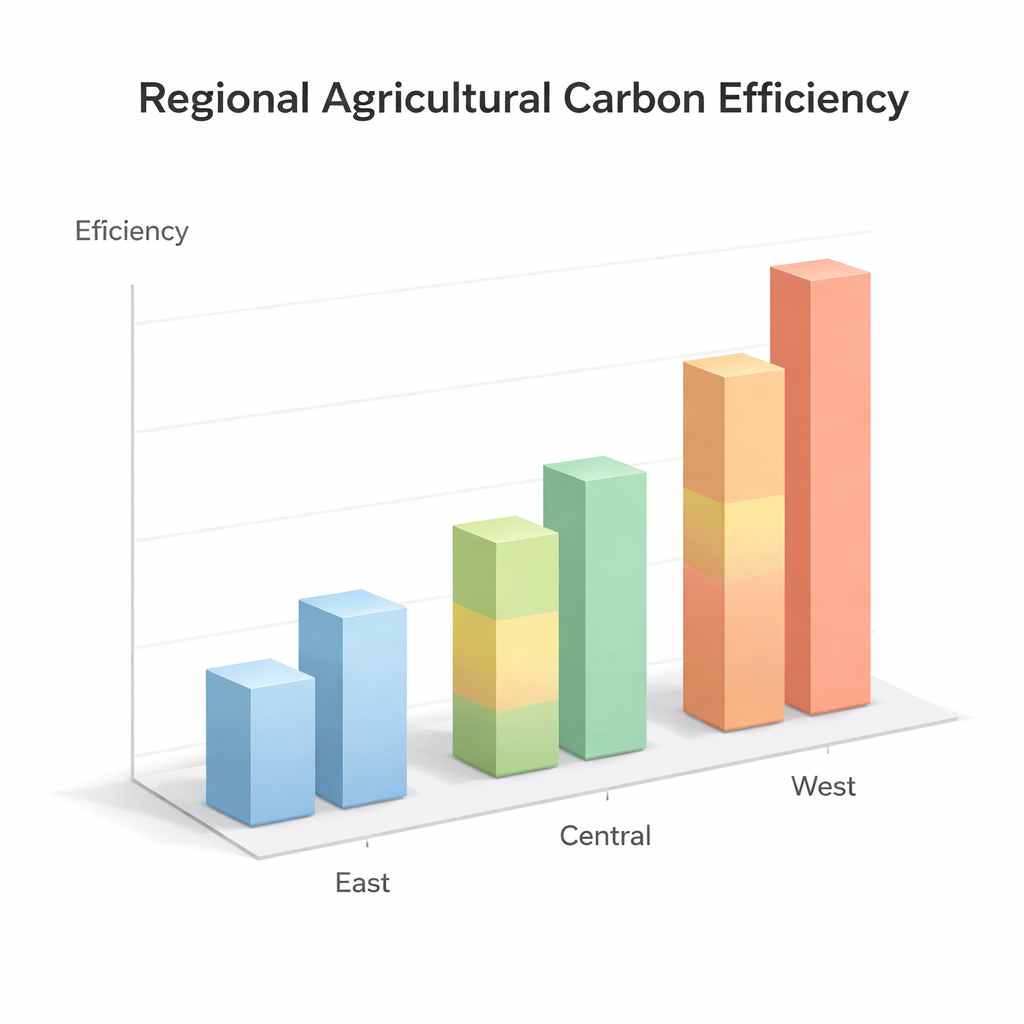
The results overturn the usual assumption that richer areas are automatically greener. The authors find a clear pattern of “high efficiency in the West, low in the East.” On average, western cities use land and inputs in ways that generate more farm value for each ton of carbon than cities in the more industrialized East. Central China lies in between. Over time, national efficiency dipped around the 2008 financial crisis and again in 2020 during COVID‑19, but rose sharply after 2020 as green agricultural policies—such as reduced fertilizer use, straw recycling, and water‑saving irrigation—took hold. Even within provinces, differences are striking: in some coastal provinces, inland cities outshine big coastal hubs, suggesting that rapid urban growth can squeeze agriculture into small, less efficient pockets.
Gaps that refuse to close
To understand inequality in efficiency, the study separates overall gaps into those within regions and those between regions. It finds that differences between East, Central, and West are the main source of imbalance and have stayed stubbornly large. Within regions, patterns vary: the East is becoming more polarized, with a few star cities pulling ahead; the West shows signs of catching‑up among its own cities; and the Central region follows a mixed path. When the authors look at the full distribution over time, they see multiple “peaks” rather than a single national norm—evidence that China is splitting into several groups of farm systems, from high‑efficiency leaders to low‑efficiency laggards.
The catch‑up paradox
At first glance, another result seems contradictory. Statistical tests show that less efficient cities tend to improve faster than those already ahead—a sign of convergence. Adding in factors like local income, internet use, education, government spending, and the level of agricultural development strengthens this catch‑up effect. Neighboring cities also influence one another: when one improves its farm efficiency, nearby areas are more likely to follow, probably through shared markets, technologies, and policies. Yet national inequality does not shrink. The explanation is that cities are catching up only within distinct “clubs”—for example, among already advanced eastern cities or among western cities with similar natural conditions—while the distance between these clubs remains wide or even grows.
What it means for climate and food policy
For non‑specialists, the main takeaway is that there is no one‑size‑fits‑all solution for cutting farm emissions in China. Western regions already get relatively high value from each ton of carbon and need support to expand production without losing that edge. Eastern regions must break their dependence on heavy inputs by spreading precision farming, cleaner energy, and smarter incentives. Central regions can benefit most from faster sharing of green technologies and know‑how. Because cities influence one another, well‑designed cross‑regional programs—such as technology transfer, eco‑compensation, and carbon‑trading pilots—could turn today’s patchwork of efficiency “clubs” into a more balanced, nationwide move toward low‑carbon, climate‑friendly agriculture.
Citation: Tang, T., Li, B. & Que, F. Research on spatial differentiation, source decomposition and convergence of agricultural carbon emission efficiency in China. Sci Rep 16, 5556 (2026). https://doi.org/10.1038/s41598-026-36075-3
Keywords: agricultural carbon emissions, China regional inequality, low-carbon farming, spatial convergence, climate-smart agriculture