Clear Sky Science · en
Asterinides sp. an endemic stygobitic seastar from an anchialine cave and its interactions among prokaryotic communities
Life in a Hidden Underwater World
Far beneath the tourist beaches of Cozumel Island lies a very different world: dark, flooded caves where strange, pale animals survive without sunlight. This study explores one such creature, an as‑yet‑unnamed cave‑dwelling seastar, and the slimy microbial carpets it lives on. By examining what lives in these mats and what ends up in the seastar’s stomach, the researchers reveal how invisible microbes may be feeding larger animals and shaping an entire hidden ecosystem.
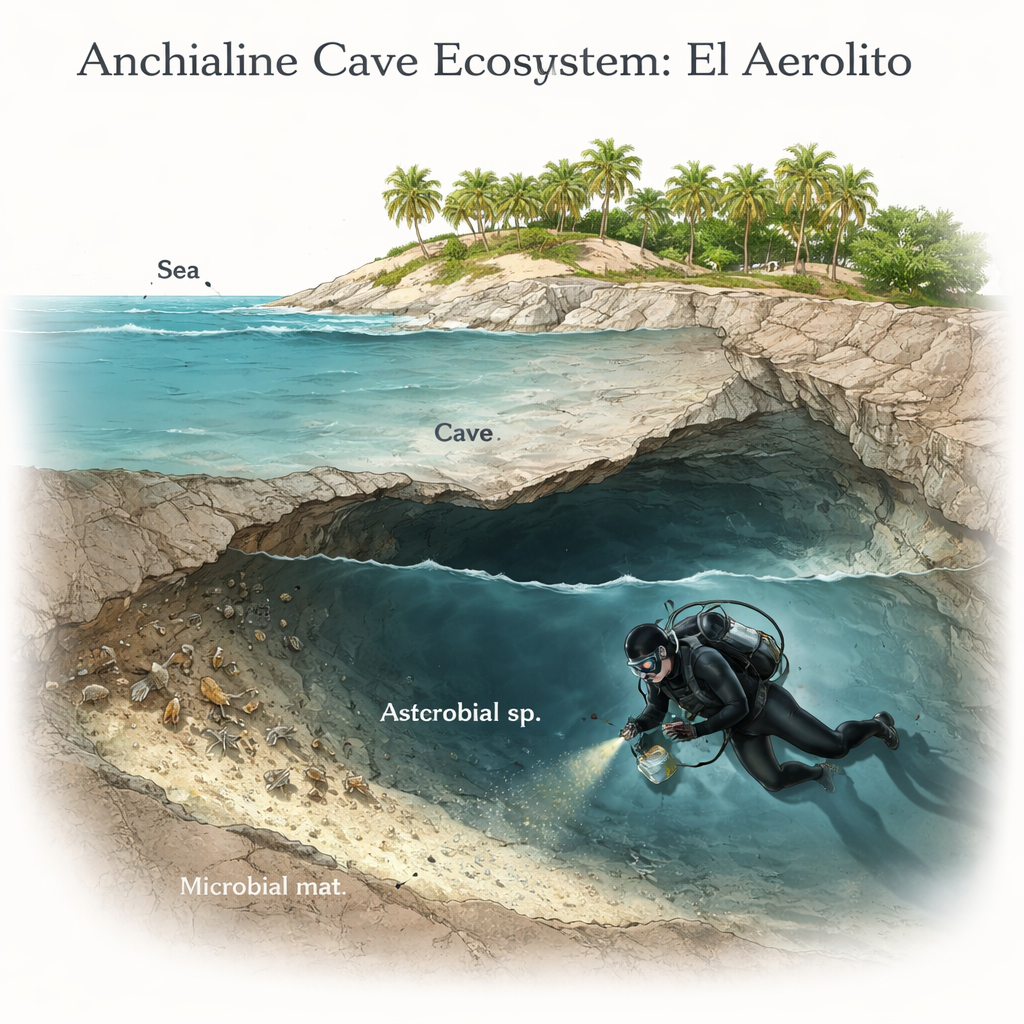
A Cave Between Land and Sea
The research took place in El Aerolito, an anchialine cave system carved into limestone on Cozumel Island, Mexico. Anchialine caves are filled with groundwater that connects to the sea through pores and tunnels in the rock. As salty seawater and fresher groundwater meet, they form distinct layers with unusual chemistry, including high levels of dissolved salts and little or no light. These harsh, isolated conditions make such caves “natural laboratories” where species evolve in unique ways and often exist nowhere else on Earth.
A Starfish with a Very Local Address
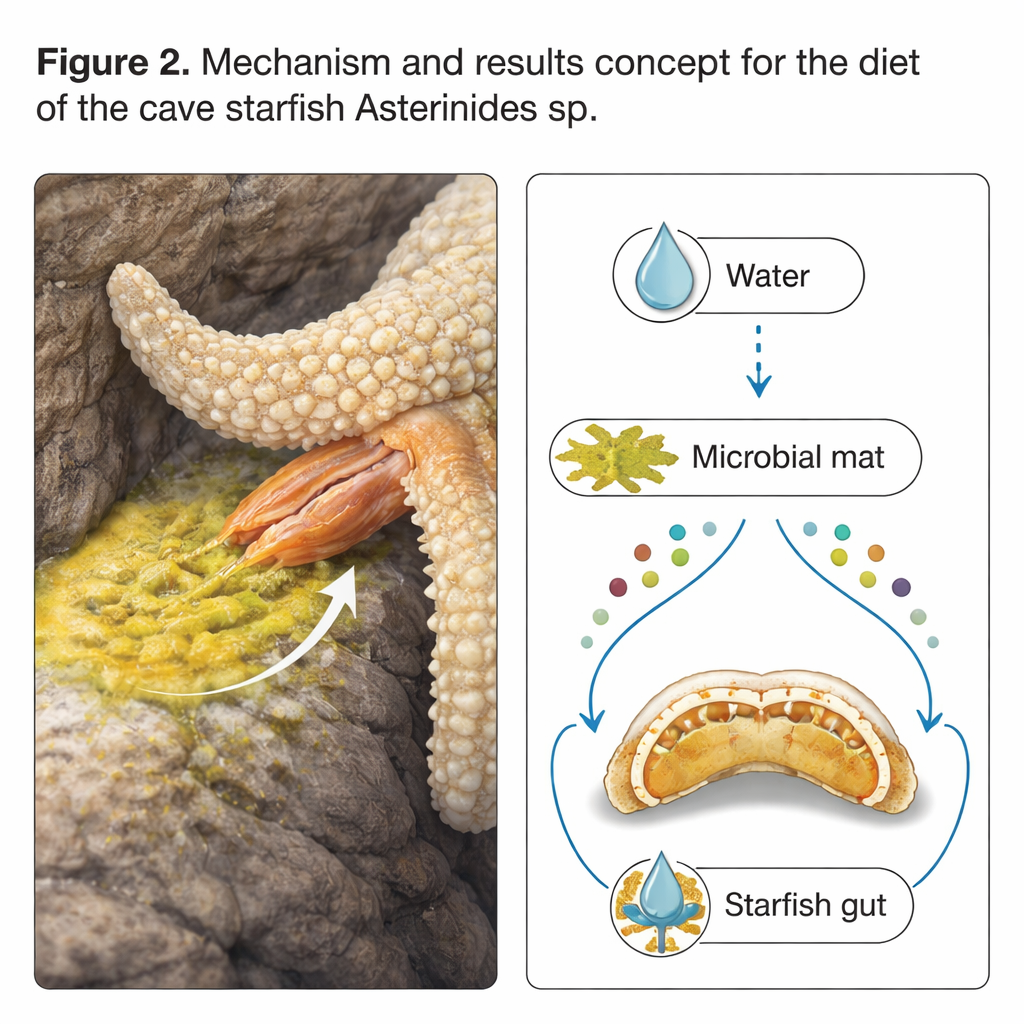
Among the most striking residents of El Aerolito is Asterinides sp., a small, pale seastar that has only been found in a few passages of this cave. It spends its life attached to the walls in the deeper, salty layer of water, often with its soft underside pressed directly onto thin films of microbial mat. Because its close relatives are opportunistic omnivores that feed by everting, or turning inside out, their stomachs over food, the team suspected that this cave seastar might be grazing on these mats as a primary food source.
Sampling the Cave’s Invisible Life
Working in tight, pitch‑black passages required technical cave diving and new tools. The team collected four types of samples: cave water, microbial mats from the walls, a rock covered with mat, and the stomach contents of seastars. To obtain gut material without harming the animals, they used a specially designed Catcher Collection Chamber that allowed the starfish to gently regurgitate its stomach contents into a protected container. Back in the lab, they extracted DNA from bacteria in these samples and sequenced a marker gene to identify which microbial groups were present and what metabolic roles they might play in the cycles of carbon, nitrogen, and sulfur.
Shared Microbes and Shared Chemistry
The cave hosted a surprisingly rich and largely unknown bacterial community, dominated by a group called Proteobacteria and many lineages not yet classified to named genera. Microbial mats, water, and starfish regurgitates all shared several key bacterial groups, including types previously linked to sulfur and carbon processing. Some bacteria appeared only in the seastar gut, hinting at a special relationship with its digestive system. When the researchers compared predicted metabolic functions, they found that microbial mats and stomach contents were more similar to each other than either was to the surrounding water. In all three habitats, microbes capable of oxidizing sulfur and fixing carbon—processes that can generate energy in total darkness—were especially important.
Food Webs, Pollution, and Conservation
Putting these lines of evidence together, the study supports the idea that microbial mats are a major food source for Asterinides sp., providing energy and nutrients through their dense cells and sticky secretions. These secretions can bind metals and pollutants, meaning that the seastars may also be exposed to contaminants seeping in from surface development and nearby roads. At the same time, the discovery of so many poorly known microbes underscores how little is understood about life in anchialine caves. By linking a cave animal’s diet to microbial activity, this work offers a framework for future studies and highlights the need to protect these fragile, evolutionarily unique underwater worlds.
Citation: Solís-Marín, F.A., Vergara-Ovando, C., Rojas-Oropeza, M. et al. Asterinides sp. an endemic stygobitic seastar from an anchialine cave and its interactions among prokaryotic communities. Sci Rep 16, 5926 (2026). https://doi.org/10.1038/s41598-026-36065-5
Keywords: anchialine caves, cave starfish, microbial mats, groundwater ecosystems, sulfur cycling