Clear Sky Science · en
Performance enhancement of carbonyl iron-based magnetorheological elastomers through iron-doped multi-walled carbon nanotubes reinforcement
Rubber That Stiffens on Command
Imagine a car suspension, a building support, or a bridge joint that can instantly become stiffer or softer just by turning a dial. This paper explores a new way to make such “smart” rubber parts work better and last longer, by mixing in ultra-small tubes of carbon doped with iron, creating materials that respond strongly to magnetic fields and can tame vibration more effectively.
Why Smart Rubber Matters
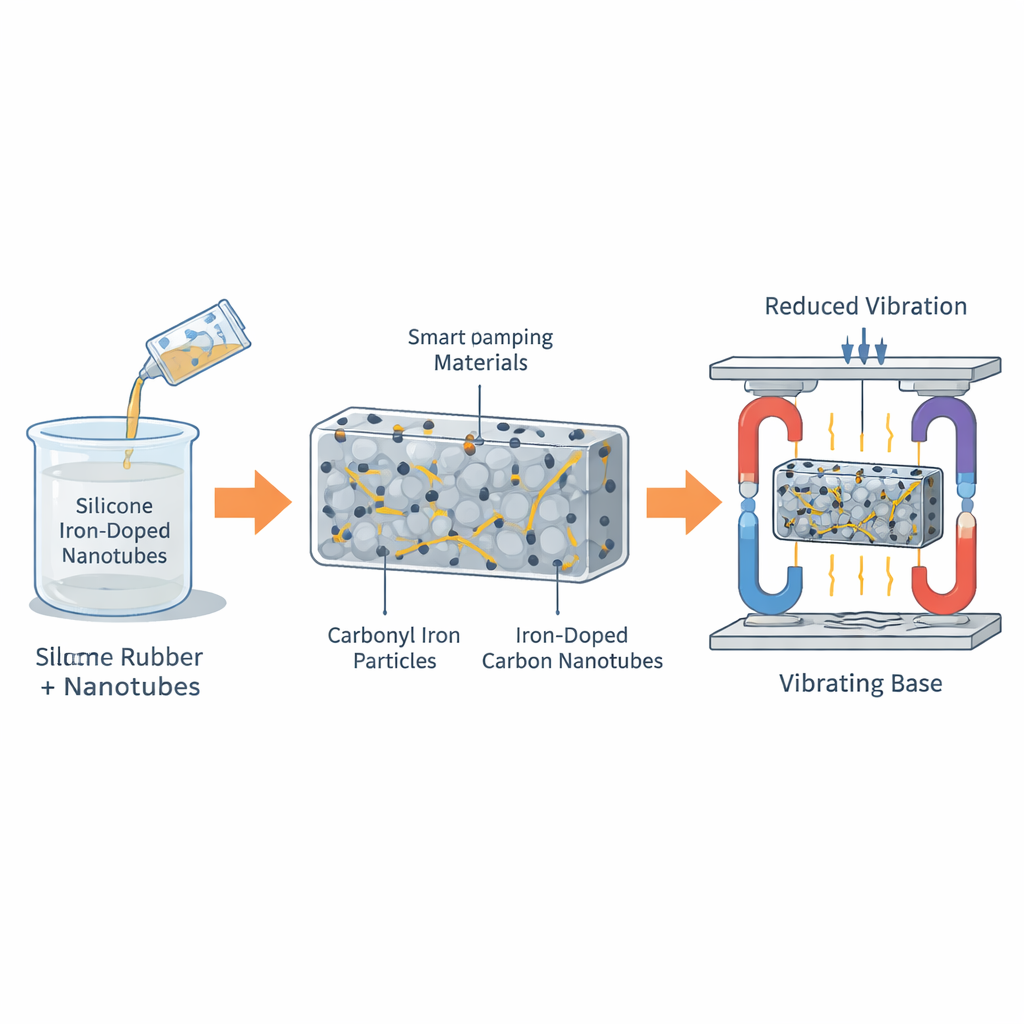
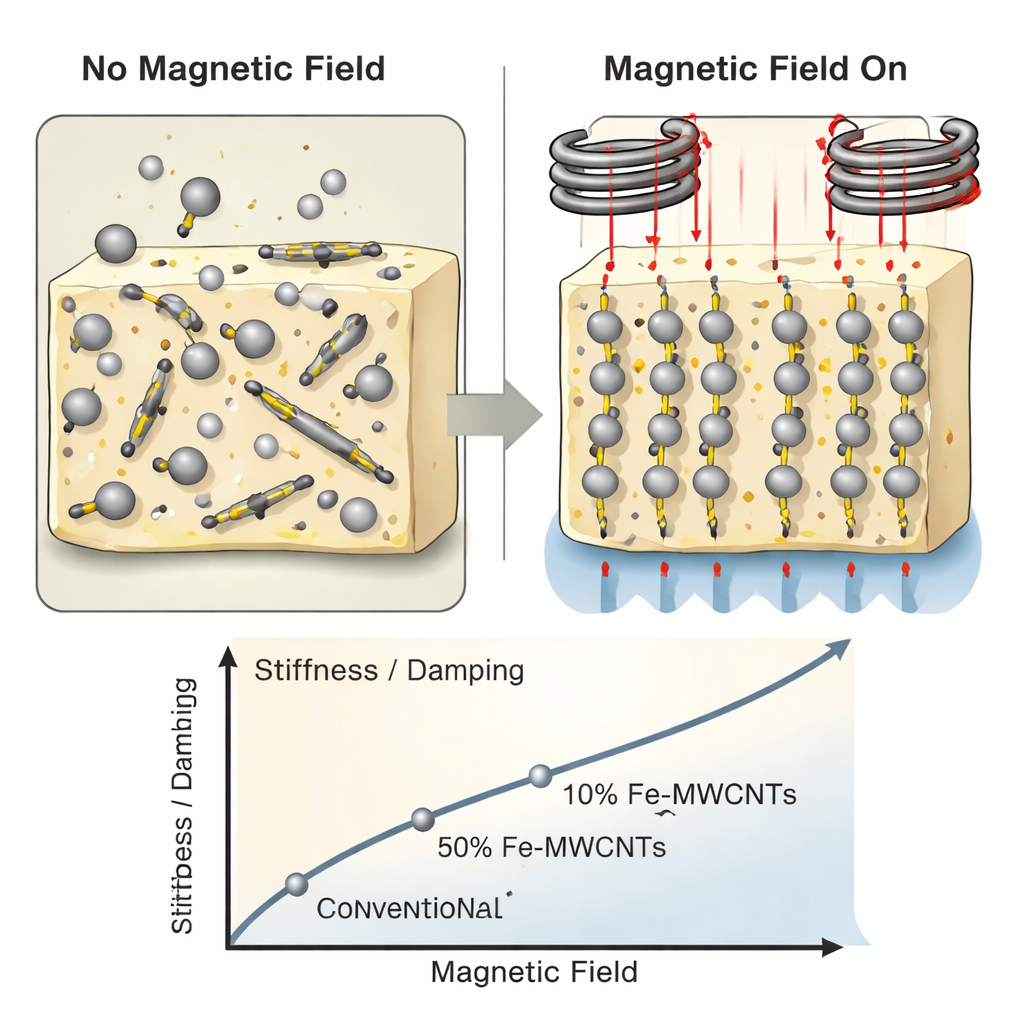
Engineers increasingly rely on special composites—mixtures of different materials—to get combinations of properties that no single substance can offer. One important family is magnetorheological elastomers, or MREs: rubber-like solids filled with tiny magnetic particles. When a magnetic field is applied, these particles line up and change how stiff and how damping the material is. That means one block of rubber can act soft on a smooth road and firm when a car hits a bump, or help a building sway less during an earthquake. Traditional versions use carbonyl iron particles inside silicone rubber, but they face trade‑offs between stiffness, energy absorption, and how strongly they react to a magnetic field.
Adding Tiny Iron-Doped Tubes
The researchers set out to upgrade these materials using iron-doped multi-walled carbon nanotubes. These nanotubes are hair‑thin, hollow carbon cylinders with iron nanoparticles attached along their surfaces. The carbon structure brings mechanical strength, while the iron brings magnetic responsiveness—so each tube works like a reinforcing fiber and a tiny magnet at the same time. The team prepared two kinds of these additives, one with about 10 percent iron and another with about 50 percent iron by weight, and mixed a small amount of them into a standard silicone rubber MRE that already contained spherical carbonyl iron particles.
Looking Inside the New Material
To confirm what they had made, the authors used high‑resolution microscopes and X‑ray techniques. They saw that the nanotubes kept their long, rod‑like form and that iron nanoparticles were attached along their walls, especially in the higher‑doped version. In the finished rubber, both the iron spheres and the iron‑doped tubes were spread relatively evenly through the silicone. Magnetic measurements showed that adding these tubes slightly increased how strongly the material could be magnetized and how well it retained magnetization, hinting at stronger interactions between the fillers and the rubber. This micro‑ and nano‑scale structure is critical: when a magnetic field is applied, the spheres and tubes can form connected chains, tying the rubber network together more tightly.
Stiffer, Better Damping, and More Tunable
The heart of the study is how the material behaves when it is shaken. Using a rheometer—a device that gently twists samples while varying frequency and magnetic field—the team measured stiffness (storage modulus) and damping (loss modulus). Compared with conventional MRE, the samples containing iron‑doped nanotubes were both stiffer and better at dissipating energy, especially under a magnetic field. At a field of about 0.47 Tesla, the material with the higher iron content nanotubes showed the largest jump in stiffness, with its magnetorheological effect—how much stiffness increases under the field—rising to about 234 percent, versus 191 percent for the standard material. In simple terms, a small amount of the new additive made the rubber respond more strongly and controllably to magnets across a range of vibration speeds.
From Lab Results to Real-World Uses
The authors conclude that iron‑doped carbon nanotubes are a powerful way to boost magnetically controlled rubber. By combining the strength of nanotubes with the magnetic pull of iron, they improved both how stiff the material can become and how much vibration energy it can soak up when a magnetic field is applied. That makes these composites promising for smart dampers in vehicles, machinery, and buildings, where parts must continuously adjust to changing motion. While the study notes that long‑term aging and different fabrication styles still need to be explored, it points toward future vibration‑control systems that are more compact, more efficient, and more finely tunable than today’s technology.
Citation: Maharani, E.T., Oh, JS. & Choi, SB. Performance enhancement of carbonyl iron-based magnetorheological elastomers through iron-doped multi-walled carbon nanotubes reinforcement. Sci Rep 16, 5912 (2026). https://doi.org/10.1038/s41598-026-36061-9
Keywords: magnetorheological elastomer, vibration damping, carbon nanotubes, smart materials, adaptive suspension