Clear Sky Science · en
Dynamic causal weighting-based risk propagation modeling for airport movement areas
Why runway risks matter to everyone who flies
Most air travelers think of safety in terms of takeoff and landing, but a surprising number of accidents and near‑misses happen while aircraft are taxiing, crossing runways, or waiting in line to depart. These busy "movement areas" are where pilots, ground vehicles, controllers, equipment, weather, and procedures all meet. Small glitches—a misheard instruction, a slippery taxiway, a confusing sign—can link together into serious incidents. This study asks a practical question with big consequences: can we use real‑world data and modern learning algorithms to see how such risks build up and spread, in time to stop them?
Many small problems, one tangled web
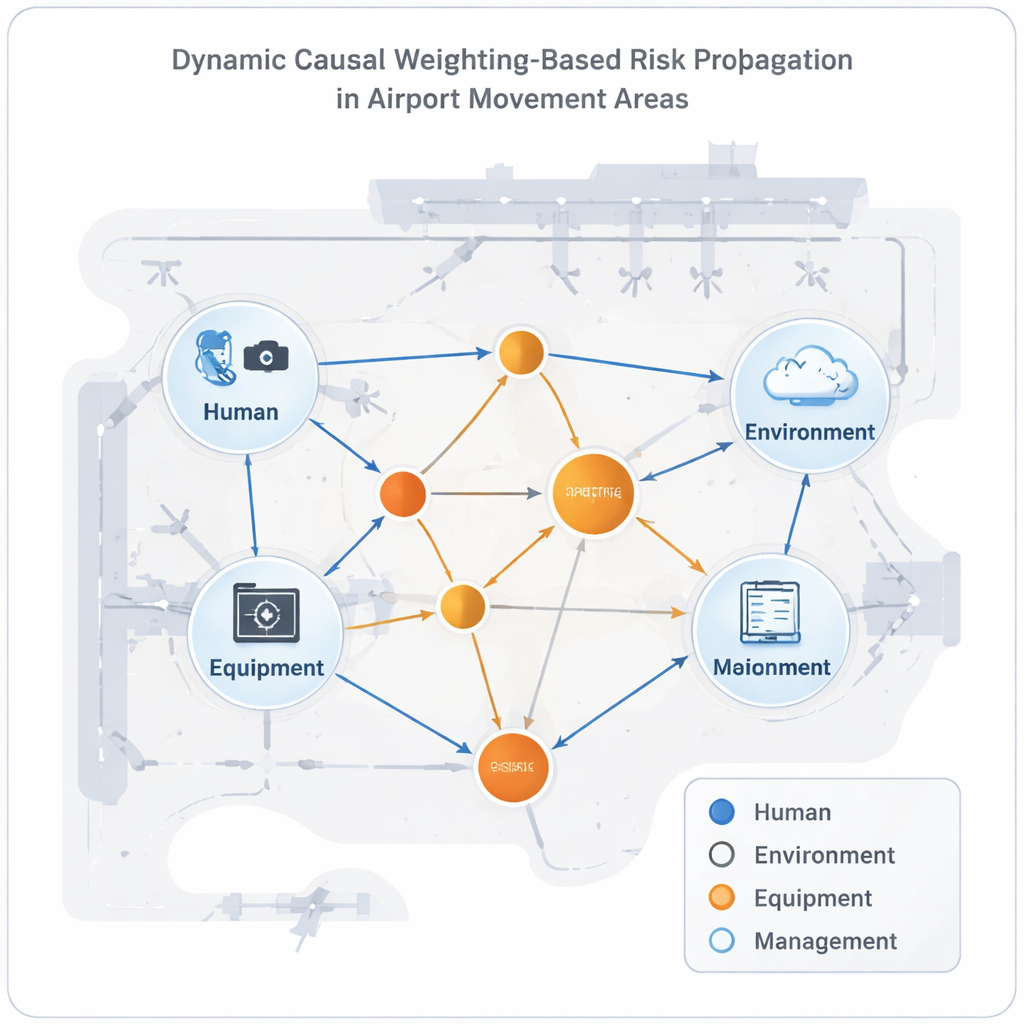
The authors start from the idea that the airport surface is a dense web of causes and effects rather than a simple chain of mistakes. Drawing on 2,795 real incidents from airports in the United States and China between 2008 and 2021, they catalogued everything that contributed to each event: human slips, equipment faults, weather, poor markings, management issues, and more. Using text‑analysis tools on narrative reports and an aviation training taxonomy, they distilled an initial list of 98 possible factors. They then applied an improved "grey correlation" method—a way to test how closely factors and accidents move together over time—to filter out the weak links. This pruning step left 63 factors that consistently matter, from low visibility and complex runway layouts to radio miscommunications and maintenance delays.
Turning incidents into a living risk map
From these 63 ingredients, the team built a network that mimics how trouble actually spreads on the airfield. Each factor becomes a node, and arrows between nodes represent one problem making another more likely—for example, high controller workload feeding into delayed instructions, which in turn set the stage for a runway incursion. Unlike many earlier models that treat all nodes alike, this network distinguishes between types of behavior. Some nodes accumulate risk until a threshold is crossed, such as a gradually worsening equipment fault. Others act as brakes, like cross‑checks and monitoring procedures that can absorb and dampen problems. The model also recognizes different shapes of interaction: straight chains, branching trees where one issue spawns several others, and converging paths where multiple small issues combine into one large hazard.
A learning model that adapts with the airport
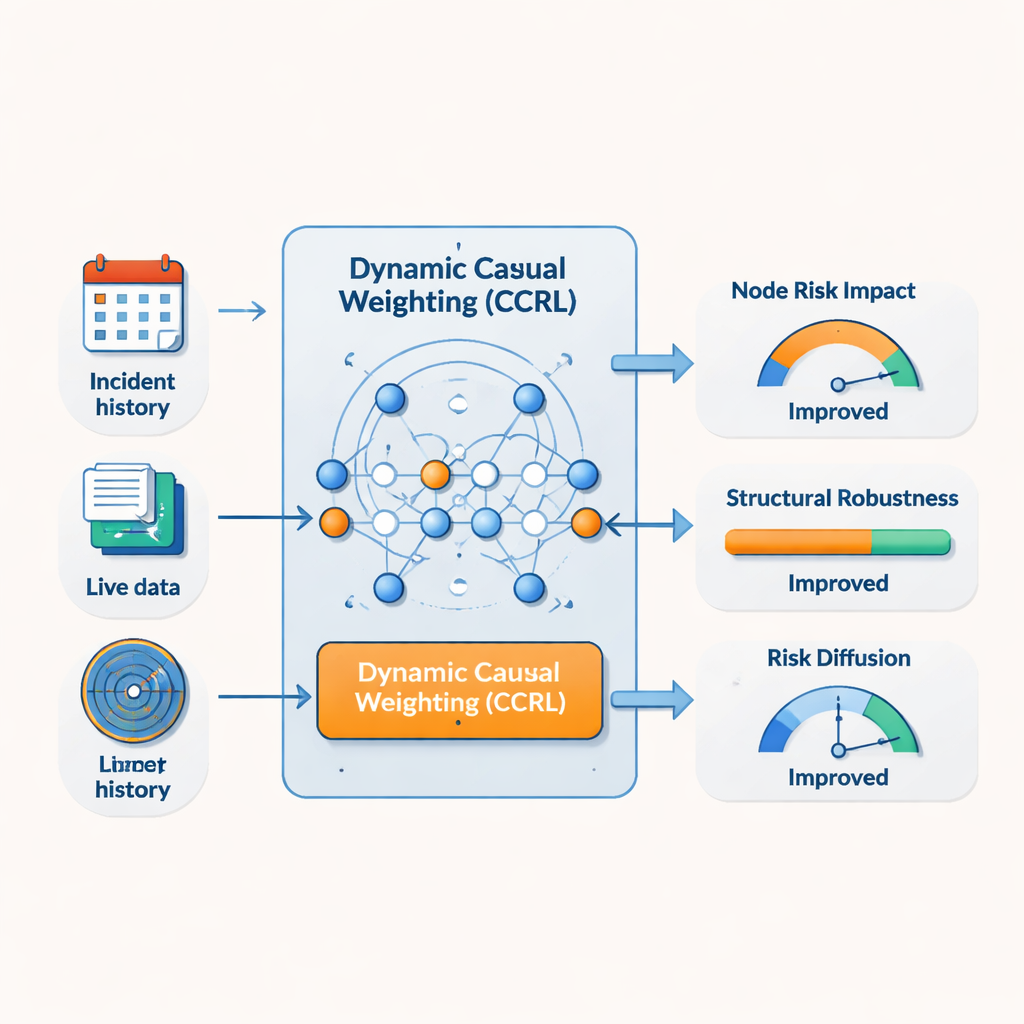
Building the map is only half the story; the real challenge is that airports are not static. Traffic levels, staffing, technology, and procedures change over time, altering how strongly one factor affects another. To capture this, the authors created a "capacity‑load" model with dynamic weights on each arrow. Every node has a capacity—how much stress it can tolerate—and a changing load—how much risk it is currently carrying. When load exceeds capacity, the node "fails" and passes risk onward. The size of that spillover is governed by a time‑varying weight learned by a specialized algorithm called causal convolutional reinforcement learning (CCRL). This algorithm mines patterns in the historical sequences of incidents, then continually adjusts the strengths of connections as new data arrive. In live use, the system ingests current traffic, weather, and operational data, updates the weights in under a tenth of a second, and recomputes how risk is likely to spread across the surface.
Finding the weak links that matter most
To judge whether this approach is useful, the researchers compared their dynamic model with established tools such as Dynamic Bayesian Networks, vector autoregression, and temporal graph neural networks. Using incident prediction accuracy as a yardstick, their method performed best, edging out deep learning while remaining more interpretable. They then defined three practical indicators: a Node Risk Impact Index to show how much trouble a single factor can cause, a Structural Robustness Index to measure how easily the network unravels when attacked at a point, and a Network Diffusion Index to summarize how widely failures can spread. These measures revealed some non‑obvious insights. Factors like certain equipment failures or communication issues, which do not sit at obvious "hubs" in the network, can nevertheless trigger large cascades. By contrast, some highly connected nodes turn out to be relatively benign.
What this means for safer, smoother flights
For airport operators and regulators, the payoff is a smarter way to prioritize limited safety resources. When the team simulated different control strategies, randomly strengthening nodes or focusing only on the most connected ones produced modest reductions in overall risk spread. But targeting the nodes that their indicators flagged as truly high‑impact cut the model’s risk diffusion index by about one‑fifth. In everyday terms, the work shows that surface safety is not just about adding more rules or more staff; it is about understanding which specific combinations of people, machines, environment, and oversight tend to turn routine days into bad ones, and then reinforcing those points before trouble snowballs. As more detailed data flow into such adaptive models, airports could move from reacting to incidents to anticipating them—quietly making the ground phase of flight as safe and uneventful as passengers already expect the time in the air to be.
Citation: Wu, W., Lin, J., Wei, M. et al. Dynamic causal weighting-based risk propagation modeling for airport movement areas. Sci Rep 16, 5249 (2026). https://doi.org/10.1038/s41598-026-36059-3
Keywords: airport safety, runway risk, aviation incidents, risk propagation, reinforcement learning