Clear Sky Science · en
Risk assessment of earthquake online public opinion based on behavioral motivation
Why online chatter after quakes matters
When the ground shakes, people don’t just run for safety—they also rush online. Posts, videos and comments about an earthquake can spread faster than rescue teams, shaping what millions believe about danger, damage and the authorities’ response. This study asks a timely question: can we measure and rate the risk hidden in that digital storm, so that panic and rumors don’t make a natural disaster even worse?
From shaking ground to viral stories
Earthquakes are among the most frightening disasters, and today their impact unfolds as much on screens as in streets. After a quake, social media fills with eyewitness accounts, fears, anger and support. This wave of conversation can help people share information and organize aid. But it can also fuel rumors, mistrust of officials and even online harassment. The authors argue that this “earthquake online public opinion” is itself a form of social risk, able to undermine relief efforts, damage government credibility and harm mental health if it spirals out of control.
What drives people to speak out online
To understand these risks, the researchers draw on behavioral motivation theory, especially “protection motivation” theory. They view each post or comment as a reaction to two questions people ask themselves during a crisis: How bad is this for me and my community? And can we cope with it? In their framework, the physical quake (its size, timing and damage) shapes how severe people think the threat is. Netizens’ behavior—how many people join discussions, where they are located, and how emotional their messages are—reveals public feeling. Media outlets amplify or distort information, while government actions and transparency influence whether people trust the response or suspect negligence or cover‑ups. 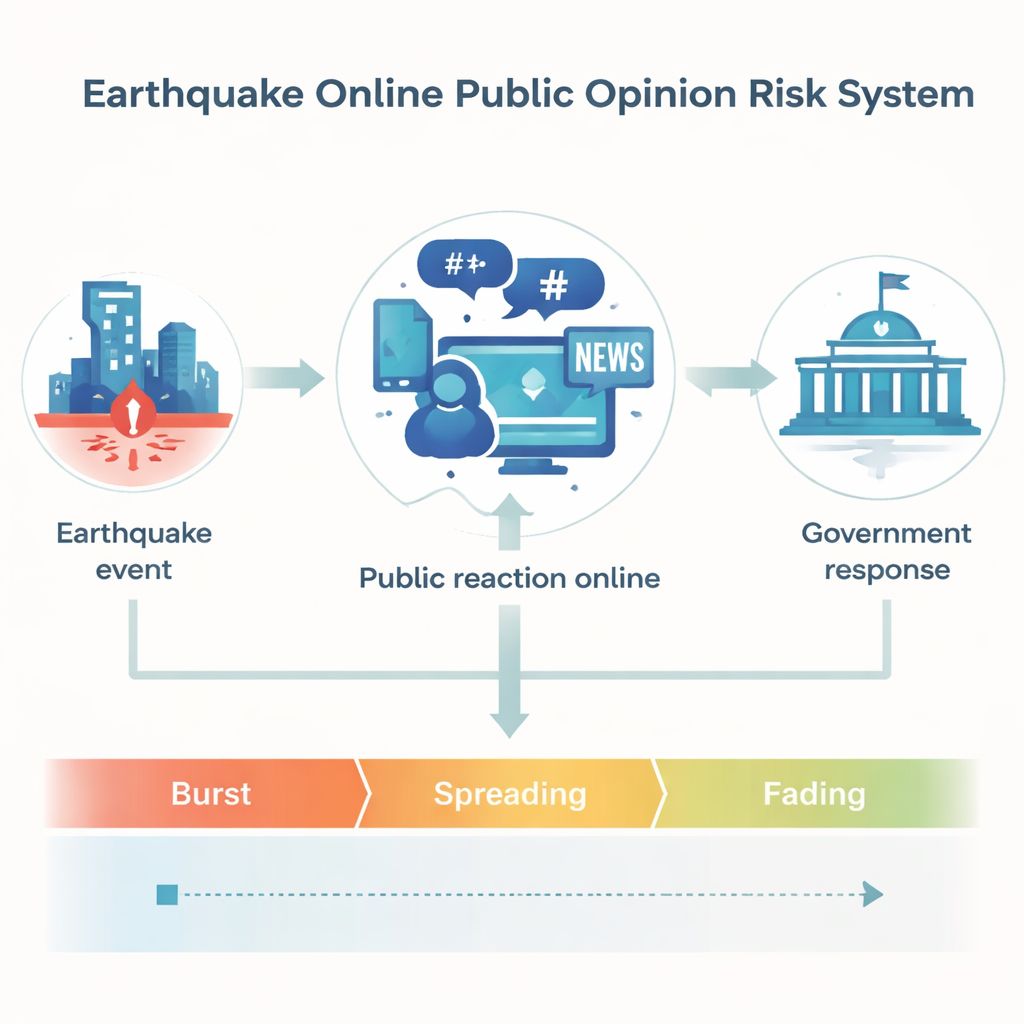
Building a “thermometer” for online risk
The team set out to turn this complex mix into an index system—a kind of thermometer for online opinion risk. They started with 30 detailed indicators grouped into four areas: the earthquake itself (such as magnitude and secondary disasters), netizens (attention and sentiment), media (participation, spread of posts, and rumors) and government (level of attention, openness, progress of rescue and mistakes). Using statistical tools to weed out overlapping or weak indicators, they narrowed the list to 19 key measures. Then they applied an “entropy weight” method, which lets the data itself decide which indicators matter most, rather than relying only on expert judgment.
Testing the model on a real earthquake
To see if their index worked in practice, the authors analyzed posts on China’s Sina Weibo about a magnitude 5.7 earthquake that struck Yibin, Sichuan, in December 2018. They collected 88,650 posts over 25 days and divided the online reaction into three phases: a burst period right after the quake, a spreading period when discussion and emotion stayed high, and a fading period as attention declined. Their risk model converted the 19 indicators into daily scores from 0 to 100, and then grouped them into five color‑coded levels, from lowest risk (blue) to highest (red). During the burst phase, risk was low to moderate, driven mostly by the quake’s severity and early public attention. In the spreading phase, risk rose to high and very high as secondary disasters, heavy media coverage, criticism of government missteps and rumors combined. In the fading phase, risk dropped again, but remained noticeable where public concern and government messaging persisted. 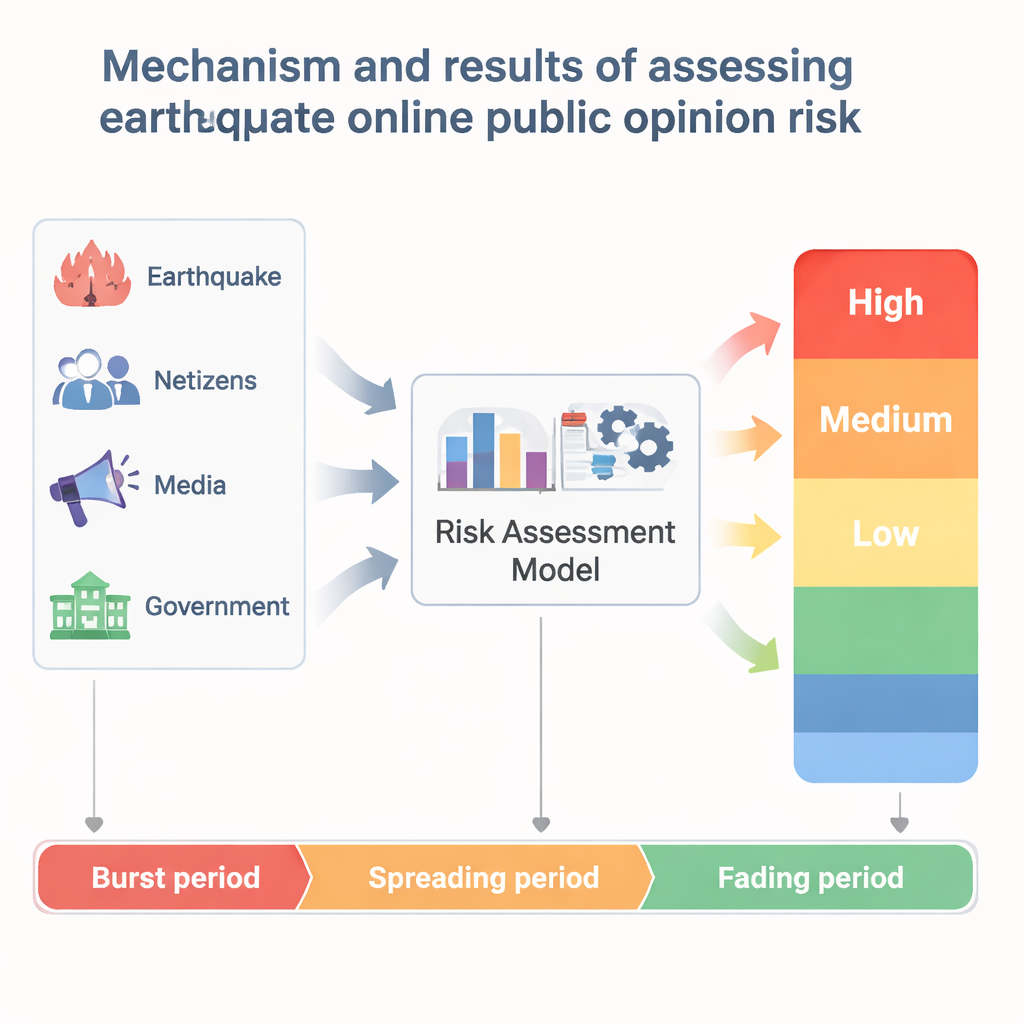
Turning scores into action plans
Crucially, the index is not just an academic exercise; it is linked to practical advice for emergency managers. For each phase and risk level, the authors outline different strategies. When risk is still low, they recommend rapid rescue, real‑time official updates and close watching of emerging topics to prevent falsehoods from taking root. At medium to high risk, they call for coordinated monitoring across agencies, aggressive rumor‑busting, greater openness about damage and relief progress, and the use of artificial intelligence tools to flag dangerous trends early. As attention fades, they urge governments to focus on resettlement, psychological support and honest reflection on mistakes, while keeping the public informed about reconstruction.
What this means for future disasters
In plain terms, the study shows that the most serious online risks after an earthquake do not come only from collapsed buildings, but from how people feel about the response: whether they believe information, trust officials and see real help on the ground. By tying together earthquake physics, human motivation, media behavior and government performance in a single measurement system, the authors offer a way to spot when online talk is sliding from concern into crisis. If built into modern emergency systems, such tools could help authorities respond faster and more transparently, reducing panic and allowing social media to support, rather than hinder, disaster relief.
Citation: Yang, S., Wu, H. & Liu, J. Risk assessment of earthquake online public opinion based on behavioral motivation. Sci Rep 16, 5830 (2026). https://doi.org/10.1038/s41598-026-36051-x
Keywords: earthquake communication, social media risk, online public opinion, disaster misinformation, emergency management