Clear Sky Science · en
Green zinc oxide nanoparticles improve zinc bioavailability and mitigate high temperature stress in rice
Why Hotter Days Matter for Your Rice Bowl
As the planet warms, one of the biggest questions is whether our staple crops can still feed everyone. Rice is the main source of calories for billions of people, yet higher temperatures can shrink harvests and make the grain less nutritious. This study explores a new, plant-based nanotechnology—"green" zinc oxide nanoparticles—that could help rice plants stay healthy in the heat while also packing more zinc, a vital nutrient many people lack.
A Tiny Helper with a Big Job
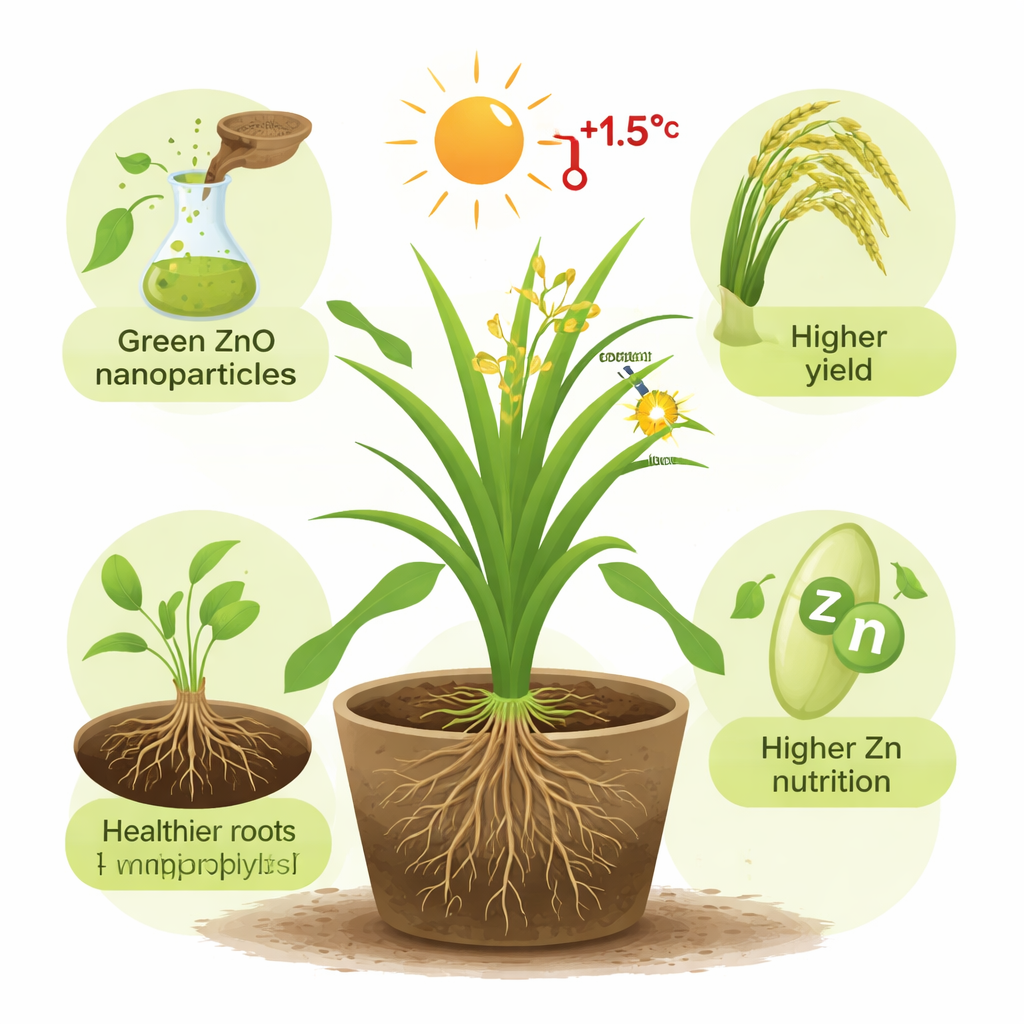
The researchers focused on zinc, a micronutrient essential for plant growth and human health. Many rice-growing regions have zinc-poor soils, and polished white rice naturally contains little zinc but plenty of phytic acid, a compound that ties up minerals and makes them harder for our bodies to absorb. The team produced ultra-small particles of zinc oxide (about 30 billionths of a meter across) using an extract from the bark of the Terminalia arjuna tree. This "green" method avoids harsh chemicals, and the tiny particle size is expected to make zinc more available to plants than standard zinc sulfate fertilizer.
Simulating Future Heat in the Field
To test whether these nanoparticles could protect rice from heat stress, the scientists grew a widely cultivated variety, PB-1121, in large pots over two growing seasons in New Delhi. Some plants were kept at normal outdoor temperatures, while others were placed in a Free Air Temperature Enrichment system that warmed the air around them by about 1.5 °C—similar to the warming expected in coming decades. Within the warmed plots, soils received either no extra zinc, conventional zinc sulfate, or one of two doses of the green zinc oxide nanoparticles mixed into the soil before transplanting the rice.
Healthier Leaves, Roots, and Grains
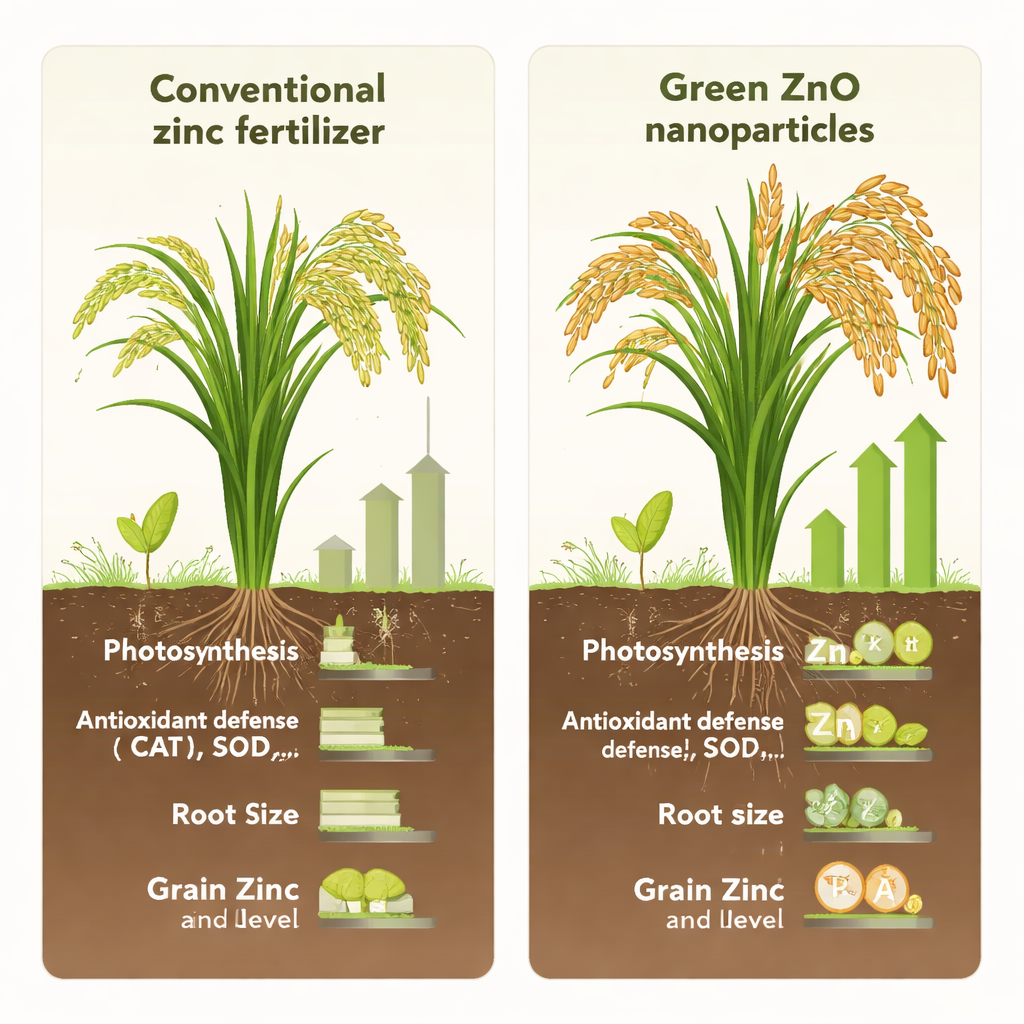
Higher temperatures alone reduced the plants’ ability to photosynthesize, lowered their chlorophyll levels, weakened their antioxidant defenses, and stunted their roots. When the soil was amended with green zinc oxide nanoparticles, these losses were largely reversed. Under heat, treated plants showed photosynthetic rates and leaf conductance up by roughly 15–18% compared with the heated control, and chlorophyll and protective pigments (carotenoids) also rose. Key defense enzymes that help mop up damaging oxygen by-products, catalase and superoxide dismutase, increased by around 7–13% compared with conventional zinc sulfate. At the same time, roots became longer, thicker, and more voluminous, giving plants more surface area to pull in water and nutrients. These physiological and root improvements translated into more productive tillers, more filled grains per panicle, fewer empty grains, and significantly higher grain yield under heat. Importantly, yields in nanoparticle-treated plants under elevated temperature were similar to those of untreated plants grown at normal temperatures, indicating that the treatment largely neutralized the damage from the extra heat.
More Nutritious Rice from the Same Field
The benefits did not stop at yield. Zinc levels in the harvested grains rose sharply—by about 69% to 107% over the no-zinc control—when the soil received green zinc oxide nanoparticles. At the same time, the concentration of phytic acid in the grain fell by around 26–31%. Because phytic acid binds zinc, the researchers calculated a much lower phytic acid–to–zinc ratio in the nanoparticle treatments, meaning the zinc in this rice should be easier for the human body to absorb. In other words, the same handful of rice could deliver more usable zinc to people who eat it, an important gain in parts of Asia and Africa where both rice dependence and zinc deficiency are common.
Promise and Precautions for Future Farming
For non-specialists, the key message is straightforward: by adding tiny, plant-derived zinc oxide particles to soil, it may be possible to grow rice that withstands hotter days, yields nearly as much grain as under today’s climate, and provides more accessible zinc in every spoonful. The study suggests that green zinc nanoparticles can outperform standard zinc fertilizers under heat stress. However, the authors also stress caution. Overuse might build up zinc to harmful levels in soil or disrupt soil life, and long-term environmental and safety impacts are not yet fully known. With careful testing, clear guidelines, and supportive policies, this approach could become one tool in a broader strategy to keep rice harvests productive and nutritious in a warming world.
Citation: Yadav, A., Bhatia, A., Bana, R.S. et al. Green zinc oxide nanoparticles improve zinc bioavailability and mitigate high temperature stress in rice. Sci Rep 16, 6573 (2026). https://doi.org/10.1038/s41598-026-36046-8
Keywords: rice, zinc, nanoparticles, heat stress, biofortification