Clear Sky Science · en
Influence of unilateral and bilateral plyometric training integrated with linear sprinting on physical performance in youth male basketball players
Why Jump Training Matters for Young Hoopers
Parents, coaches, and young players all want the same thing: to jump higher, move faster, and last longer on the court—without getting hurt. This study looked at a simple question with big practical consequences: what kind of jump and sprint training best boosts performance in teenage male basketball players? By comparing different ways of jumping—on one leg versus two—combined with sprinting, the researchers tested which approach most improves key abilities like vertical jumping, quick direction changes, and repeated sprints.
Four Ways to Train the Same Team
Fifty-two competitive boys, aged 14 to 17, from regional basketball academies took part. All were already practicing and competing regularly. The players were randomly split into four groups. One group did single-leg jump drills plus straight-line sprints; another did two-leg jump drills plus sprints; a third did only sprint training; and a fourth group continued with their normal basketball practices without added jump or sprint work. For eight weeks, the three training groups added two supervised sessions per week while keeping their usual team schedule the same. 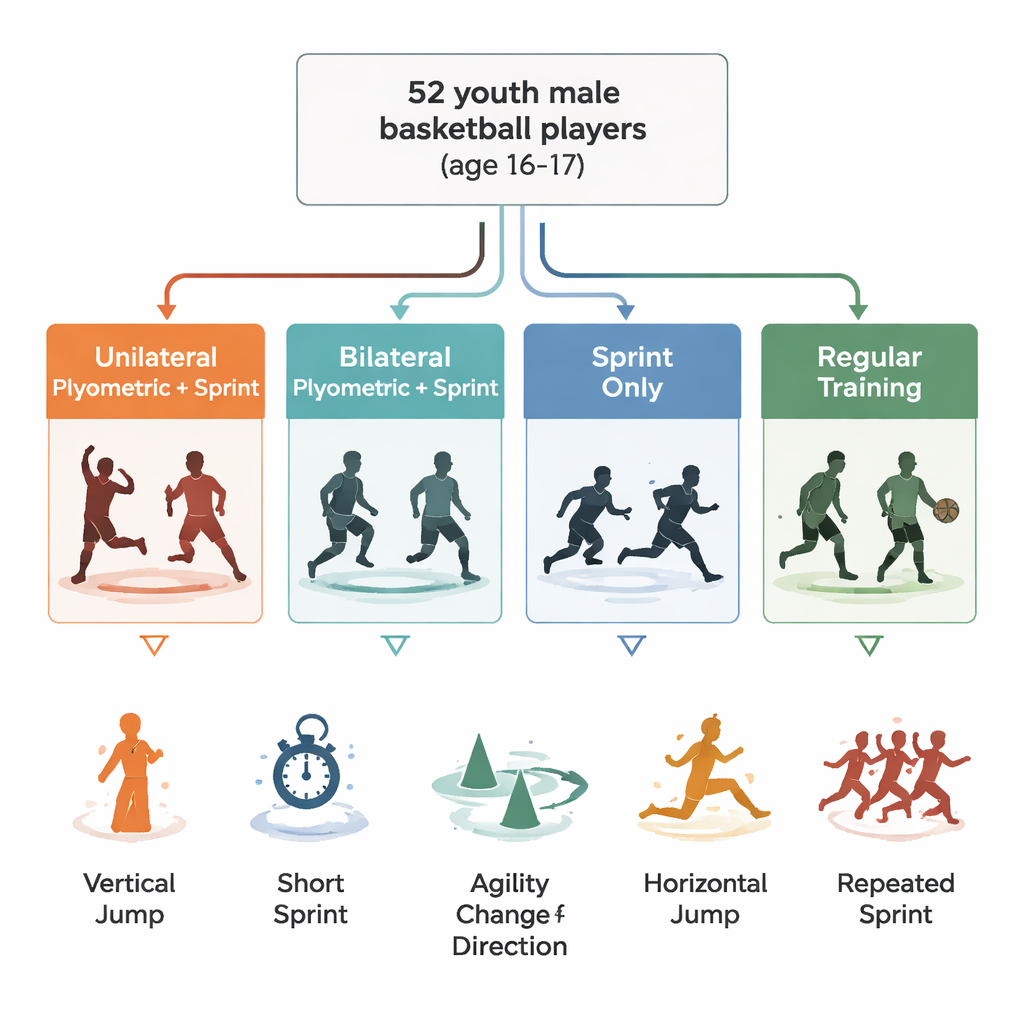
Measuring Real-World Court Skills
The tests were chosen to mirror real basketball demands. Vertical jumps reflect rebounding and shot-blocking power. Short sprints show how quickly players can get up the floor or recover on defense. Change-of-direction and reactive agility capture how well they decelerate, plant, and explode toward a new target—vital for staying in front of an opponent or cutting to the basket. Long jumps, including single-leg versions, measure horizontal power, the engine behind first-step quickness. Repeated sprint tests reveal how well players maintain speed across multiple bursts, similar to repeated fast breaks or defensive sprints late in a game. All of these tests are well-validated, meaning they are reliable indicators of on-court physical ability.
What Improved—and What Didn’t
After eight weeks, the two jump-plus-sprint groups—single-leg and two-leg—showed the clearest gains. Explosive power, agility, reactive agility, horizontal jumping, and repeated sprint ability all improved by roughly 3–7 percent in the training groups, while the control group mostly stayed the same or even declined slightly in power. 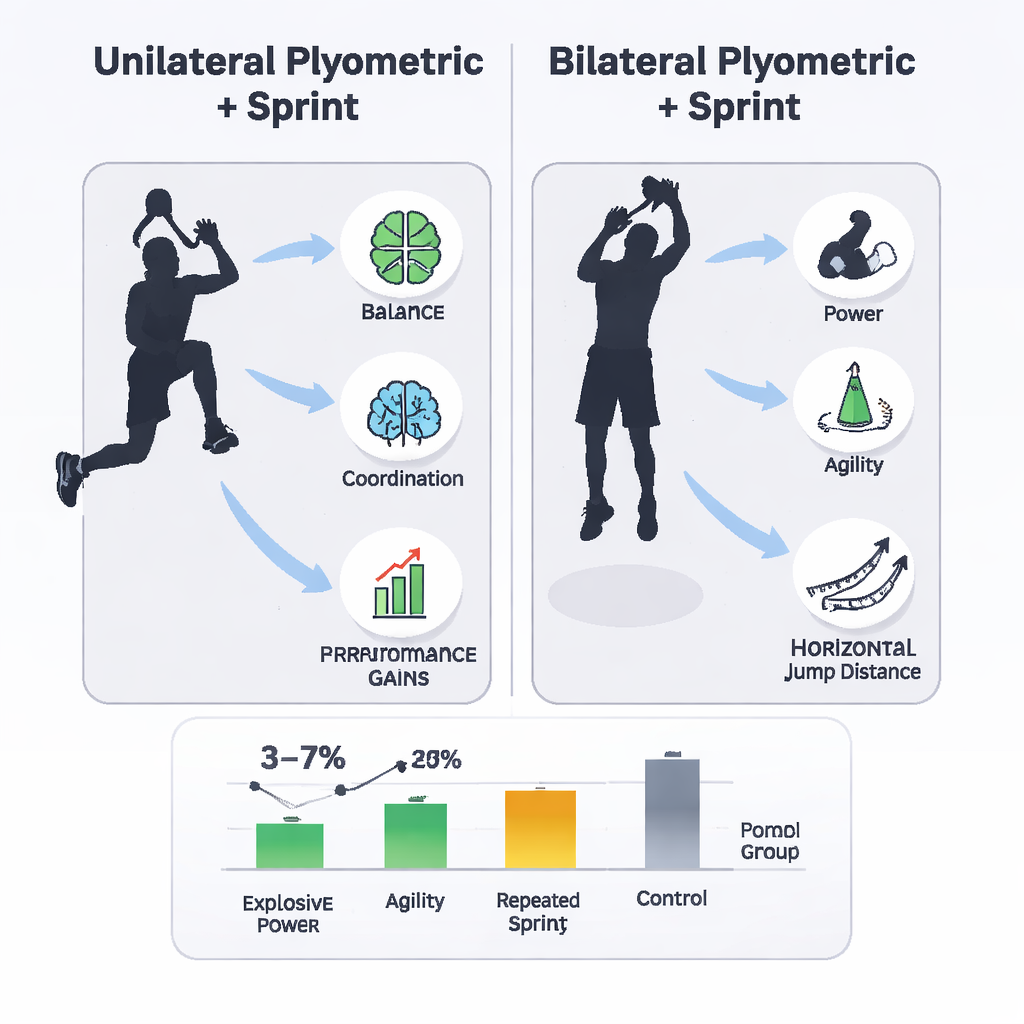
Single-Leg vs. Two-Leg Jumps in Plain Terms
The contrast between single-leg and two-leg jump training offers a simple takeaway. Single-leg work seems especially helpful when the goal is well-rounded athletic development: better balance between legs, greater control in awkward positions, and improvements that show up across many tests. That matches what we see in games, where players often push off or land on one leg during drives, cuts, and contested shots. Two-leg training shines when the aim is raw power in big, forceful movements, like going up for a rebound or exploding into a hard stop-and-go. In practice, this means coaches do not have to choose one or the other—but can tilt the mix depending on whether they want to correct imbalances and improve overall movement quality, or maximize sheer jumping and pushing power.
What This Means for Young Players and Coaches
For families and coaches planning workouts, the message is clear: structured jump training, especially when paired with sprinting, pays off. Two short sessions a week for eight weeks boosted key physical qualities that matter directly on the court, and did so more effectively than sprint work alone. Single-leg programs slightly edged out two-leg training in overall versatility, while two-leg programs were better for agility and horizontal drive. Perhaps most important, relying only on normal practices risks leaving athletic potential untapped—or even slipping backward during growth spurts. Thoughtfully designed jump-and-sprint routines can help young basketball players move better, jump higher, and repeat high-intensity efforts more reliably, setting a stronger physical foundation for both performance and long-term development.
Citation: Zhang, X., Li, G. Influence of unilateral and bilateral plyometric training integrated with linear sprinting on physical performance in youth male basketball players. Sci Rep 16, 5236 (2026). https://doi.org/10.1038/s41598-026-36041-z
Keywords: youth basketball training, plyometric exercise, sprint performance, agility and jumping, adolescent athletes