Clear Sky Science · en
Modeling and simulation of VANET routing protocols under realistic mobility patterns
Why smarter car conversations matter
As cars become more connected and automated, they increasingly "talk" to each other and to roadside equipment to avoid crashes, smooth traffic, and support self-driving features. But these wireless conversations happen in a very chaotic environment: vehicles speed up, slow down, change lanes, and travel in groups. This paper asks a deceptively simple question with big implications for road safety and smart cities: under realistic traffic behavior, which ways of organizing these digital conversations work best, and how much does the style of driving and traffic flow actually matter?
How cars form pop-up networks
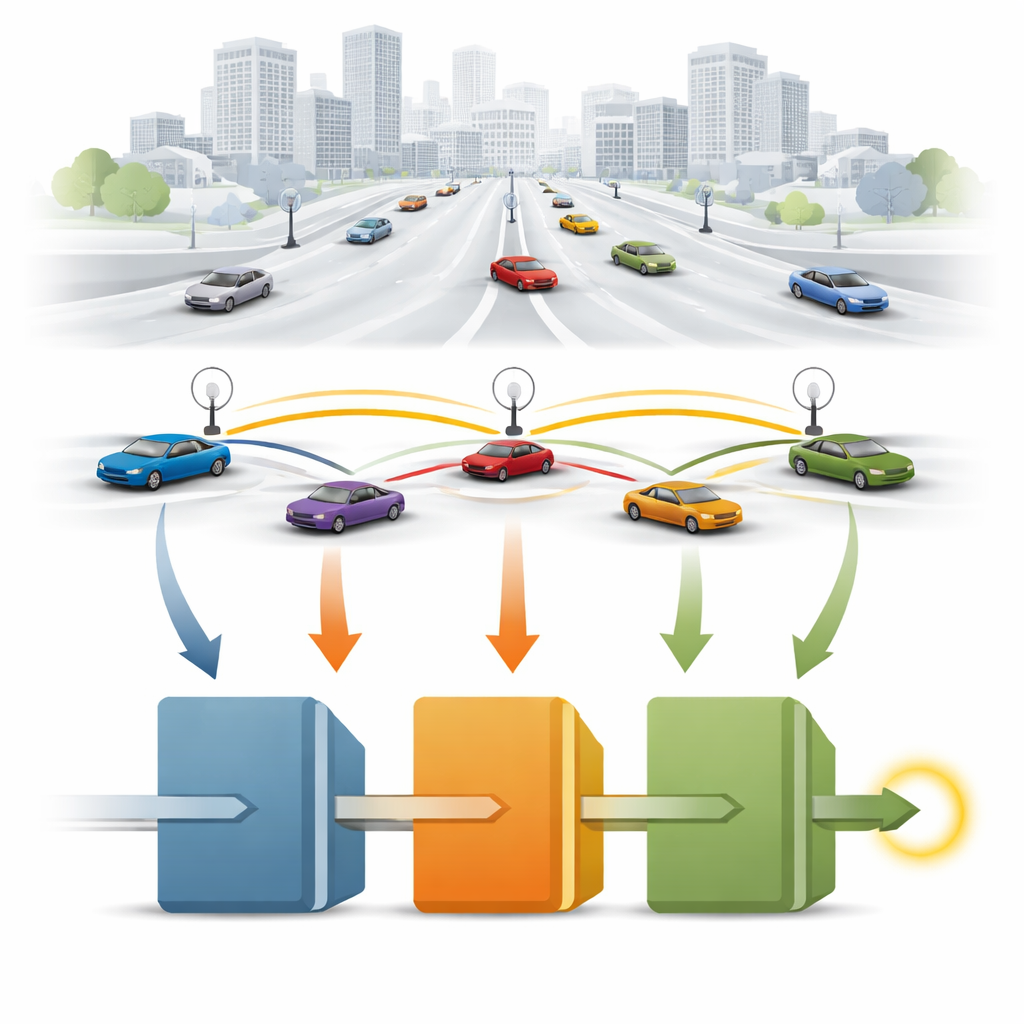
Modern vehicles can create temporary wireless networks on the fly, known as vehicular ad hoc networks. In these networks, messages such as hazard warnings hop from car to car, or from a car to roadside units, without relying on a fixed cellular tower. To move each message, the network must decide which car should pass it along next. That decision is handled by a routing protocol—a set of rules that tells each vehicle how to pick the next hop as traffic patterns constantly change. Different families of protocols either wait to discover routes only when needed, maintain routes all the time, or use position information from navigation systems to forward data. Choosing among them is not just a software problem: it depends strongly on how the vehicles themselves move.
Why simulated driving styles change the story
Because real-world experiments with hundreds of moving cars are expensive and risky, researchers rely heavily on computer simulations. Those simulations need a model of how cars move—whether they wander randomly, follow city grids, cruise on highways, or travel in tightly spaced convoys. Earlier studies often used very simple movement patterns that ignored lane discipline, car-following behavior, braking, or stop-and-go waves at traffic lights. This paper argues that such simplifications can paint an overly optimistic or misleading picture of how well a routing method will perform once deployed on real roads. To fix this, the authors build a broad testbed that combines advanced traffic simulators with a detailed network simulator, letting them study communication performance under 14 different, more realistic movement patterns ranging from urban grids to highways and carefully modeled car-following behavior.
Putting five routing strategies through their paces
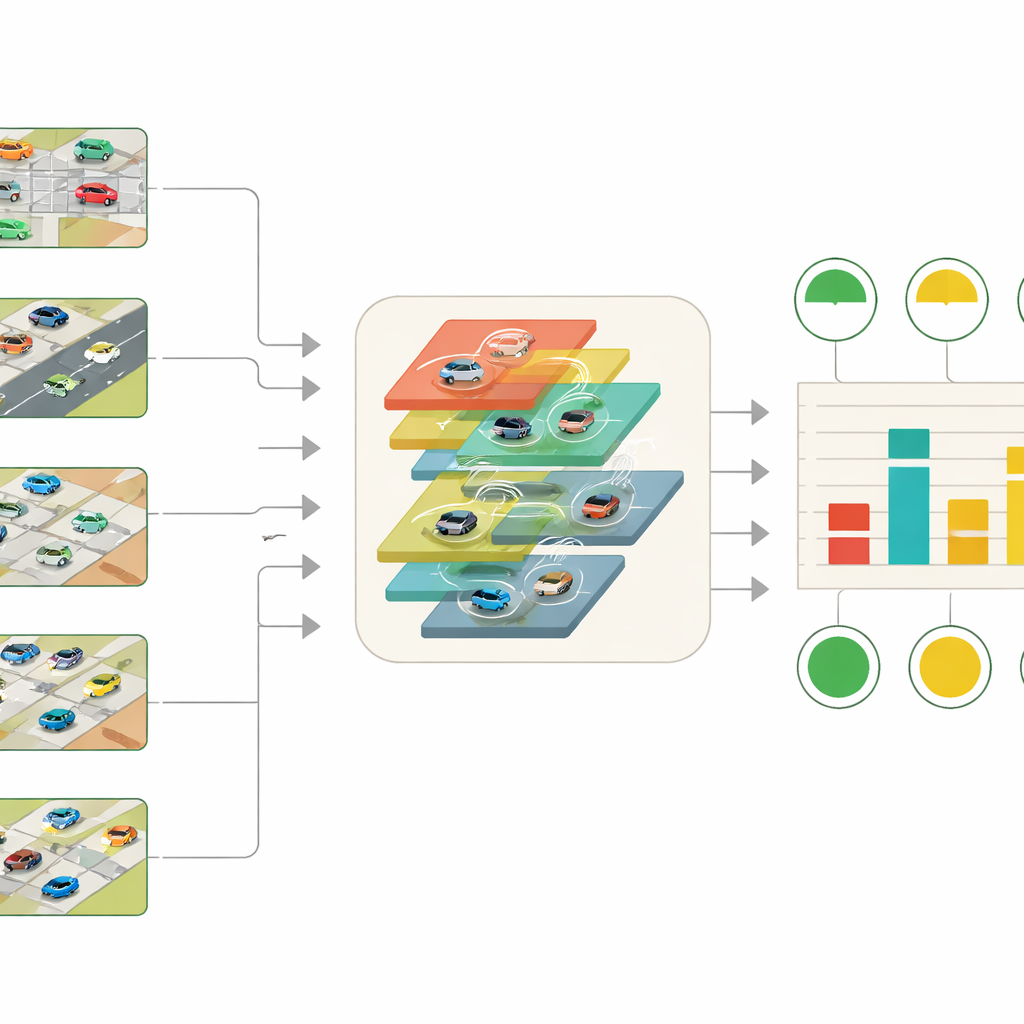
The study compares five widely used routing approaches that together cover the main design philosophies in this field: two that discover routes on demand, two that constantly maintain network maps, and one that relies on vehicle positions. One hundred simulated cars drive along a one‑kilometer road segment at city speeds while exchanging data, and the same experiment is repeated for every combination of routing method and movement pattern. The authors track eight practical indicators that matter for safety and reliability: how many packets arrive successfully, how long they take, how smooth the timing is, how much data per second gets through, how often links break, how many extra control messages are needed, how many packets are lost, and how much radio energy is used. They also apply statistical tests across multiple runs to ensure that observed differences are not just due to random chance.
What they found in the traffic lab
Across this large battery of tests, one pairing stands out. A routing scheme that discovers routes only when needed performs best when coupled with a detailed car‑following movement model in which each vehicle accelerates and brakes smoothly while keeping a safe distance. This combination delivers the highest share of successfully delivered messages, the lowest delays and timing fluctuations, the best data rate, and the lowest energy use and link breakage in the simulated setting. The key reason is that realistic, smooth car behavior leads to more stable wireless links: roads do not "tear" the network apart as often, so the routing method spends less time scrambling to repair paths and more time moving useful data. Other protocols and movement patterns work reasonably well in some scenarios but tend either to waste more control traffic, suffer more frequent link failures, or respond poorly to sudden changes in traffic density.
What this means for future connected roads
For non-specialists, the main message is that how we model traffic is just as important as how we design the networking algorithms that ride on top of it. The study does not invent a new protocol, but it offers a carefully controlled comparison showing that, under one realistic urban scenario, a widely used on‑demand routing method paired with a naturalistic car‑following pattern gives the most reliable and efficient results. The authors caution that their conclusions apply to the specific road layout, speed, and vehicle count they tested, but their framework can be reused for other conditions. As cars move toward 5G and 6G connectivity and more automation, such mobility‑aware evaluations will help engineers choose communication strategies that are better matched to real driving behavior—supporting safer, smoother, and more energy‑efficient transport systems.
Citation: Sharma, S., Kour, S. & Sarangal, H. Modeling and simulation of VANET routing protocols under realistic mobility patterns. Sci Rep 16, 9130 (2026). https://doi.org/10.1038/s41598-026-36039-7
Keywords: vehicular ad hoc networks, routing protocols, mobility models, intelligent transportation systems, network simulation