Clear Sky Science · en
Intestinal microbiome interactions influence Metarhizium-based biocontrol efficacy against the sugar beet weevil
Why tiny beetle guts matter to sugar lovers
Sugar beet fields across Europe are under siege from a small but devastating pest: the sugar beet weevil. With many powerful chemical insecticides now banned, farmers urgently need new ways to protect this key crop. This study explores an unexpected ally in that fight—the invisible community of microbes living inside the beetle’s gut—and how these microbes can make or break the success of a natural fungal pesticide. 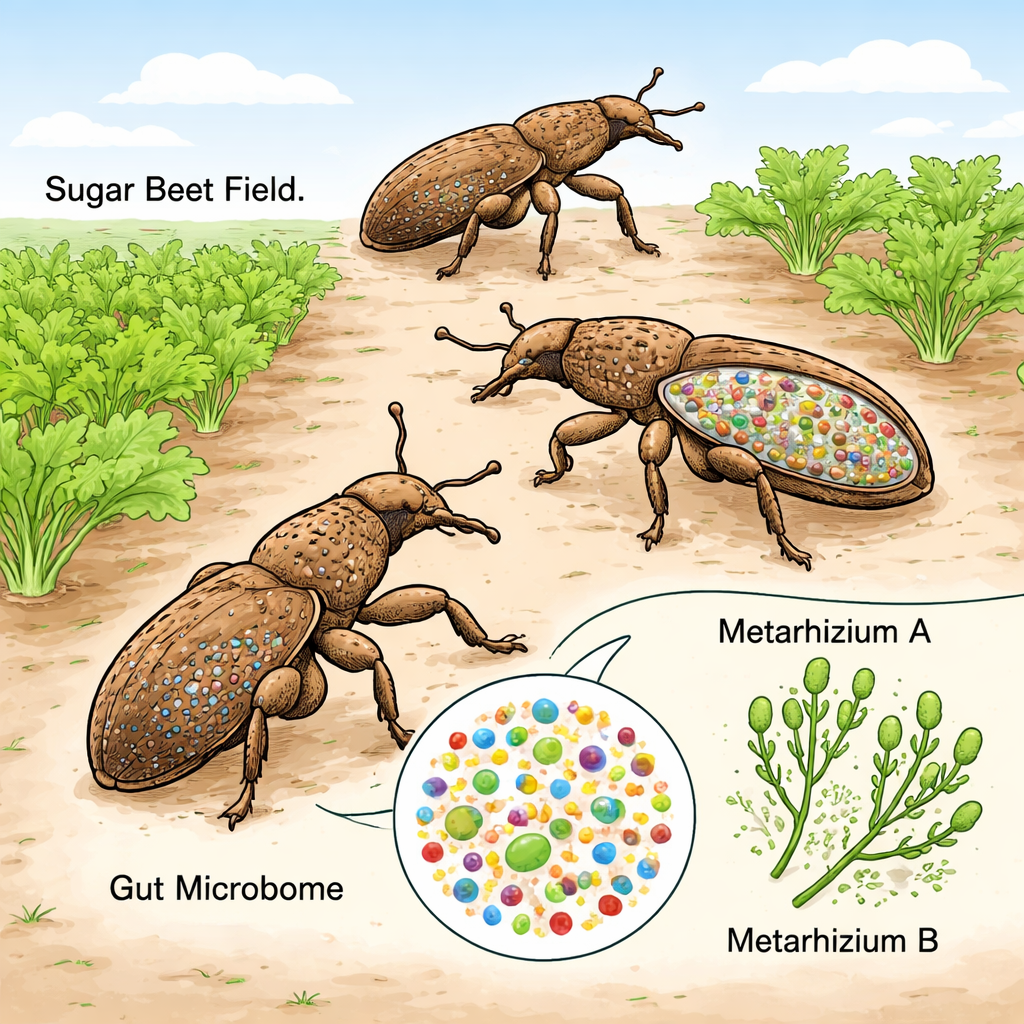
A pest that can wipe out a young field
The sugar beet weevil is capable of destroying up to half of all seedlings in a field, especially as warmer temperatures speed up its development and feeding. For years, farmers relied on broad-spectrum insecticides such as neonicotinoids, but these have been largely banned in the European Union. One promising alternative is the use of entomopathogenic fungi—species that naturally infect and kill insects. Two such fungi, Metarhizium brunneum and Metarhizium robertsii, can invade the weevil through its outer shell, spread through the body, and eventually cause a fatal fungal disease known as mycosis. Yet field trials show that these fungi do not always work equally well, prompting scientists to ask what else inside the insect might influence whether infection succeeds.
The hidden ecosystem inside a beetle
Like humans, insects carry rich microbiomes—complex communities of bacteria and fungi that help digest food, support immunity, and sometimes even protect against disease. The researchers collected adult sugar beet weevils from Austrian fields and exposed them either to M. brunneum, M. robertsii, or no fungus at all. They monitored how long the insects survived and carefully checked which ones developed visible fungal growth. Using DNA sequencing of gut contents, they then compared the intestinal microbiomes of weevils that died from fungal infection to those that survived without mycosis, looking both at overall diversity and at specific microbial groups.
Diverse microbiomes, stronger beetles
The team found a clear pattern: weevils with rich, diverse gut communities were much more likely to resist lethal infection, even when exposed to Metarhizium spores. These survivors, including untreated “healthy” controls, harbored a broad mix of bacteria such as Salmonella, Stenotrophomonas, Serratia and Staphylococcus, and fungi such as Cephalotrichum, Penicillium, Cladosporium and Mortierella. Many of these microbes are known from other systems to help digest plant material, outcompete harmful microbes, or produce antifungal compounds. In contrast, weevils that succumbed to Metarhizium typically showed species-poor gut communities dominated by the fungus itself and a few bacterial genera, especially Enterobacter and Pantoea. This suggests that a rich microbiome acts like a protective shield, while a simplified one leaves the beetle vulnerable. 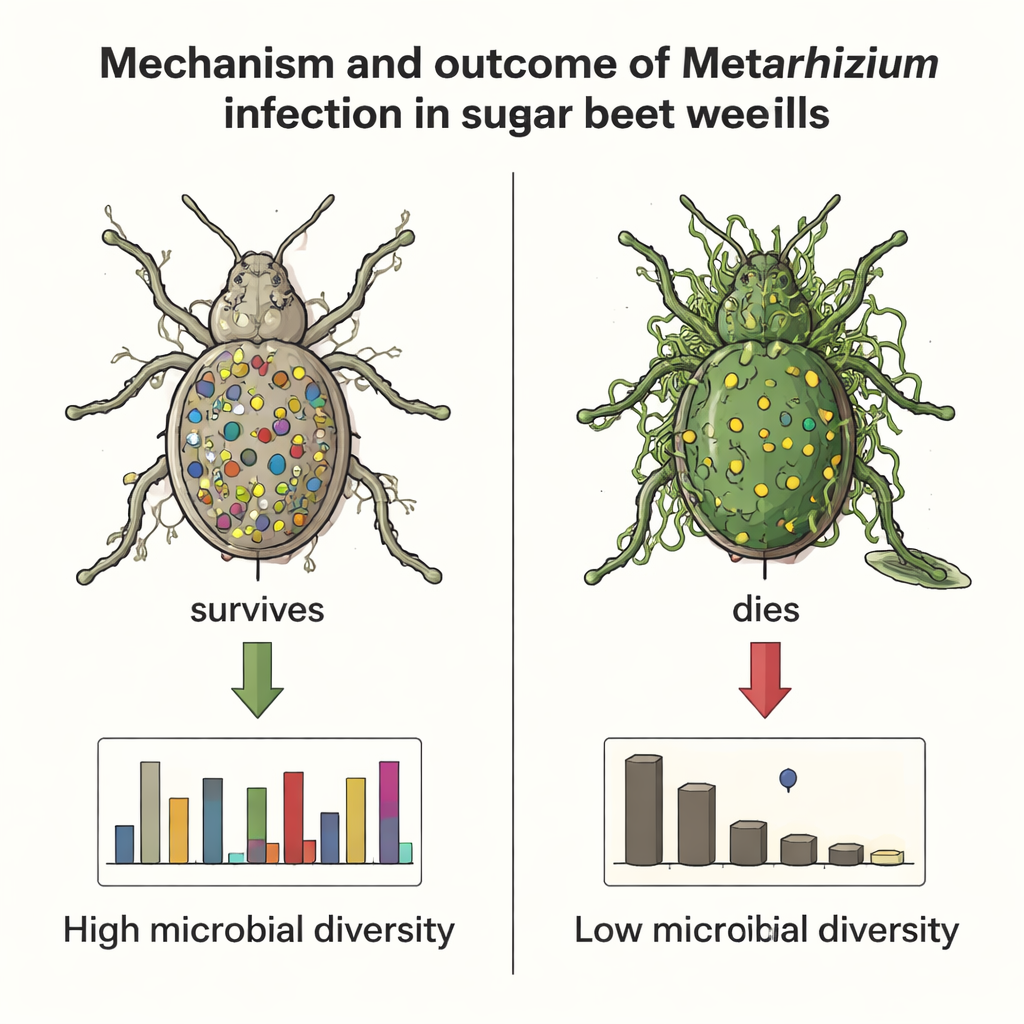
Friends, foes, and double agents among microbes
Digging deeper, the study identified particular microbes that might either support or hinder fungal control. Pantoea and Enterobacter were strongly linked to weevils that did develop mycosis; Pantoea agglomerans, for instance, is known to interact closely with insects and can both tolerate and produce antimicrobial fumes. Meanwhile, several other microbes found in non-mycotic weevils—including Serratia marcescens, Penicillium and Cladosporium—are themselves capable of killing insects or weakening them with toxic compounds. These “double agents” could become powerful partners if intentionally combined with Metarhizium, boosting overall mortality of the pest while still fitting within a biological control strategy.
Male beetles as a special weak point
The researchers also uncovered a sex difference with practical consequences. Male sugar beet weevils generally died earlier than females and were more likely to be killed by fungal infection. Their gut microbiomes were enriched in certain bacterial and fungal groups, including some with potential insecticidal or disruptive effects. In nature, males tend to emerge from the soil earlier in spring and begin feeding sooner, giving them more contact with treated plants and soil. The authors argue that timing fungal and microbial applications to target these early, more susceptible males—possibly combined with pheromone traps—could skew the population and reduce the next generation of weevils.
What this means for future pest control
For non-specialists, the message is that success or failure of “green” insect control does not depend only on the attacking fungus, but also on the microscopic life already inside the pest. A complex, robust gut community can help shield weevils from fungal attack, while certain bacterial and fungal partners may enhance or even replace the fungus’s killing power. By understanding and managing these hidden alliances—along with differences between male and female beetles—farmers and scientists may design more reliable, targeted, and chemical-free strategies to protect sugar beet crops and the sugar supply they underpin.
Citation: Wöber, D., Wernicke, M., Cerqueira, F. et al. Intestinal microbiome interactions influence Metarhizium-based biocontrol efficacy against the sugar beet weevil. Sci Rep 16, 5174 (2026). https://doi.org/10.1038/s41598-026-36038-8
Keywords: sugar beet weevil, entomopathogenic fungi, insect gut microbiome, biological pest control, Metarhizium