Clear Sky Science · en
Trends in heart failure prevalence in post-disaster Fukushima residents 2015–2021
Why this matters to everyday life
More than a decade after the Fukushima earthquake, tsunami, and nuclear accident, doctors are still uncovering how life in the region has affected people’s hearts. This study looks at how common heart failure—a serious condition in which the heart cannot pump blood well enough—has become among adults in Fukushima between 2015 and 2021, and how risks differ by place, age, and sex. Its findings help explain who may need the most medical attention now and in the years to come.
Taking the pulse of a recovering region
The researchers used an unusually comprehensive health database that links annual checkups with health insurance claims for residents aged 40 and older across all 59 municipalities in Fukushima Prefecture. Because health insurance is universal in Japan, these records capture a large share of the population. A person was counted as having heart failure only if they had both a doctor’s diagnosis and prescriptions for heart failure–related medicines, helping ensure that the cases reflected real, ongoing illness rather than one-time suspicions.
Where you live still shapes your heart risk
When the team compared different parts of Fukushima, clear geographic patterns emerged. Overall, men had more heart failure than women: about 37 cases per 1,000 men versus 26 per 1,000 women, and they were hospitalized more often as well. Rates were highest in the coastal region and in the official evacuation zones established after the 2011 nuclear accident, and lower in the central urban area. As people aged, both the chance of having heart failure and the odds of being hospitalized for it rose steeply, especially for men in their 50s and early 60s, who were roughly twice as likely as women the same age to have the condition. 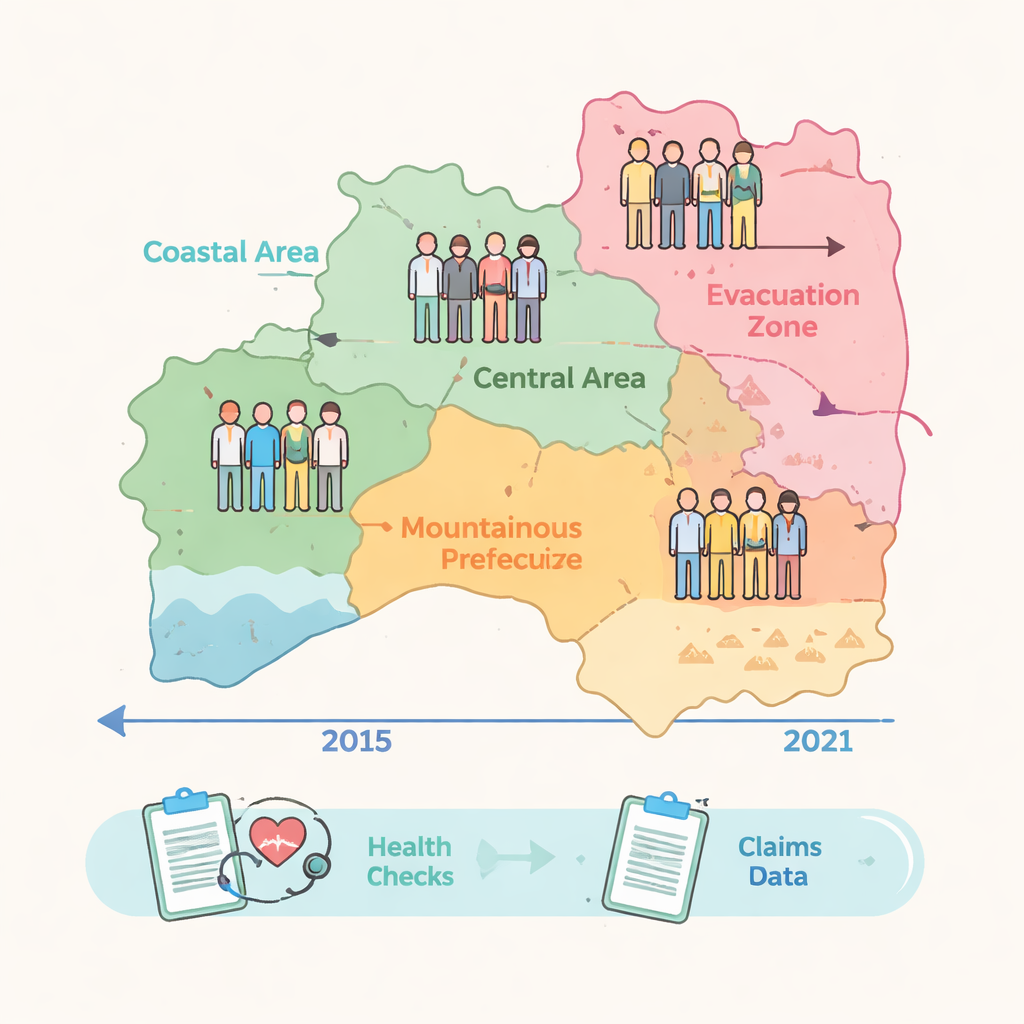
Trends over time, before and during the pandemic
To see whether the problem was getting better or worse, the authors examined year-by-year changes from 2015 to 2021. They found that in men, heart failure became steadily more common in every region, with the sharpest rise in the mountainous western area and the slowest in the evacuation zone. In women, rates dipped slightly up to 2018 and then began to climb again. Overall, only the mountainous area showed a clearly significant increase when men and women were combined. The data also captured the disruption caused by COVID-19 in 2020, when fewer people attended health checkups and heart failure patients elsewhere in Japan faced worse outcomes, making it harder to interpret short-term ups and downs around that year.
Generations and lifestyles leave a long shadow
Because heart problems develop over decades, the team went further and asked whether people born in different years faced different risks. Using an age–period–cohort analysis, they found that heart failure has been rising most notably among men born from the mid-1920s through the mid-1970s. Among women, risk fell for those born before about 1960 but increased again for women born in the 1960s and 1970s. The steepest recent increases were seen in people in their mid‑40s to early 50s, suggesting that today’s middle-aged adults could carry a heavy burden of heart disease as they grow older. These patterns line up with other Fukushima research showing growing rates of obesity, high blood pressure, and abnormal blood fats, particularly among men and in certain regions. 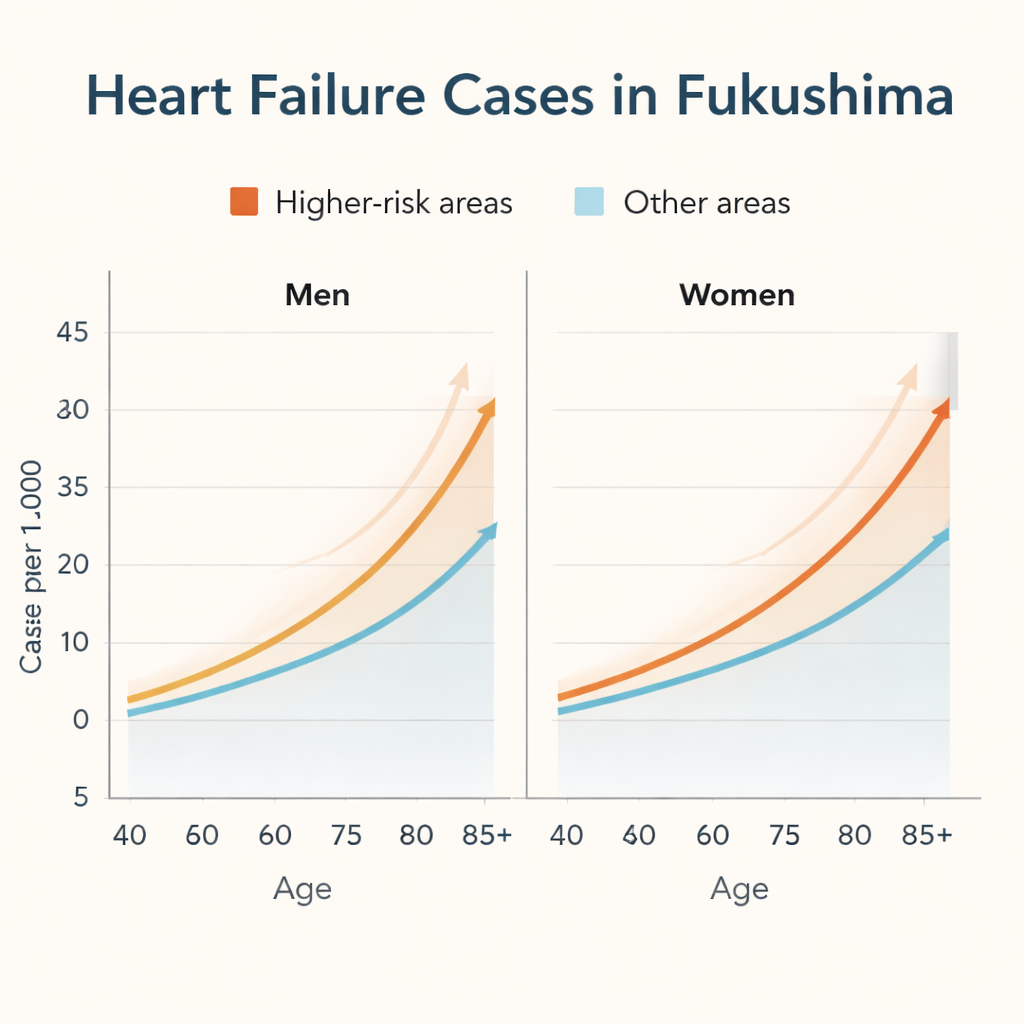
What this means for the future
For non-specialists, the study’s message is that heart failure is not just a problem of very old age, nor is it spread evenly across communities. In post‑disaster Fukushima, men—especially those living along the coast, in evacuation zones, or in the mountainous interior—are developing heart failure more often, and warning signs are appearing in people well before retirement age. Because many of the key drivers, such as weight gain, high blood pressure, and unhealthy lifestyles, build up slowly and can be changed, the authors argue that continuous monitoring and targeted prevention for adults in their 40s and 50s are essential. By acting sooner with better screening, counseling, and treatment in the highest‑risk areas, health authorities may be able to prevent thousands of residents from sliding into disabling and costly heart failure in the decades ahead.
Citation: Ma, E., Ohira, T., Fukasawa, M. et al. Trends in heart failure prevalence in post-disaster Fukushima residents 2015–2021. Sci Rep 16, 5222 (2026). https://doi.org/10.1038/s41598-026-36032-0
Keywords: heart failure, Fukushima, disaster health, epidemiology, cardiovascular risk