Clear Sky Science · en
Numerical simulation of flow field in single-head broken-tooth spiral extrusion dewatering channel
Turning Manure into a Manageable Resource
Across large farms, mountains of wet livestock manure pose a daily challenge: they smell, are hard to transport, and can pollute water if handled badly. One promising solution is screw-based machines that squeeze out water, leaving a drier, easier-to-handle solid. This study uses advanced computer simulations to look inside one such machine in detail, asking a practical question with big on-farm consequences: what screw shape and spacing of its "teeth" gives the best, most stable dewatering performance?
How a Squeezing Screw Cleans Up Slurry
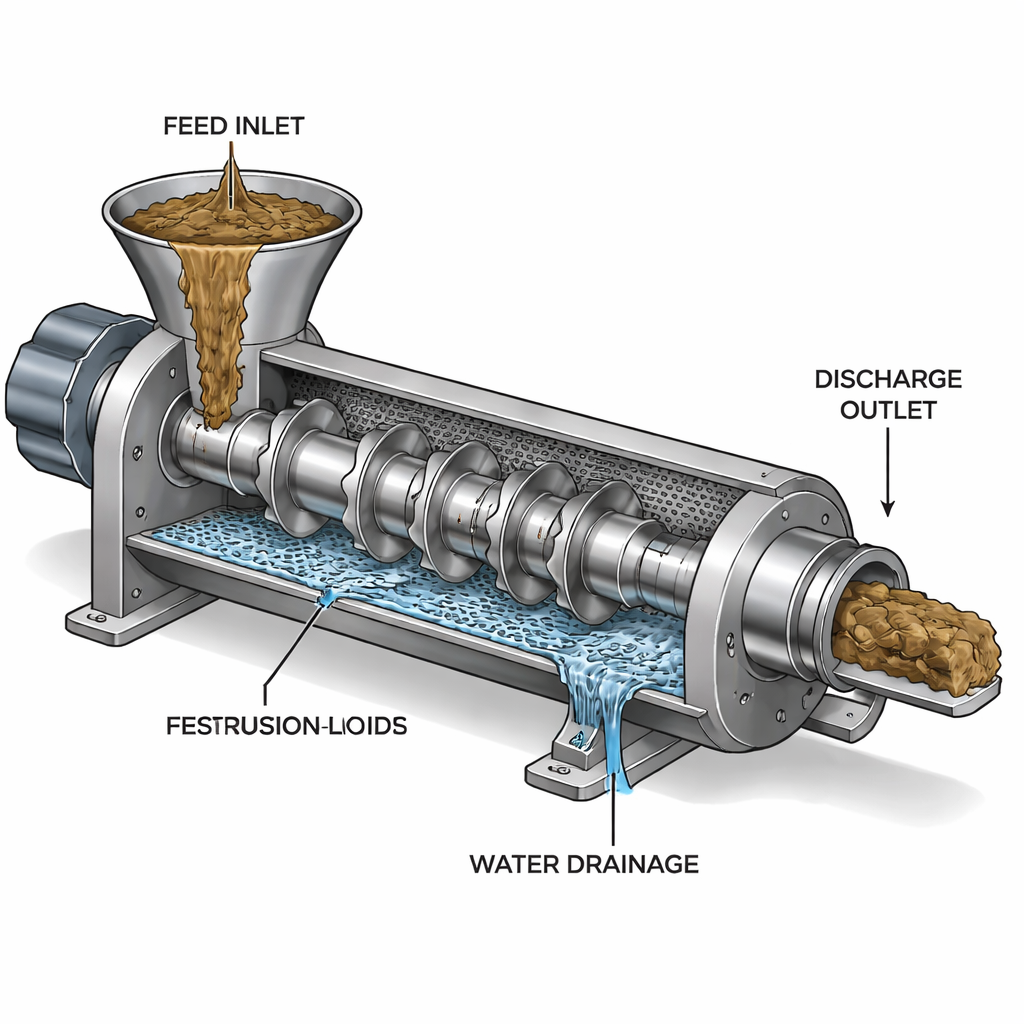
The device studied is a screw extrusion separator. Sloppy manure is fed into one end of a cylindrical chamber that contains a rotating metal screw. As the screw turns, its blades push the mixture forward, pressing it against a perforated screen. Water seeps out through the screen and is collected, while the thickened solids are forced toward a discharge outlet. By adjusting design details such as how tightly material is squeezed, how fast it moves, and how often the blades are interrupted by gaps, engineers can tune how dry the outgoing solids become and how smoothly the machine runs.
Why Broken Teeth and Tapered Shafts Matter
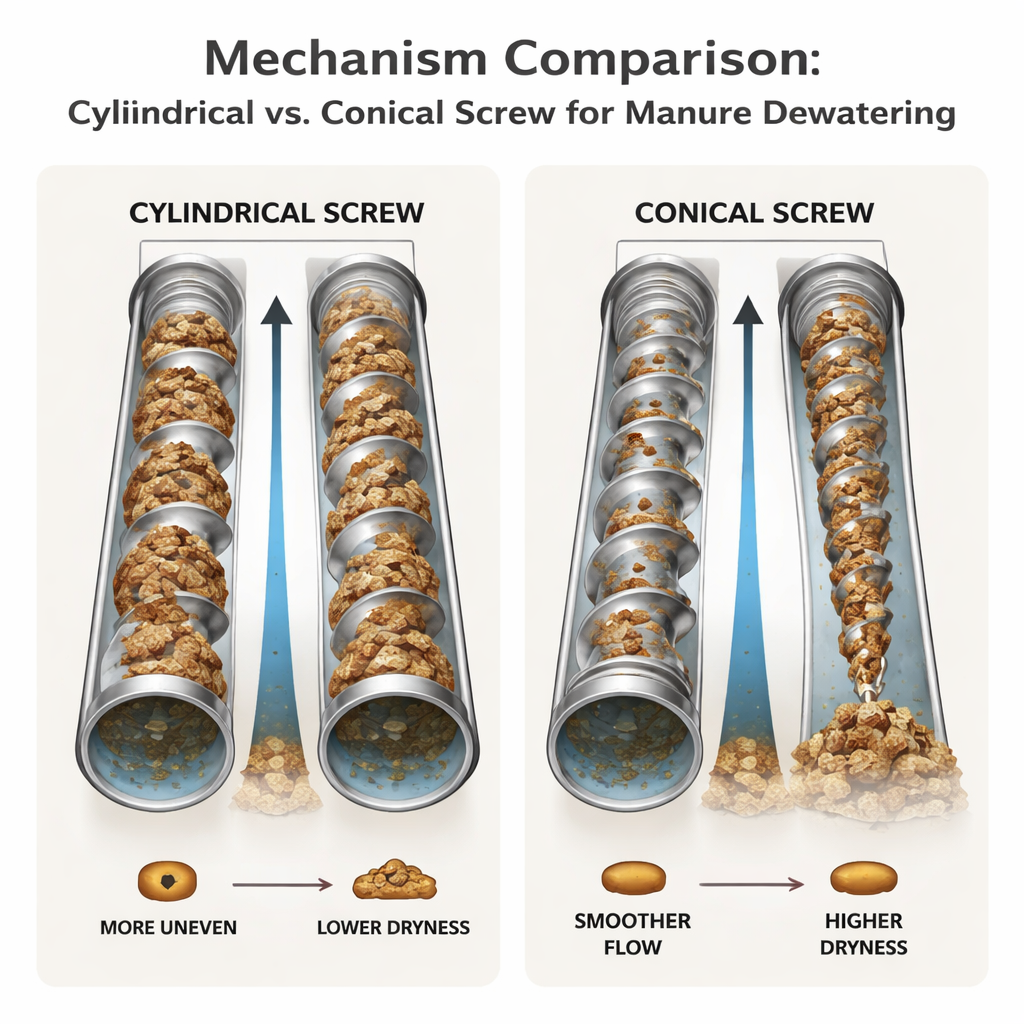
Rather than using a simple, continuous spiral, the researchers focus on a "broken-tooth" design, where short screw sections are separated by small gaps. These interruptions change how the manure clumps, slows, and accelerates, which in turn affects how water is squeezed out. They compare two main shaft shapes: a straight cylinder and a gently narrowing cone, each fitted with the same pattern of interrupted blades. For each, they test several gap distances between screw sections. By tracking how particles move, how densely they pack, and how pressure builds along the channel, they reveal how subtle geometry choices translate into real-world separation efficiency.
Looking Inside with Virtual Experiments
Peering inside a working manure press is nearly impossible, so the team turns to numerical simulation. They treat the manure as a mixture of water and tiny solid particles and use an Eulerian multiphase flow model, a standard tool in computational fluid dynamics. With a detailed 3D model of the machine, they simulate the flow of manure through different screw designs and monitor how the local solid content, particle speed, and pressure change along selected lines and cross-sections. To check that the virtual model is realistic, they compare its predictions with measurements from a real screw press. The simulated dryness at the outlet differs by less than 10% from experiments, which is considered good agreement for such a complex mixture.
Finding the Sweet Spot in Design
The simulations show that shaft shape and tooth spacing together control how evenly the material moves and how dry it becomes. In straight cylindrical shafts, the concentration of solids in the squeezing zone rises in a jerky, wave-like fashion, with noticeable build-up and risk of clogging near the screen. A gap of 40 millimeters between interrupted sections gives the best balance: solids at the outlet reach about 48% by volume, and the flow is more stable than for shorter or longer gaps. When the shaft is conical, gradually narrowing toward the outlet, the picture improves. The solid content rises more smoothly, pressure stays higher and steadier, and particles are less likely to pile up. Here, a 40 millimeter gap again stands out, delivering about 55% solids at the outlet and relatively uniform discharge, while too-small gaps don’t give the material enough time under pressure to fully dewater.
Practical Takeaways for Cleaner Farms
For farmers and equipment makers, the message is clear and practical: using a gently tapered screw with interrupted blades and an interruption spacing of about 40 millimeters can significantly boost the dryness and stability of manure separation compared with a straight shaft. Drier solids are easier to store, transport, and use as fertilizer, while smoother internal flow reduces clogging and wear. By showing how small geometric changes alter the hidden flow inside the machine, this study offers a roadmap for designing more efficient, reliable separators that help turn a messy waste problem into a manageable resource.
Citation: Na, R., Wang, N., Ma, S. et al. Numerical simulation of flow field in single-head broken-tooth spiral extrusion dewatering channel. Sci Rep 16, 5011 (2026). https://doi.org/10.1038/s41598-026-36029-9
Keywords: manure dewatering, screw press separator, multiphase flow simulation, cylindrical vs conical screw, agricultural waste management