Clear Sky Science · en
A multimodal spatiotemporal convolutional network with attention mechanism for athlete anxiety behavior recognition
Why anxious athletes matter
Anyone who has ever choked on a crucial exam question or missed an easy shot in a game knows how nerves can sabotage performance. For competitive athletes, this problem is magnified: anxiety can cost medals, scholarships, and careers. Yet most ways of tracking an athlete’s nervousness still depend on after-the-fact questionnaires and a coach’s intuition. This study introduces an objective, real-time system that watches athletes’ bodies and faces, listens to their physiology, and automatically estimates how anxious they are during competition.
Seeing the invisible signs of nerves
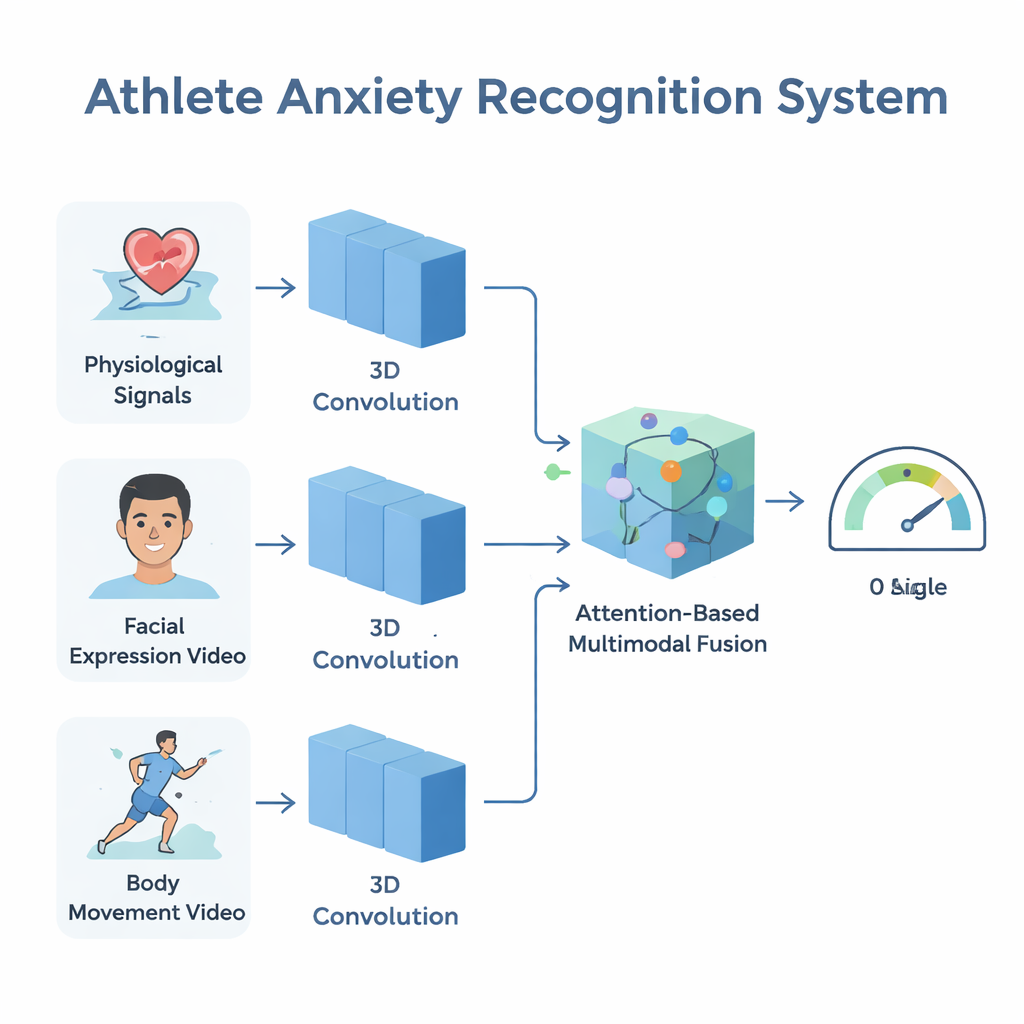
The researchers start from a simple idea: anxiety shows up in many ways at once. When athletes worry, their heart rhythm changes, their palms sweat, their posture stiffens, and tiny facial movements betray their tension. Instead of focusing on just one of these clues, the team combines several at the same time. They collect heart and skin-conductance data from wearable sensors, high‑definition video of faces and full‑body movement, and standardized psychological surveys taken before and after real university competitions. In total, 68 athletes from four sports contribute over two thousand short clips, each labeled as either anxious or calm based on a well‑known anxiety questionnaire.
Teaching a digital coach to read the game
To turn this rich stream of signals into an anxiety score, the authors design a deep‑learning "coach" that specializes in patterns unfolding over time. Their model uses a spatiotemporal convolutional network—essentially a series of filters that slide not only across space (pixels, body points, sensor channels) but also across seconds. This lets the system notice both quick flares of tension and more gradual build‑ups of stress during a 30‑second slice of play. Crucially, the network handles each type of data—physiology, facial expression, and movement—along its own path before combining them, so that the strengths of one channel can make up for weaknesses in another, such as a partially obscured face or brief sensor noise.
Letting the model focus where it counts
Because not every moment or signal is equally informative, the researchers add an "attention" mechanism. This part of the model learns to assign higher importance to the frames and signals that best distinguish anxiety from calm. For example, a spike in skin conductance paired with a brief jaw clench and restless leg movement may get more weight than a stretch of steady breathing and neutral posture. The attention module also learns how much to trust each data stream on the fly, shifting emphasis if, say, physiological data are clear but the video is noisy. By adapting its focus in this way, the system becomes more robust to real‑world conditions and better at spotting subtle, early signs of nerves.
How accurate and practical is it?
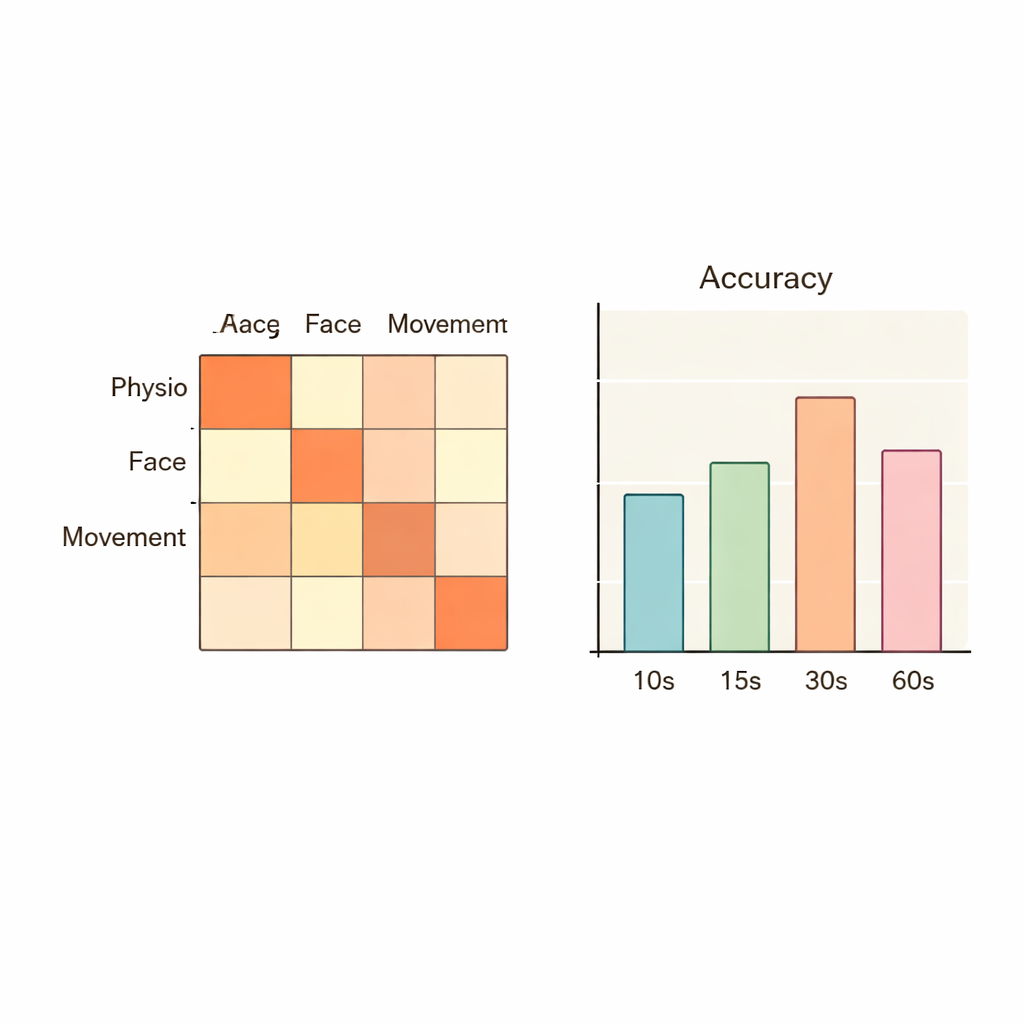
When tested against a range of existing methods—including classic machine‑learning algorithms, standard video networks, and Transformer‑style deep models—the new system comes out on top. It correctly classifies anxiety levels about 95% of the time and achieves a high balance of precision and recall. The authors systematically test different time window lengths and show that about 30 seconds of data provide the best compromise between having enough context to see an anxiety episode and keeping the delay short enough for real‑time feedback. Even when one type of data is missing—for instance, if only the wearables are active—the system still performs reasonably well, suggesting it can handle imperfect field conditions.
What this means for athletes and coaches
In plain terms, the study shows that a computer can learn to read athlete anxiety almost as it happens, using a mix of body signals and behavior, and do so more reliably than earlier tools. Instead of relying solely on how an athlete says they feel after the fact, coaches and sports psychologists could receive continuous, objective estimates of mental strain during training and competition. That could enable timely breathing exercises, lineup changes, or rest breaks before anxiety spirals into a full‑blown collapse in performance. While the system still depends on multiple sensors and powerful hardware, and must be deployed with strong privacy safeguards, it points toward a future where managing the mental side of sport is as measurable and data‑driven as tracking speed or heart rate.
Citation: Yang, F., Gong, F. A multimodal spatiotemporal convolutional network with attention mechanism for athlete anxiety behavior recognition. Sci Rep 16, 5237 (2026). https://doi.org/10.1038/s41598-026-36023-1
Keywords: athlete anxiety, sports psychology, wearable sensors, multimodal deep learning, real-time emotion monitoring