Clear Sky Science · en
Enhancing MPPT performance of a grid-connected Doubly-Fed induction generator-based wind power plant using hybrid ANFIS-PI control strategy
Smarter Wind Turbines for a Changing Climate
Wind farms are becoming a backbone of clean electricity, but real wind is messy—gusty, irregular, and constantly changing. That makes it surprisingly hard for turbines to squeeze out every possible watt. This paper explores a new way to “teach” large grid-connected wind turbines to react more intelligently to shifting winds, so they can harvest more power from the same breeze while feeding a stable flow of energy into the grid.
Why Getting the Most from Every Gust Matters
Modern wind turbines do not simply spin at one constant speed. Instead, they continuously adjust how fast they turn and how hard the generator works, searching for the so‑called maximum power point—the sweet spot where a given wind speed produces the most electricity. This task, known as Maximum Power Point Tracking (MPPT), is especially important for a widely used machine called the Doubly‑Fed Induction Generator (DFIG), which connects to the grid through sophisticated power electronics. Traditional controllers, based mainly on fixed mathematical rules, struggle when wind conditions change quickly or when the turbine’s behavior becomes highly nonlinear. The result is that real wind farms often fall short of their theoretical power potential.
Blending Human-Like Rules with Machine Learning
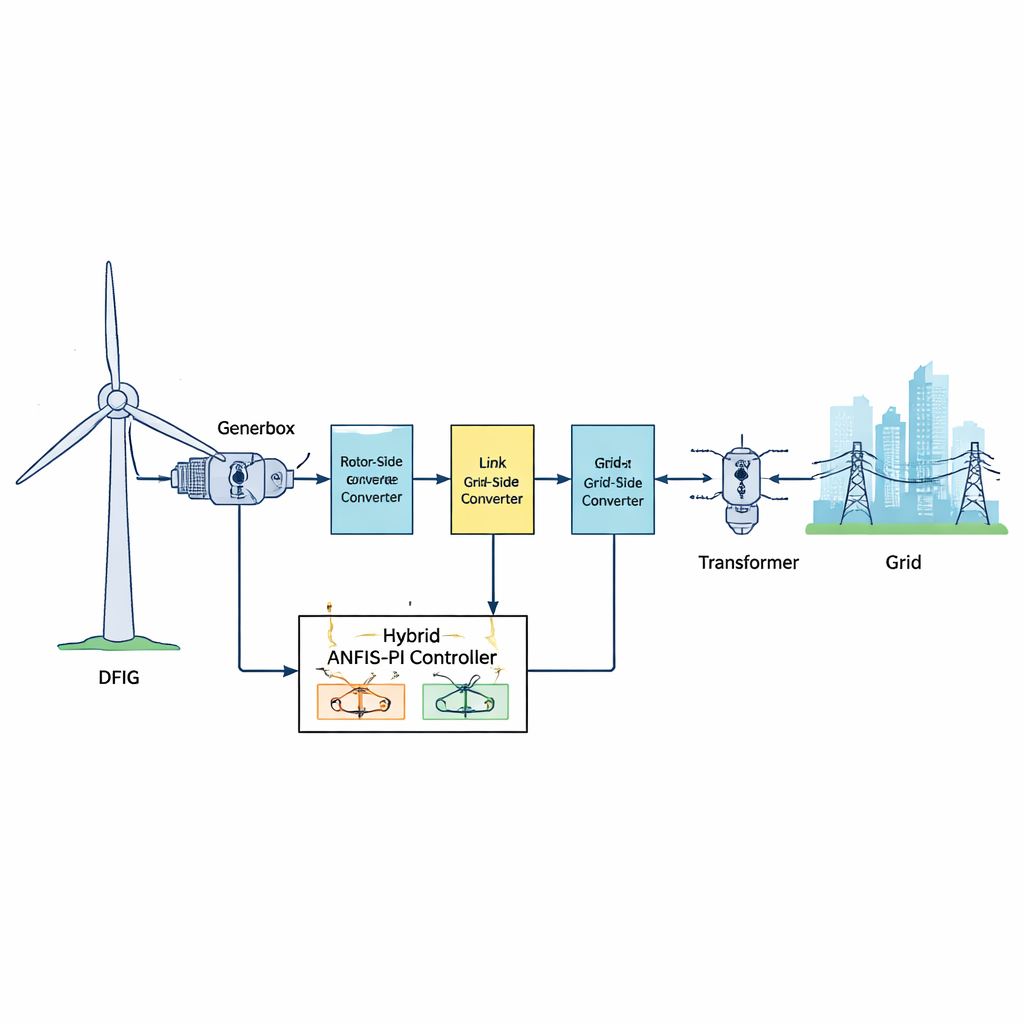
To address these limits, the authors propose a hybrid control strategy that couples a classic industrial controller—called a Proportional‑Integral (PI) controller—with an Adaptive Neuro‑Fuzzy Inference System (ANFIS). ANFIS blends two ideas: fuzzy logic, which captures human‑style “if‑then” rules such as “if wind speed is moderate, then increase torque slightly,” and neural networks, which learn how to fine‑tune those rules from data. In this study, real wind speed and power output records from Ethiopia’s Adama II wind power plant are used to train the ANFIS. The hybrid ANFIS‑PI controller then supervises the back‑to‑back power converters that link the turbine’s rotor and the electrical grid, constantly adjusting currents and torque to keep the turbine near its best operating point despite fluctuating winds.
Inside the Digital Twin of a Wind Farm
The team built a detailed “digital twin” of a grid‑connected DFIG wind turbine in MATLAB‑Simulink, a standard engineering simulation platform. Their model includes the aerodynamics of a horizontal‑axis wind turbine, the mechanical behavior of the gearbox and rotor, and the electromagnetic workings of the generator and converters. They also modeled the grid‑side components such as filters and transformers that shape the quality of the delivered power. On top of this physical model, they implemented three competing control strategies: the existing PI controller used at Adama II (serving as a real‑world benchmark), a fuzzy‑logic‑plus‑PI (FLC‑PI) controller, and the new hybrid ANFIS‑PI controller. All three were tested using real, highly variable wind profiles ranging from calm conditions to gusts around 17 meters per second.
How Much Extra Power Can Intelligence Deliver?
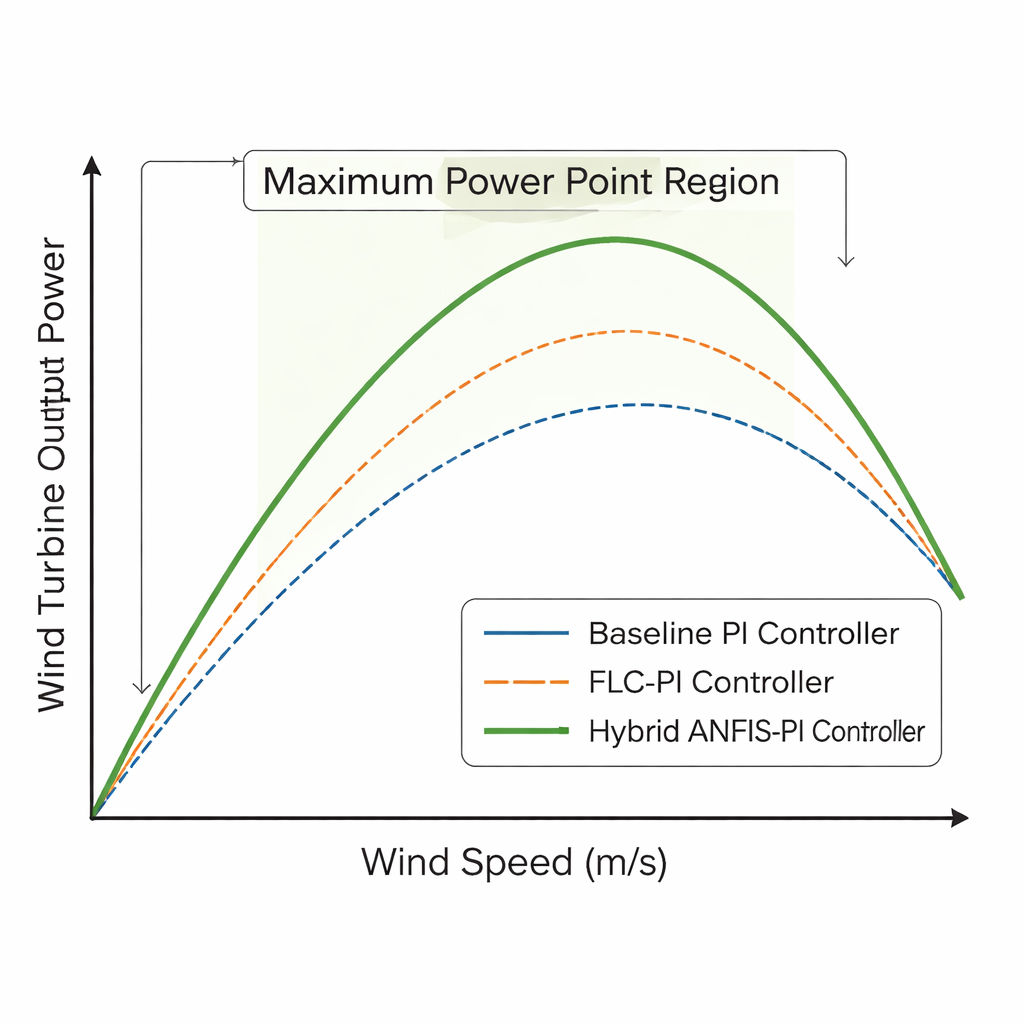
The most visible benefit of the new approach is an increase in the turbine’s maximum electrical output under rated wind conditions. At a typical operating speed of 12.5 meters per second and a blade pitch angle of zero degrees, the reference PI controller reaches about 1.56 megawatts. The fuzzy‑logic‑enhanced FLC‑PI controller raises this to roughly 2.2 megawatts, already a significant jump. The hybrid ANFIS‑PI controller goes slightly further, delivering about 2.22 megawatts—an increase of more than 42 percent over the original PI scheme. A key indicator of efficiency, the power coefficient (a measure of how much of the wind’s kinetic energy is converted to electricity), improves from around 0.41 with the PI controller to about 0.55 with ANFIS‑PI, approaching practical limits for commercial turbines. The simulations also show that rotor speed and torque are better coordinated, allowing the turbine to track the moving power peak more closely as the wind surges and dips.
What This Means for Future Wind Farms
For non‑specialists, the main message is straightforward: by making the “brains” of a wind turbine smarter, it is possible to get markedly more clean power from the same hardware and the same wind. The proposed ANFIS‑PI controller learns from real operating data and continuously refines how the turbine responds to changing conditions, outperforming both traditional and simpler intelligent controllers. Although the study focuses on one Ethiopian wind farm and assumes normal, fault‑free grid conditions, the method can be adapted to other sites by retraining the ANFIS module with local data. In a world racing to expand renewable energy, such intelligent control strategies offer a cost‑effective way to boost output and stability without building new turbines.
Citation: Biyazne, L.W., Tuka, M.B., Abebe, Y.M. et al. Enhancing MPPT performance of a grid-connected Doubly-Fed induction generator-based wind power plant using hybrid ANFIS-PI control strategy. Sci Rep 16, 5732 (2026). https://doi.org/10.1038/s41598-026-36021-3
Keywords: wind energy, maximum power point tracking, intelligent control, doubly-fed induction generator, neuro-fuzzy systems